Monday, September 11, 2017

Solar Eclipse, Eclipse DXing, Fire Haze, Blood Sun, and Indian Summer

A blood sun, due to haze in the air in August, from Canadian forest fires. Amazingly, I was able to balance it on the tip of my hedge without the hedge burning to the ground.
As I write this, it's early September, and the last few weeks of summer is upon us. August was warm and dry, yet we have had a lot of hazy and smoky conditions because of forest fires in Central and Eastern Washington, as well as the fires up in Canada.

The Canadian fires made the air so hazy that the nearby valley walls were bluish from the smoke, and the sun was a deep orange ball as it neared sunset.
The moon was a blood moon also. Ironically, the Apocalypse didn't happen! :-)
I was able to take a few pictures of the sun when it was setting on the haziest days.

More recently, the fires in the mountains east of here blew some ash in our direction, visible on our cars and even our garbage cans.

The past few days we've had temperatures in the 70's F, and high clouds with haze. Usually we'd be in that time of year called "Indian Summer", which is when September has really nice weather. But right now it's a warm, dry, and grey period. Still -- it's not bad for us here in the PNW, if you aren't near a wildfire. And it's not like the hurricanes they are dealing with in the SE US.
Seattle, before and after. The top view is on a normal, grey day. The bottom pic was the view of the Skyline obscured by forest fire smoke.
One of my best pics of the Solar Eclipse of August 12st, using a paper plate and a dark cardboard folder.
SOLAR ECLIPSE: NOT MUCH TO SEE, BUT A LOT TO HEAR ON THE AM BAND
On August 21st we of course had the "Great American Eclipse", a solar eclipse that wasn't visible here in Seattle unless you had special glasses. Here are some pics of my attempts to see the Eclipse. It was fun, but I have to admit that Eclipse DXing the MW/AM band was a bit more productive:
My first 'pinhole Eclipse projector' was a paper plate on a paper plate -- which didn't work too well. The sun's "dot" on the plate should have had a chunk taken out of it. For some reason, the stars weren't aligned right, and it didn't work.
The sun's light was filtered, seeming like a small cloud had gone across it -- which was when I took this picture from my weight room. But as you can tell from this picture, 90% totality really doesn't make that much difference. Some people around here said it felt colder. I didn't notice a difference.
My cat really wasn't all that interested in the Eclipse. :-)
My best Eclipse shot using the pinhole Eclipse projector. Taken a few minutes after totality. A lot of people bought those 'Eclipse glasses', but I didn't necessarily trust them. I decided to try the pinhole method instead, and DX the AM band.
This shot was taken about 20-30 minutes after totality, just inside. I was trying to see if the partial Eclipse would still show up. Viewing a Solar Eclipse with a pinhole projector isn't all that dramatic, but it was still better than nothing. It was still fun.

I made a sort of pinhole projector and was able to view the eclipse after my workout. I also turned on my trusty Sangean PR-D5 and heard some Solar Eclipse AM-band DX. I concentrated on frequencies I new would be either dead or near dead during the daytime: 1660, 1650, 1700, 1670, and a few of the regional channels lower in the AM band.

The first Eclipse DX station I heard was KQMS 1670, Redding, California. Usually it fades out early in the morning in summer, about 7 a.m. at the latest. During the Eclipse it was audible with a talk show at 10:20 a.m. For those not in the U.S., Redding is in Northern California. It's the last major California city on the I-5 corridor before you hit the Oregon border.
My trusty Sangean PR-D5 in my workout room, picking up KQMS 1670 in Redding, California, about 700 or so miles away (around 1000 km?). I never hear it as late as 10 a.m. during the summer here. It was a definite Eclipse DX catch. Unfortunately, as the PR-D5 has no signal meter, you'll just have to take my word for it that I heard the station. :-)
Then 1660 KBRE The Bear faded up -- it is located further south, in Merced, California. They played "Limelight" by Rush.

Then I heard KBND, Bend, Oregon on 1110 kHz -- Usually they aren't audible late in the morning, so it was definitely a DX catch. So was KUMA 1290 from Pendleton in Eastern Oregon -- they usually aren't audible here during the day, even in Winter.

My best catch was KSL on 1160 kHz. Salt Lake City, Utah is about 900 miles / 1200 km away. I heard a talk show on that channel, and a mention of Utah.

All in all, it made up for not being able to actually see the Eclipse.

The following pictures are some I took over the past month, in no particular order:
Another pic of the blood moon during the hazy days of August.
A second shot I took of the blood sun balanced on top of a fir tree.
During August, we had many evenings where it was in the 70's F as late as 9 or 9:30 at night.
Haze covering the Cascade Mountain foothills, during a trip through SE King County, Washington.
A view northbound on State Highway 169 during the Canadian forest fire haze. As the air conditioning stopped working in my car, it was over 95 degrees F inside. Definitely summer!
Buckley, Washington, in early August. It used to be a railroad and lumbering town. It is located on what was the first Northern Pacific mainline across the Cascades -- the rails have long been torn up. Now Buckley is a distant bedroom community for workers in Tacoma and Seattle.
A view down the main street of Buckley. It has a very quiet atmosphere, and it is really a nice little town.
A cool looking older brick building in Buckley.
Some innertubers floating down the Cedar River in August, when the river is low and safe, and the water is warm.
Not my sentiments, of course, but somebody with a spray can was expressing themselves.
Then they added a smiley face to the wall -- you can see where other graffiti was painted over in grey, previously.
A couple kids made a sand castle at a popular river beach.
The sun glinting off the Columbia Tower in Seattle.


In other news, I got an electric chainsaw. It really helps with some of the brush cutting in my yard, and it's something I've needed for a while. I also got a better LED headlamp for doing some yardwork at night, which I actually enjoy doing sometimes. I'll take out one of my radios and listen to sports talk or a football game while working. I recently discovered that if I hold one of my radios up near the top rail of a chain-link fence, it acts like an antenna booster!
The haze down a suburban street during the Canadian forest fire smoke in mid-August. The hazy conditions kept the temperatures from reaching 100 degrees F, which was otherwise forecast. It only reached the mid 90's.
The haze from the forest fires made for some good sunsets after it started clearing.

A COUPLE SANGEAN PR-D5 RADIO NOTES
I've added a few notes to my article in this blog about the Sangean PR-D5 -- the power button's concave shape makes it a bit funky at times, although it always works. Sometimes when I push it on my radio I get the "Alarm" function -- I think it isn't engaging 100% and the Alarm button is probably on the same rail. I may eventually modify my radio with a rounder power button, but until then it's something I'll live with as it is working well otherwise.

I still use the PR-D5 nearly every night while writing or doing stuff around the house.

I also found that an external loop antenna works well when set it in front of either of the PR-D5's speakers. The radio seems to respond very well with a loop set there. As I type this I have my Select-A-Tenna in front of my Sangean PR-D5's right speaker, and it's boosting some California and Nevada stations on 1270 (KVMI, Tulare and KBZZ, Reno).
A panorama view of the sun reflecting off the Columbia Tower in Seattle -- both of these pictures I took some time in July.
I've also included these notes (on my power button) in my PR-D5 article for future reference, as many of my blog readers seem to be MW/AM DX aficionados.

I also have an article I'm working on about my latest acquisition: a Sony HD Radio I found at a thrift store.
An old pic of me playing my Kingston acoustic guitar.

9-11
As I finish this blog post, it is now 9-11. For some reason, every 9-11 brings back memories of what happened in NYC when the planes went into the World Trade Center towers. Many 9-11's I'd watch the movie "World Trade Center", and "Flight 93", both of which were excellent movies on what happened that day. I am not sure I'll get a chance to watch either movie this evening, as I will be busy with work and a neighborhood meeting.

Sometimes it's hard to believe that September 11th, 2001 was truly 16 years ago. But there ya go. I've coincidentally been reading two books roughly related to 9-11: "American Sniper" by Chris Kyle, who makes several mentions of it, and was in the SEALs during that decade; and "WAR", by Sebastian Junger, a book on the experiences of the US soldiers serving in the Korengal Valley in Afghanistan during the years just after 2001 when the US began military action over there. Both are very interesting books, and I especially recommend "WAR" to any American (or anyone) who is interested in what these soldiers go through. The book is a fascinating view of their lives.

Until later, dear readers, hope your September is enjoyable and safe -- especially anyone in Texas, Florida, and other areas of the Gulf region, who are suffering from the effects of two massive hurricanes.
CC 9-9-2017 and 9-11-2017.

Monday, August 28, 2017

AM/MW RADIO AND THE CASCADIA 'BIG ONE' -- The Importance of a Dying Broadcast Band During Major Earthquakes & Other National Disasters

As you probably know, I listen a lot to the MW/AM band at night. I have several posts on nighttime, long distance AM band listening, and a few posts on radios that work well on the AM band (as MW is known here in the U.S.).

I also listen to FM, usually when I'm doing stuff around the house -- I have my radios' presets set to the four prominent rock stations in the area here (KVRQ, KISW, KFOO and KNDD), as well as three of the pop stations (KBKS, KQMV, and KPWR).

But AM radio listening is a hobby for me because it's kind of like fishing: a challenge. At night, when the skip is rolling in, you never know what you're going to hear. It's also the only way I can hear California on the radio, being that many stations in the US now geo-block.
Although the AM band in the US is mostly a haven for Sports Talk, News Talk, religious programming and ethnic music and programming, it would be vital during national disasters, because of its long distance capabilities. During a massive power outage or major earthquake, high-performance and low power consumption radios like the once pictured (a Realistic DX-375) would be useful for receiving emergency information.

IT'S A DYING BAND -- NO DOUBT ABOUT THAT
The AM band is slowly dying. It's a fact. In the 1970's, radio listenership in the US was maybe 30-40 percent AM, and the rest was FM. Today AM listenership is about 16 percent at best. The demographics listening to AM are older. The younger demographics listen to FM only, or don't listen to radio at all.

In many other parts of the world, AM is gone. There are no AM stations in Scandinavia, aside from two longwave broadcasters (in Iceland and Norway) that are there to serve local mariners. Europe's MW stations are disappearing. Even in Mexico the AM band is being depopulated as stations move to FM.  Here in the US AM is still alive because of sports talk and ethnic broadcasters -- this is because the FM band is full in most major markets. But newer demographics aren't tuning in very much, if at all. They use their smart phone.

Now, every generation has their favorite technology, and they all make their choices. For example, CD's and DVD's were a terrific technology. Now they are going the way of the Dodo, being replaced by internet streaming. It's just the way things progress. It's much the same in radio.
Mini-boomboxes like this Sangean would be good for disasters because of their excellent long-distance capabilities. One would need a couple extra sets of C Batteries for this radio, however, if the power stayed off for longer than a couple weeks.

AM RADIO'S NATIONAL IMPORTANCE
However, the dying AM band has a use that can't be replaced easily: in cases of national disasters or emergencies, where there are issues with infrastructure or massive power outages, AM is the only dependable means of broadcasting. Unlike FM and TV stations, which are line of sight and are vulnerable in the case of earthquakes or severe storms, a powerful AM/MW station can cover several states easily, especially at night. Unlike the internet, which is wireline technology, where the cables can be broken by earthquakes -- and computers and smartphones are highly dependent on the electrical infrastructure -- AM stations can operate using generators and most AM radios will run for a couple weeks on a good set of batteries.
Location of NW US volcanoes in relation to Cascadia Fault. (Courtesy US Gov't)

I recently read a chilling report on the Big One, the Cascadia Fault earthquake that geologists and seismologists tell us is due to occur. When it happens, it will devastate the Western half of the Pacific Northwest, from Southern BC Canada to the Northern reaches of California.

The Cascadia Fault line is a 900 mile long fault that runs along the Juan De Fuca Plate subduction zone. It is the reason there is a string of volcanoes 200 km east of the Pacific beaches -- that's where the colliding Juan De Fuca and North American plates heat up the molten rock enough that it rises upwards towards the surface of the Earth.


THE CASCADIA FAULTLINE
The Cascadia Fault, like many such faults, has a tendency to lock in place for about 300 years before letting loose with a Big One, a 9 point Earthquake, similar to the Great Alaska Earthquake of 1964 and several large ones that hit Chile, Japan, and the one that hit Indonesia in 2004.
A diagram showing the mechanics of the Cascadia Fault, and its proximity to the Northwestern US and SW Canada. (Courtesy USGS)


Both State and Federal authorities are aware that the Big One is due to strike. They are preparing for it, but how can you adequately prepare for a massive jolt that will take down most of the power to a 900 mile long, 150 mile wide swath of territory populated by 8 million people, including major cities like Vancouver and Victoria, Canada; Seattle; Tacoma; Olympia; Portland; Salem; and Eugene? According to estimates, powerlines will go down, broadcast stations will go off the air, cell systems will crash or run out of power, numerous bridges will be damaged or collapse, port facilities will be damaged, rail lines will be severed, and vital highway links will be damaged in many places. Some buildings may collapse, especially close to the ocean.

One of the things people need during such emergencies is information. With the internet, local FM, TV, and AM broadcasters and cell systems all down, the only reliable source of information is long distance AM radio. Many people believe that the National Weather Service stations would be important emergency stations, and although that may have some merit, most people in this region don't have weather radios and chances are very high that weather stations would be off the air in the coastal regions which would be most adversely damaged.


Diagram showing how the Cascadia Subduction zone is responsible for the volcanoes in the NW US. (Courtesy USGS)
'CASCADIA RISING'
A recent report entitled "Cascadia Rising" admits this fact: when the Big One hits, local broadcasters may be knocked off the air for possibly a couple weeks or more. And the big city, inland FM and TV stations remaining on the air won't reach much of the area that will be most highly damaged (and probably without electric power): the Pacific Coast.

Here is a link to the Cascadia Rising report:
https://huxley.wwu.edu/files/Cascadia_Rising_high_0.pdf

It says that AM radio may be the only broadcast media available for a while to those in the coastal areas of Washington and Oregon, which may be most heavily hit by a 9.0 magnitude earthquake.

This is where AM radio's importance comes in to play. AM radios are cheap, run well on a few batteries, and at night even low cost AM radios can pick up major regional stations.

I have several used Walkmen I got at a thrift store. They all will pick up KFBK and KGO in California, KBOI in Idaho and KSL in Utah -- all four of them are 50 kilowatt news-talk stations that are audible nearly every night in Western Oregon and Washington. CBR in Calgary, Canada also comes in very strongly (although with some interference from local KOMO on the next channel). Several lower powered stations from Eastern Washington and Oregon also are audible with strong signals nearly every night of the week: KBND from Bend, Oregon; KUMA from Pendleton, Oregon; KGA from Spokane, Washington, and KIT from Yakima, Washington. Several other news stations from areas that would be unaffected by a Cascadia quake (CFFR Calgary, KOH Reno, CBK Saskatchewan) also come in on my Walkmen with decent signals nearly every night.
Small headset radios like Sony Walkmen make for excellent disaster radios. Sony Walkmen usually have good MW/AM band performance and are easy on batteries. Some of them are available fairly cheap at thrift stores or online. The Sony Sports Walkman in the lower left of this picture pulls in distant AM stations decently, is easy on batteries, and was purcased at a thrift store for $2.99. When shopping for walkmen radios, whether new or used, name brands like Sony, Sangean, and GE seem to work best on AM.

The FCC and Federal authorities are well aware of the AM band's importance in US national emergencies. That apparently is one reason they are interested in keeping the band on the air. Other countries and regions perhaps don't have same level of risk of natural disasters that the US has: for example, Europe doesn't have hurricanes, tornadoes, or as many massive earthquakes (aside from Italy) as we receive. Europe is more densely populated and perhaps the emergency infrastructure is more concentrated than we have here in the US -- especially in the Western US, where there are more earthquakes and volcanoes.

The Sony ICF-38 is an excellent emergency radio -- it works great on AM, pulls in a lot of stations every night, it's very good on FM, and is very easy on a set of AA batteries. A set of AA's can last a couple weeks or more if you listen at moderate sound levels.
Either way, the AM band is vital for national emergencies, and I hope those in power in the Federal government continue to see its value. It is very difficult to completely disaster-proof the communications infrastructure: as several massive power blackouts during the last decade have shown, sometimes it doesn't take much to wipe out power in several states for days at a time. For example, one major blackout that occurred in the NW US during the 1990's happened because several power lines heated up and drooped into some trees during some warm weather, down near the Oregon border. This triggered a series of shocks to the electrical grid that caused a regional blackout.

A major earthquake could possibly wreak more havoc with the grid than that.

Even though AM stations also run on electricity, the fact the MW band has a long distance nighttime capability, and the receivers are readily available and fairly cheap, is an important factor that hopefully the authorities won't overlook.

Wednesday, August 9, 2017

Medium Summer, 'Tropenatt', and An Encounter With Owls

Seattle skyline at night, a recent pic.
We're now nearing the end of the second month of summer here in the PNW, and summer so far has been medium, in that the temperatures have been moderate, if sunny.

The last few days have been typical, with temperatures about 75F to just under 80F.

However, the last few nights have been nice -- I go out on an evening bike ride many evenings, and the last couple of evenings it's been 68-70F as late as 10 p.m. (21C). In some of the northern European countries they have a word for it: "Tropenatt" (Tropic-night), which I think is more colorful than our American "wow, it's warm out tonight!"
The mystery plant that grows on my birch tree, which blooms in early June.
Some people wading in the river during low water season.
Robins getting the 'early worm' down at the local river park. They basically ignored me snapping away with my Nikon L32 camera.

LATER THAN USUAL SEASONAL CHANGES
I think that although we're apparently in global warming, it feels like it's actually cooling. Maybe it's the sun's output slackened during the solar minimum. The frogs kept croaking and chirping in the ponds much later than they usually do; the cottonwoods put out very little cotton this year, and the season only lasted a week or two; there are fewer moths out than usual -- my cats have less of them to bat at and run after. And at night it somehow feels like autumn out, even though the trees are all green.

Trees near the clutch of cottonwoods where the local owls hang out at night.
AN ENCOUNTER WITH OWLS
Unfortunately, I have no pictures -- but I was almost sideswiped by a OWL a couple nights ago while riding my bike!

I was pedaling my ten-speed down a wooded part of the Cedar River Trail, where it is lined on each side by groves of cottonwood, alder and firs. The past three weeks I've been hearing these unusual skreeeeee noises coming here and there from the trees to each side of the trail, seemingly coming from trees maybe 20-50 feet away or more, with some more of these unusual sounds echoing down from higher up in the hills. One animal would make this skreeeeee noise, and then others would answer.

Three or four nights ago as I was riding I heard a skreeeee and then I suddenly heard and felt the flopping of wings off of my left shoulder: a large bird had swooped down to get a small animal and I apparently had scared him. He flopped his wings slowly -- as owls do -- and went up into a nearby branch of an alder tree that bordered the Trail.

I stopped my bike, and turned, and shined my LED flashlight at the animal: it was a Barred Owl!

Suddenly, he made this skrreeeeeee noise. Then he made another.

Several other skrreeeeeee noises answered his call -- it was as if there were several of these owls in the area, all warning each other of the intruder on the bike (probably my headlight disturbed him).

Now I knew what sort of animal was making that noise in the hills -- only in that one section along the Trail.

Apparently the Barred Owls like that section, perhaps because there is a large, large field nearby, and they probably can hunt mice and small rabbits easily.

The funny thing is -- I never had heard so many of them before. Not before this summer. I'd heard the noise before, but only rarely. Now there seem to be at least five or six of these owls, calling out during the night time.

You learn something new every day.

I've heard such owls before, up in the hills -- although you don't hear them often. They have a higher pitched 'hoot' than a Great Horned Owl (the kind you always hear in the movies, hooting at night).

Apparently the government wants to kill off a lot of Barred Owls, thinking they are displacing the Spotted Owl -- an owl that I doubt has ever seen this area in 100 years. The idea of killing an Owl for just being an Owl seems a bit displaced.

More recently, I was riding my bike at night and heard one of these owls skreeeeeeing by the Trail, and a small group of people came by. I pointed out the sound to them, and we all looked up and saw the owl. He was also looking down at us, skreeeeing a few times from his alder tree branch, and then he flew off to another tree about 50 feet away (about 13 meters).

I've seen Barred Owls in trees a couple times before. They don't fly away quickly. It's almost as if they are curious about people, looking down at you, like they are saying "what are you looking at?"

A Seattle skyline pic on a grey day; photo taken last month.
Overall, life has been normal. Work has stayed fairly busy, I'm relearning new bagpipe tunes (the number of tunes I know now is around 37 of them -- although I can't play them all proficiently on the pipes yet). Re-learning tunes I knew in the past, they never leave your memory completely. The fingers manage to find them on the chanter.

My radio hobby has taken a back seat -- the AM band is mediocre most evenings. Or maybe I'm bored with it. I don't know.

I've included a few pictures here from the past couple of months, mostly taken during bike rides along the Trail, as well as others I've taken when I have my trusty Nikon L32 with me.

As per usual, if you right click on the pictures on this blog, they should appear in their own screen to be viewed a little better.
A small, early summer backyard bonfire.
Tropenatt ('tropic night'), 77 degrees F (24-25C) at 9 p.m.
A pic from a ride at sunset on a warm, 'tropenatt' evening.
A look at a distant hill right at sunset.
Sunset in late July. As the year progresses, it sets further West. At solstice, it sets in the middle of the three little trees to the right center of the pic. As mentioned before on this blog, I call it my "Solstice Sundial".
You never know what you're gonna see on the Cedar River Trail.
Yep....
Here's hoping all are having a good mid-year. Here in the U.S. it's the heat of the summer, and here in Seattle our best month, weather-wise, is happening: August.

Happy August to everyone.
CC 7-28-2017, 8-9-2017


Sunday, July 16, 2017

FOURTH OF JULY

When I was a child, the Fourth Of July used to be a very fun holiday. Over the years, it got more low key... as it was this year. I made pizza. I decided to not bother with fireworks -- any sparklers I have are stored away somewhere -- and as I had no guests over, there was no real reason to pull out the sparklers and light any of them.

The surrounding neighborhoods had very few fireworks going on. The City's ban on them has quashed such activity for the most part. As I have written before, even "safe-and-sane" fireworks are banned, which seems a bit extreme.
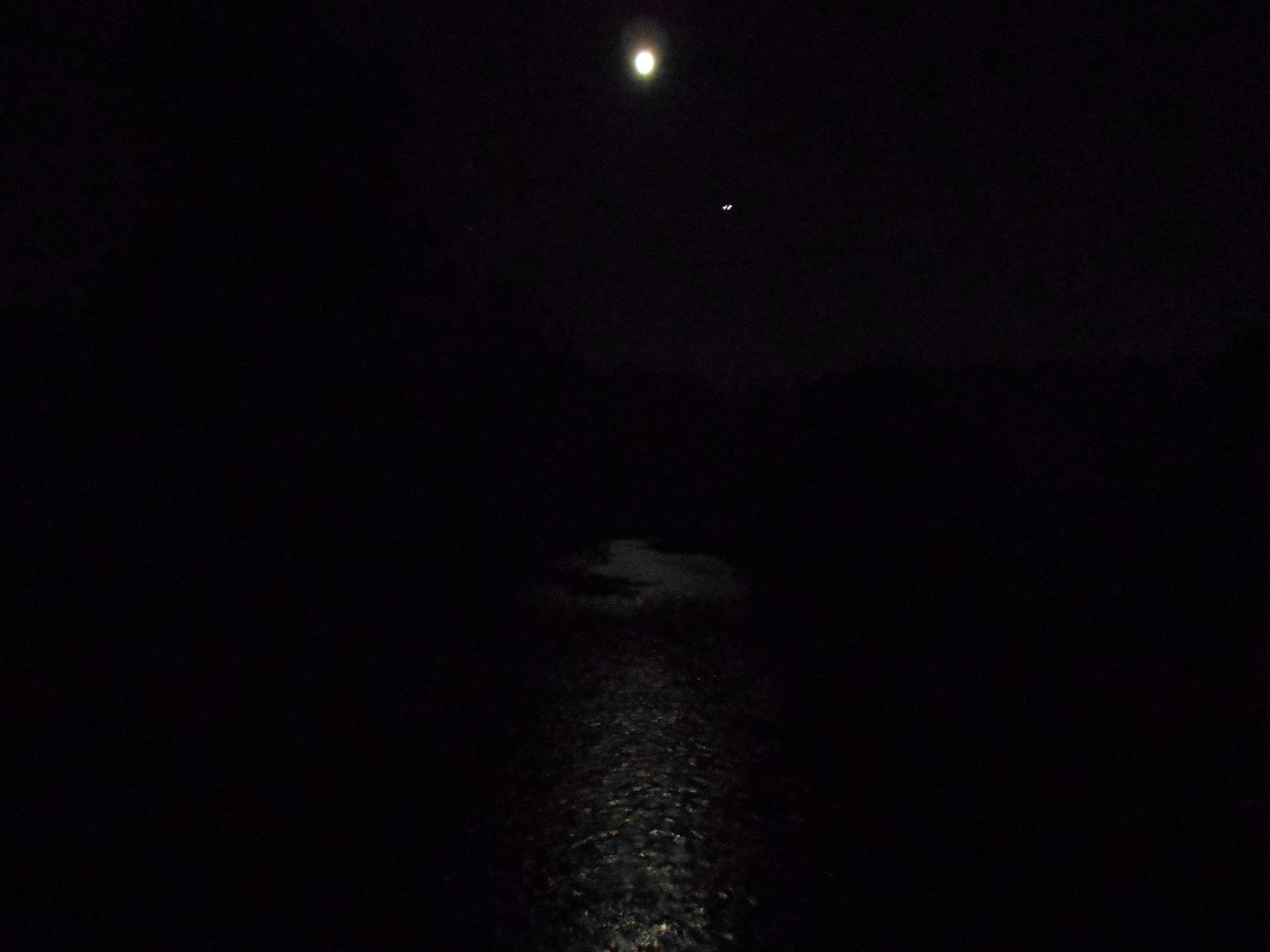
The moon rising over the River on the night of the 4th. The second, tiny light below it is a jet airplane.
On the hills on each side of the area where I live, however, there still were numerous rockets and mortars being lit, and the 'boom' noises echoed down through the valley.

I took a night-time bike ride, and got a halfway decent picture of the moon rising over the Cedar River. I also saw a lone electric shopping cart -- apparently stolen from a store somewhere and ridden until the battery gave out.
The renegade shopping cart, a day or so after it was dropped off alongside the Cedar River Trail.
I saw some guy riding an electric shopping cart down a nearby sidewalk the previous evening. His ride seemed awful slow -- I think one can walk twice as fast as those carts move: now I know how far he got before the machine would drive no further. :-)
A pic taken of the Cedar River closer to Solstice... But it's how everything looks here when it's full-on summer.
Today (July 5th) the weather was sunny and 85 degrees F. Full-on summer.

Hopefully, the weather will hold. I still have a lot of clearing to do around an apple tree that has been taken over by that common threat, the Himalayan Blackberry. :-) There are so many Himalayan Blackberries in Washington they should be the State plant. People treat them as a weed, which they sort of are: except during August and September they're loaded with very edible berries.

I've sometimes wondered why people want to kill off a plant that grows without any cultivation needed, is the world's cheapest security fence, and provides baskets of free food. Ah well.
Usually the local pond ducks never stay still long enough to get a decent picture. This time they apparently changed their minds.
A couple shots of the moon rising a couple nights after the 4th of July. The Nikon L32 can take decent moon and night shots.
In honor of the veterans, of whom I often think about on the Fourth, I found a link of music that I usually think of when the Fourth hits. It's not American band music, but -- after all -- I played in a bagpipe band for 4 years a long time ago, and the bagpipes historically were an instrument of war. All The Blue Bonnets Are Over The Border shall have to suffice. Apparently a piper played it while the Brits were storming the beaches of Normandy.
https://www.youtube.com/watch?v=-YsMCqgZPKE

A slightly cleaner sounding recording of it is here: it's the third (last) tune in this short YouTube audio clip:
https://www.youtube.com/watch?v=uwKgGTANQQg

I've been relearning All The Blue Bonnets, and still have a ways to go before I get it down right. Perhaps if and when I do I'll record it and post a link here.

As I post this, it's about a week after the Fourth, and the last fortnight has been a bit tiring for some reason. There was more work than usual, which is good; but less sleep than usual for some reason, which isn't so good.

We're having lots of sunny, pleasant weather here in the great green Northwest, and plenty of yard work and bicycling awaits.

Hope all are having a great July so far.

CC -- July 9th, 2017