Tuesday, September 28, 2021

Some Thoughts On A Dream Gone Wrong


Gabby Petito, on the California coast. From her YouTube. 

As many, if not most of you are probably aware, social media poster and traveller Gabby Petito was found dead in a remote area of Grand Teton National Park, in the US state of Wyoming, It's a sad end to a tragic series of events involving Gabby and her boyfriend, who is now apparently wanted by Federal authorities in connection with her murder.

Now, I hadn't been following the news much over the past few weeks -- outside of the brief news reports I heard on the radio while writing, I haven't paid much attention to news. I've just gotten burnt out on it. 

But I kept seeing references to a "lost blonde girl" in social media, and a couple days later someone on Facebook posted a pic of Gabby which was taken when the Moab Police (in Utah) pulled over the white van, in which she was riding, for erratic driving. The boyfriend was driving.

In the pic, Gabby was crying. There was talk about how the police handled the situation, as it appeared Gabby was possibly a victim of abuse. There were some people talking about how Gabby was travelling across the country, living her dream. But in that pic, her sadness was deeply touching.

The pic struck me -- she was such a pretty girl, was living a glamourous life of travel and adventure -- and here she was, miserable. Why?

It turns out that she and her fiancee had a tumultuous and probably violent relationship. And it also appears that her boyfriend Brian Laundrie was verbally (and physically, according to witnesses) abusive -- witnesses had seen Brian hit Gabby and slap her on one occasion, and witnesses also saw her crying in a Mexican restaurant in Jackson, Wyoming, not too long before she disappeared. Her boyfriend was described as volatile, enough to where the witnesses were concerned. In the police video available to see online, Gabby mentioned that he had struck her.

I checked out some of the Moab Police bodycam footage, and a few other videos about Gabby, and then I found Gabby's Instagram, which is still available online to see. 

Gabby's Instagram is full of pics that make it look as if she were living a dream life: there's pics of her on the beach, pics of her posing in the mountains, posing in front of murals in California, and even a couple pics of her near the beach in Costa Rica. There are pics of her and her boyfriend hugging, laughing, enjoying life together. From the pictures, the two appeared to be in love, nothing but happy, and living their dreams.

Apparently, Gabby's dream was to be a "travel blogger". Now, I know a bit about blogging, and know a little about social media, but I hadn't heard of "travel blogging" before. I knew that some people blogged during travel, but wasn't so aware of it being a big thing. But I guess there are people who travel all over the US, Europe, and all over the world, and they blog about it, and have lots of followers.

Gabby's Instagram is undoubtedly an example of this: she has 1.2 million Instagram followers. Gabby's posts on Instagram had the hashtag "VanLife". I wasn't aware that the idea of living out of a van was a big social media deal, but I guess it is.

Gabby wanted to have a successful VLOG website -- a video blog, based on her travels with her fiancee. She had been working on her website the day the cops pulled them over when they were fighting. It seems that Gabby -- 22 years old, who had just quit a nutritionist's and pharmacy tech's job to travel and blog -- had a dream of being an internet personality. Both Gabby and her boyfriend were described as online 'influencers' -- people who post pictures and videos online that bring in lots and lots of followers. Many people apparently make a lot of money being influencers.

Perhaps Gabby was aiming for that goal -- to be a popular influencer.

I won't go into more detail on what happened. It appears Gabby was murdered in some remote campsite in the Tetons, and a lot of evidence points to her boyfriend as the murderer -- right now, as I write this, he is a fugitive. 

But I can't get over the tragic nature of what happened to Gabby Petito. I've known girls like her in the past -- they dreamed big. There are a lot of young women who dream big, using the internet and social media as a platform to achieve their dreams. All one has to do is peruse Instagram for a while and you'll see all sorts of examples. It's not difficult to find attractive young women who have thousands of followers, their social media loaded with fashionable photos. Like Gabby's Instagram, their pics often reflect the perfect life, where nothing goes wrong, and all is happiness. 

In some cases, perhaps it's illusory. In others, maybe it's real.

Gabby Petito didn't have that luck She had her whole life ahead of her, and a big dream of making a living as a travel blogger. Now she's gone.

Rest In Peace, Gabby. You deserved better, no matter what the circumstances. You deserved a chance to pursue your dream, to find your happiness, and be known for your travels and your pictures and videos. But not this way.


Tuesday, June 29, 2021

The CB Mystery of "GI Joe" in Belize -- and 105F in the Shade

My venerable Cobra 148GTL, a terrific CB/SSB radio -- and it still works. I took this pic in 2011 and was hearing a mess of skip signals on channel 6, just off a small whip attached to the back of the radio. Over a decade earlier, I was able to talk to Texas, Alaska, California and Mexico with this radio.

I hang out at several radio forum websites, under different pseudonyms, and often at these forums the subject of Shortwave radio comes up. 

And CB radio (also known as the 11 Meter Band) often is raised as a SW-related subject, as well. The ham guys on the ham sites seem to decry CB, making fun of CB operators. The MW and SW guys seem to have a more positive view of the 11 meter band.

I'm old enough to remember CB, during the last edge of its heyday, which was during the turn of the decade, just when the 1990's began. The sunspots were up, and the 11 Meter Band was hopping with activity. It wasn't long after 1991-1992 that the sunspots started their dip, and then the internet cut into the Shortwave radio band's popularity, and CB, too.

But as late as 1990, even with a CB radio plugged into a whip antenna stuck into the back of the set, you could hear much of the world. I bought a SSB CB radio (Uniden 122) and then a second, better one (Cobra 148), and even just using the legal channels (my radios were, and are, both 100% stock), I could hear Latin America, Hawaii, Canada, the SE US and Texas, California, and even Australia. And most of this long distance CB skip was on sideband.

During this period, I built an 11 meter quad antenna. With the quad I was able to talk to Northern California fairly often, and also parts of Canada and even Alaska. One of the more interesting convos I had was with a guy driving a truck up the gravel highway that runs from Fairbanks to the North Slope / Prudhoe Bay region of Alaska. I don't know what the name of the road was back in 1989, but now it is called the Dalton Highway:

Dalton Highway - Wikipedia

The Alaskan trucker was driving up into the isolated, desolate looking, and majestic appearing Brooks Ranges when we talked. He said a lot about the highway, and we also talked fishing -- in Alaska they have a lot of big lake trout. That 'QSO' was one of the standouts.

My Realistic Patrolman SW-60, a portable radio that runs on 4 C-Cells for a long time. When I first got it, of course, there was a lot more activity on the SW, VHF, VHF-Low and UHF bands. I heard my only satellite on this radio, just off the whip -- a weather satellite beeping around 136 Mhz. For a non-TRF model this radio does really well on MW at night. It's probably a good emergency and camping radio for those who still have them, as it gets MW and FM well, and also the Weather band.

The quad antenna also came in handy for VHF Low Band 'skip' on my Realistic Patrolman SW60. The radio has provision for an external, balanced antenna (via Motorola style jack) so I plugged the quad into the radio and tuned the VHF Low Band. The 11 meter quad antenna was tuned close enough to the 30-33 MHz portion of the VHF Low Band that I heard Louisiana accented guys talking about oil rigs -- in clear FM, as well as other Texan and Louisiana accented speech.

After building that quad antenna, I built a three element, wire beam, which aimed South-East. I hung it by ropes from the house, the other ropes attached to some poplar trees. With that antenna I was able to talk to Texas, New Mexico, Louisiana, and Coahuila and Chihuahua Mexico. Because I know some Spanish, I made contact with some Mexican sideband CBers on their favorite sideband channel of that time, which (I think) was the upper side of channel 29. The main way to call "CQ" was "Hola Once! Hola Once!" (hello 11, hello 11).

So I have quite a few fond memories of talking on the CB sideband.

THE STRANGE SAGA OF BELIZE'S "GI JOE"
But then there was a CB mystery, which has always puzzled me. It's almost like the CB radio version of an urban legend, but this guy was very real... he was the mysterious guy who was on CB skip every afternoon during the summer and fall of 1989 or so -- a guy who called himself "GI Joe".

I was working at a college radio station at the time, and sometimes I would hook up my CB to a magnet mount antenna atop my Ford sedan car, and switch the CB on to listen to the CB sideband channels while commuting, and sometimes I would listen a while in the parking lot just before going up to work -- and there he'd be, most afternoons: "...this is GI Joe.... Just an old soldier... I'm in Belize..."

He had no call letters or 'unit numbers', like sideband people had back then. Just his 'handle': "GI Joe".

He always had tons of US stations trying to talk to him, and some Canadian stations, too. Some of them didn't know (or hear correctly) where "GI Joe" was located, so sometimes he'd spell out the name of the country ("it's B-E-L-I-Z-E...") -- and sometimes he would even tell them where it was on the map (in Central America, near Guatemala, Mexico's Yucatan Penisula, and Honduras). 

"GI Joe" never talked about the conflicts going on in Central America at the time (US involvement with the Contras), nor did he say exactly where he was, but at least once he seemed to mention an offshore island (Belize has a couple offshore, barrier islands). He sometimes mentioned the weather, which he always said was warm.

Of course, because F2 skip was on (the peak of the solar cycle), "GI Joe" was usually heard very well. I don't remember him saying what kind of radio he had, but my guess is that his radio was probably a ham rig like a Yaesu or Kenwood, tricked out for the CB band, because he got out so well.


And for a couple months it seemed that every afternoon, I heard him... "This is ol' GI Joe, in Belize, calling CQ..." You can't necessarily tell a person's age from their voice but he sounded like he was close to retired.


Any time he made a call, there was a 'pile-up' of stations trying to reach him -- from the Southern states of the US, from Texas, from Florida, from Ohio, from Ontario Canada... "GI Joe" had quite a draw. I think I remember him talking to a guy in Utah or Colorado or California, but never anyone in the Northwest US. Of course, this was years ago, and I'm going by memory.


He didn't say too much about his life, aside from mentioning now and then that he had been a soldier. I don't know if he was married, divorced, widowed, or whatever. He also didn't specifically say where he was, like ham radio operators will do.... aside from him being possibly on an island with a beach, and I think he said he was living in a camper or caravan trailer. I tried to talk to him more than once but never got through.


I stopped hearing him some time during the early 90's, and I never heard him after that. Also, internet searches came up completely blank. There apparently is a store by that name that shows up in searches -- but it's not him, obviously. One would think he'd been mentioned somewhere on CB forums because of all the guys (and women) who talked to him, but nothing ever came up. Even searches of radio people in Belize comes up blank.


A lot of Americans apparently retire or move to Belize. I have found that out from internet searches. "GI Joe" obviously was one of them -- probably sold his house and stuff and either drove a camper van to Belize, or somehow got a hold of one when he moved there. But who he was? We will never know.


I rack it up as a mystery. He was just a guy who -- with just a simple CB radio and a decent antenna -- talked to probably hundreds of people every day of every week, and then eventually disappeared, into the ether.


If you're still out there somewhere, "G.I. Joe", this one's for you, and stay safe.


Dry, packed earth -- a pathway just off the bicycle Trail that a lot of people use as a detour. It's what's left of the Milwaukee Road railroad grade. The dirt is drier than I have seen it in a long time. Although this photo was taken a few days ago, I'm certain that our heat wave here made the dirt only drier and even more hard-packed.

HEAT, HEAT, AND MORE HEAT

Here in the Seattle area we're not used to heat. "Hot" to us is 85 degrees F (about 29C), and 90-95 degrees F (35C) is really hot. It usually hits 90F about 4-5 times a year. 100 or greater is rare.


When I was a kid, usually once a year the temperature would break 100. Now, to you folks who use the Centigrade system in the rest of the world, 100 to us is similar to what 40 is to you: a round number that means SUPER HOT. When I was a kid, 100+ temperatures were exciting for some reason. We'd all talk about it, how hot it was. I remember at least 3-4 times the thermometer hit 101 and 102. Never hotter than that.


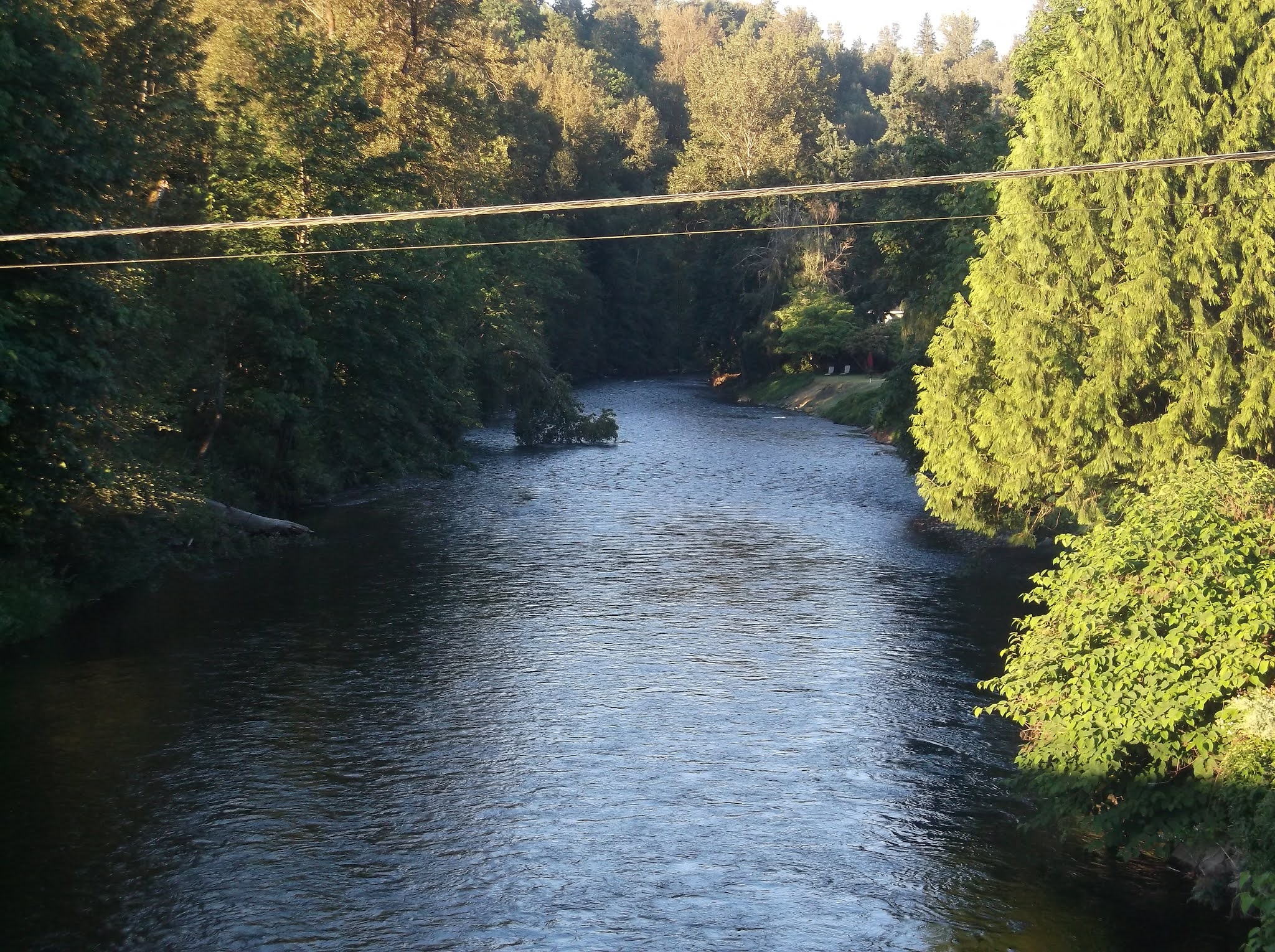
The clear, sun-sparkling waters of the Cedar River when the sun is high in the sky and warm temperatures and river recreation beckon.


Last week they told us that there was a heat dome building in the Western US, and that we'd have record breaking temperatures over the weekend, and into Monday. They were right. About 200 miles north of us is a small town in British Columbia, Canada called Lytton. It's in a relatively dry area (rain shadow) NE of Vancouver, BC. It was 118F there -- that's 48C. That's HOT.


Here in Seattle on Sunday it was 105 (40C), and on Monday it was 108 (42C) on my front porch. For us, that is REALLY HOT. Especially for rainy, moderate weather Seattle. The hardest part of it was trying to sleep, because the rooms in the house were still hot, and most people here in the Seattle area do NOT have air conditioning. Just fans. And if the power goes out during the heat (which it did for a couple hours), you don't even have the fans. :-(


Thankfully, it's cooling down over the week!


I notice I have a couple new readers from parts of the world... One from Colombia (new country), one from Luxembourg (new country), several from Croatia (new country, I think), one from Belgium (a rare check-in), and Japan, Pakistan, India, Indonesia, Australia, Germany, Canada, Brazil, Argentina, Portugal, Italy, Netherlands, Hungary, Romania, and the Czech Republic all have checked out the blog. Usually, half of my readers are overseas. I hope your temperatures are moderate and you're all well and safe. 


Peace.

C.C. June 29th, 2021.


Saturday, June 26, 2021

SOLSTICE SUNRISE

Solstice Morning Idyll -- the rising sun through the trees.
In the past, I have written several articles about Summer Solstice, including pictures of the sunsets, sunlight, sunrise (generally through the clouds), etc. 

I've always been fascinated by the Solstices, sometimes tracking the sun's apparent movement as it sets and rises, including marking the trees on the distant hillsides where the sun come up, and goes down.

This year I didn't catch any sunset pics. But I did get out during Solstice morning, the a.m. of June 21st.

So here are a few of the pics I took, including a couple I took through the trees when the sun had just set on the early evening of June 21st.

A frog pond and bicycle trail on Solstice Morning. The morning was pleasant, with the air fresh and cool.
Looking east, the sun just rising over the hills to the left of the picture.
A lone pigeon sits on one of the electric wires near the river. Often there will be 10-20 pigeons there.
The Cedar River in the Solstice sunrise.

All these pics I took with my newly awakened Fuji AX655, 16 megapixel digital snapshot camera -- the camera which froze up on me in 2016 and then fixed itself after sitting on my desk immobile for 5 years. There is a post about that here: Interrock Nation: My FUJI AX655 16 Megapixel Snapshot Camera Fixed Itself

The Cedar River, lazier flowing than usual, in Renton on Solstice Morning.
The Renton skate park at night, June 21st. It was shut down during the Corona lockdowns, but things are back to normal now.
The big Cottonwood tree near the trail, Solstice Morning.

A FEW WORDS ABOUT MY EXPERIENCE WITH THE 'JAB'
Nothing else much has been happening here. I've been off work. 

After getting my second Pfizer jab, I have had no side effects I can think of, aside from the time I work up in the middle of the night, and my heart was racing a little for about a minute. Then it settled down. It didn't happen again. I also had a slight muscle pain behind my neck. Whether that was from oversleeping or whether it was a side effect of the vaccine I don't know. My left arm, where I got jabbed, was a little sore for two days.

That's it.

My elderly mother got both Pfizer jabs and all she had was a sore arm -- no other side effects whatsoever.

My ZebraKenko, purple 10-speed bicycle -- Japanese made in the 1970's. Still hitting the road in 2021.

I'm going into detail about my experience with the 'jab' here because there is still a lot of paranoia about the vaccines here in the US. I myself measured out the pluses and minuses of risk -- I figured it was better to get the jab and deal with a few side effects, rather than catch corona and risk a ton of health issues.

For what it's worth, I still take garlic extract and zinc every day, as well as a few other supplements. I've been taking garlic and zinc for years.

My Grundig G2, my favorite go-to SW radio. It performs as well off the whip as my other radios perform when connected to a 25 ft. (10 meters) indoor wire. On SW, these small DSP-chip radios can really perform.

IN OTHER, NON-HEALTH RELATED THINGS:
On Shortwave radio, I've been experiencing the same mostly dead SWBC bands as I've experienced over the past 4-5 years. I have heard Voz Missionaria just barely, on 9665 khz, and Radio New Zealand is amazingly strong during the evenings on 7245 khz. I believe their antenna system amplifies the effective power by 16 db towards the Pacific Ocean Islands region, so we here in the Western U.S. receive that benefit.

I also heard the BBC broadcasting to West Africa, in French, from the UK on 9410 khz last night. It was weak, but readable. The signal had over-the-pole choppiness to it.

Early in the morning a couple days ago I switched on my Grundig G2 and tuned around the 49 meter band. It was the first time in maybe six to eight months I tuned the 49 meter band during that hour. Usually, early mornings is when the "Asian Pipeline" comes in. That's my name for the plethora of Asian stations I hear early mornings when the SW conditions are good.

When I first got my G2 in 2014, I tuned around the 49 and 41 meter bands around 6 a.m. local time (it was still dark out), and both bands were loaded with signals -- mainly from Japan and China. For the next year or so I noticed much the same thing. Of course, the solar minimum began to kick in during 2017 and that began to choke off SW.

This particular recent morning when I tuned the 49 meter band, the SW conditions weren't so hot. There still were a few signals from China: CNR1, their main channel, was audible on 5-6 frequencies. CNR1 is used to jam other broadcasts aimed at China. In the early 2010's, I'd hear it SIO 555 many mornings with a smooth voiced announcer talking softly as romantic piano music played behind him. On a higher fidelity SW radio, like my DX-390, G2, or DX-350, it sounded very full, like a decent AM band, smooth jazz station.

I didn't hear the piano music this time, though.
The moon through the trees, the night of June 21st. My Fuji AX655 takes pretty good night sky shots.

That's about all for now. I hope that this blog posts finds you all well and safe.

Peace.
C.C. June 24th, 2021.


Monday, June 21, 2021

Streaming Radio? Hello, Geo-Fencing

A pic of my Sangean PR-D5 radio playing a radio stream off my tablet computer, back in 2016. In a few years, that tablet computer's screen may show a blocked website instead.

Several years ago I wrote an article about Geo-Fencing, and how it would be the death of radio DXing (Distance Listening).

In that article, I suggested that because of streaming royalty fees, there may be a day in the far future where you won't be able to DX or hear broadcasts in other states and cities. The AM stations may lower their power to save money, or go all-digital (which doesn't DX as well as analog signals), and they will Geo-Fence their online streams -- essentially blocking listeners from other areas.

A link to my previous article, which I originally wrote in 2016:

Interrock Nation: GEO-BLOCKING AND THE DEATH OF DXing (Radio Distance Listening)

A recent decision by the US Copyright Royalties Board may have accelerated that possibility.

WHAT IS GEO-FENCING?

Now, "Geo-Fencing" is the practice of limiting the regions of the world that can log into your radio stream. To put it simply: they 'fence' you off.

I personally discovered Geo-Fencing in 2015 or so when I tried to 'tune in' to NFL football games in other cities, and found out, to my dismay, that the streaming of games was blocked. A Pittsburgh station would be broadcasting a Steelers game over the air, but their online stream was a repeat show of some guy talking about sports.

This was an example of Geo-Fencing -- the NFL wants control over who gets to hear or watch every game. They want to monetise every single view (or listener). Hence, if you want to watch or listen to games online, you have to pay via the NFL site (or another pay service that pays the NFL). This is a type of Geo-Fencing: blocking who can access the content.

In broadcasting, there is also Geo-Fencing of radio broadcast streams.

SOME HISTORY: STATIONS DIDN'T ALWAYS BLOCK ACCESS

When radio stations started streaming their broadcasts in the 2000's, they generally let anyone in the world log in and listen. In fact, in 2000, I was able to listen to stations in Australia daily from work, using my computer. I could also listen to US radio stations anywhere. When I first got Tune-In in 2012, it was like a smorgasbord of radio. I could hear stations all over the US, and all over the world.

Then I started seeing more and more stations streams being blocked. I would 'tune in' a station on the Tune-In app, and I would get an error message stating that the station's stream is not available in my part of the world. This was an example of Geo-Fencing -- I was being 'fenced off' from hearing the programming.

As the royalties for streamed music increased, after a protracted series of negotiations between the NAB (National Association of Broadcasters), representatives for the music publishers, and representatives for musical artists (who believed they weren't getting enough money for streaming of their music), stations had to pay more for every song streamed over the internet.

Then many radio stations started Geo-Fencing (or Geo-Blocking).

For example, when I first began to listen to a rock station out of California, sometimes I'd log into their stream when the AM band wasn't delivering the signal. After a while, they started Geo-Fencing. I would get an error message on my computer screen.

Some stations that are part of the IHeart or Radio.com (now Audacy.com) networks never Geo-Fenced. 

But a lot of stations that aren't part of those networks chose to Geo-Fence, because every time an online listener hears a song played, the station pays a fee. And stations do not care to pay for listeners in far away places. They only make money off of local listeners.

Hence, we got Geo-Fencing.

A NEW INCREASE IN FEES: POSSIBLE INCREASE IN GEO-FENCING

A recent decision reached by the US Copyright Royalties Board may change online radio listening, especially for people who listen from far away places, or other metros. Some think this may also induce smaller radio stations to stop streaming altogether.

The US Copyright Royalties Board recently increased the cost per song / per listener from $.0018 to $.0021. Now, these rates may look small, but if you use a calculator, and multiply 1000 online listeners times 10 songs per hour, that's maybe $500 a day ($3500 a week). Using this example of 1000 listeners / 10 songs an hour, it would be around a $700 a week increase), which could be a lot of money for a smaller station to pay. In the case of 1000 listeners every hour I suggested above, that would be an increase of costs for a station amounting to $20K - $30K a year.

The article can be read here:  CRB Raises Royalty Rates - Radio Ink

Not only are the per-song-streamed costs going up, but there are other streaming fees that will also increase.

Some radio analysts believe that this increase in costs will lead to more stations Geo-Fencing, and they also think that many stations will turn off their streams, period. After all, local listeners have the FM or AM broadcast that they can listen to, for free. And due to longstanding agreements and laws, the Over-The-Air costs of playing a song are much less than they are for streaming the same exact song.

ANOTHER OPTION: PAID SUBSCRIPTION

Another option that may happen thanks to increases in streaming royalty costs is the rise of the paid subscription model. In other words, you pay to be able to listen to a radio station's online stream. Apparently there are a handful of stations in the United States that do this, including one in Monterey, California that plays eclectic music. 

Paying for content online, obviously, is not a new idea. It began to be a standard in the last decade, as internet content providers learned how to monetise their content. There are numerous examples of pay-to-play in the online content world, be it video, audio, written media, or a mixture of both. 

For example, most online newspapers have paywalls. They may give you three or four free articles, and then you have to pay to access anything except headlines -- and some online newspapers will not even allow you to access those without paying.

Online radio may adopt the same model. The only stations that won't be affected -- possibly -- are the ones associated with the big streamers IHeart and Audacy (the former Radio.com). There may come a time that even those two will charge, but I have read that because they are large conglomerates, they apparently can negotiate their own royalty rates.

WHAT DOES THIS ALL MEAN TO DXers?

In my earlier article on DXing and Geo-Fencing, I saw a day approaching (maybe a decade or two away) where AM DX stations would be lower powered, or off the air, and you wouldn't be able to hear them online either, due to Geo-Fencing. 

This new agreement and ruling from the US Copyright Royalties Board may accelerate that day. Chances are high that in the future, royalties will not go down: they will always go up.

Radio is having trouble making money right now. Since 2005, radio revenues in the US, industry wide, has dropped by a third -- and if you account for the 30% inflation since 2005, radio has lost almost 60% in real revenue in just 16 years. Radio is in no place to pay more for streaming music without seeing a ROI (return of investment). 

And Still: GET 'EM WHILE YOU CAN

Once again, I'll repeat my recent mantra: Get 'Em While You Can.

If you have a SW radio, log all the stations now before more go off the air. Don't depend on some recent glowing forecasts of an awesome sunspot cycle -- there is a possibility the solar prognosticators may be wrong, and even if they're right, that doesn't mean SW stations won't go off the air.

As recent as Sept. 2020, NASA was telling us that Solar Cycle 25 could be as weak as Cycle 24 was. Cycle 24 peaked at 114 sunspots. NASA believes Cycle 25 will peak at 115.

You can read the article here: Hello Solar Cycle 25 (weather.gov)

This certainly would follow the trend noticed by some solar observers over the past several cycles.:

A NOAA based chart showing the downward trend in Solar peaks since Cycles 21 and 22 a couple decades ago.


Another NOAA / NASA based graph forecasting Cycle 25. As you can see, it may be the same as Cycle 24, which although OK, wasn't phenomenal.

If you have a decent AM radio and are into the AM band (especially DXing at night), enjoy it while you can. AM radio is having more trouble with the economy than FM radio, and FM radio isn't exactly rolling in the dough in many regions. As the Solar Cycle progresses, MW reception at night should improve, which should help DXers.

Finally, if you enjoy streaming radio from other cities and countries, enjoy it while you can. In a decade what you may be able to hear may be reduced, or you may have to subscribe to listen to it.

IN OTHER NEWS...

The weather here has been summery. I haven't started clearing the yard yet, but that's on my long list of things to do in better weather.

I've been riding my ten-speed bike a lot more. I got out of the habit over the fairly cold, damp and rainy winter, and decided a week ago that I need to ensure I return to the habit of daily 5 mile bike rides. I have to admit, it's very enjoyable, even if it's at night and there isn't much to see, it's a great pastime.

I got my second corona vaccine shot (Pfizer), and had no side effects (at least any that I could tell). in two weeks I will be considered 'vaccinated'. 

I notice I have had some visitors here from new places: Bulgaria, Belarus, Iraq, Romania, the Netherlands, Belgium, Turkey, South Korea, and Poland. I also have visitors from Germany, the UK, Italy, Russia, Ukraine, and sometimes France. In the other parts of the world I have been getting visitors from India, Brazil, Argentina, Indonesia, and Australia. I had a visitor from Nepal, which was a first. I had a visitor from Iran last week.

I always appreciate it when people from overseas visit here, and try to keep my subjects and writing with them in mind.

Peace and good health to all of you, wherever you are.

C.C. 6-21-.2021 


Wednesday, June 16, 2021

Some Normalcy, Shortwave Sunspots, and La Voz Missionaria

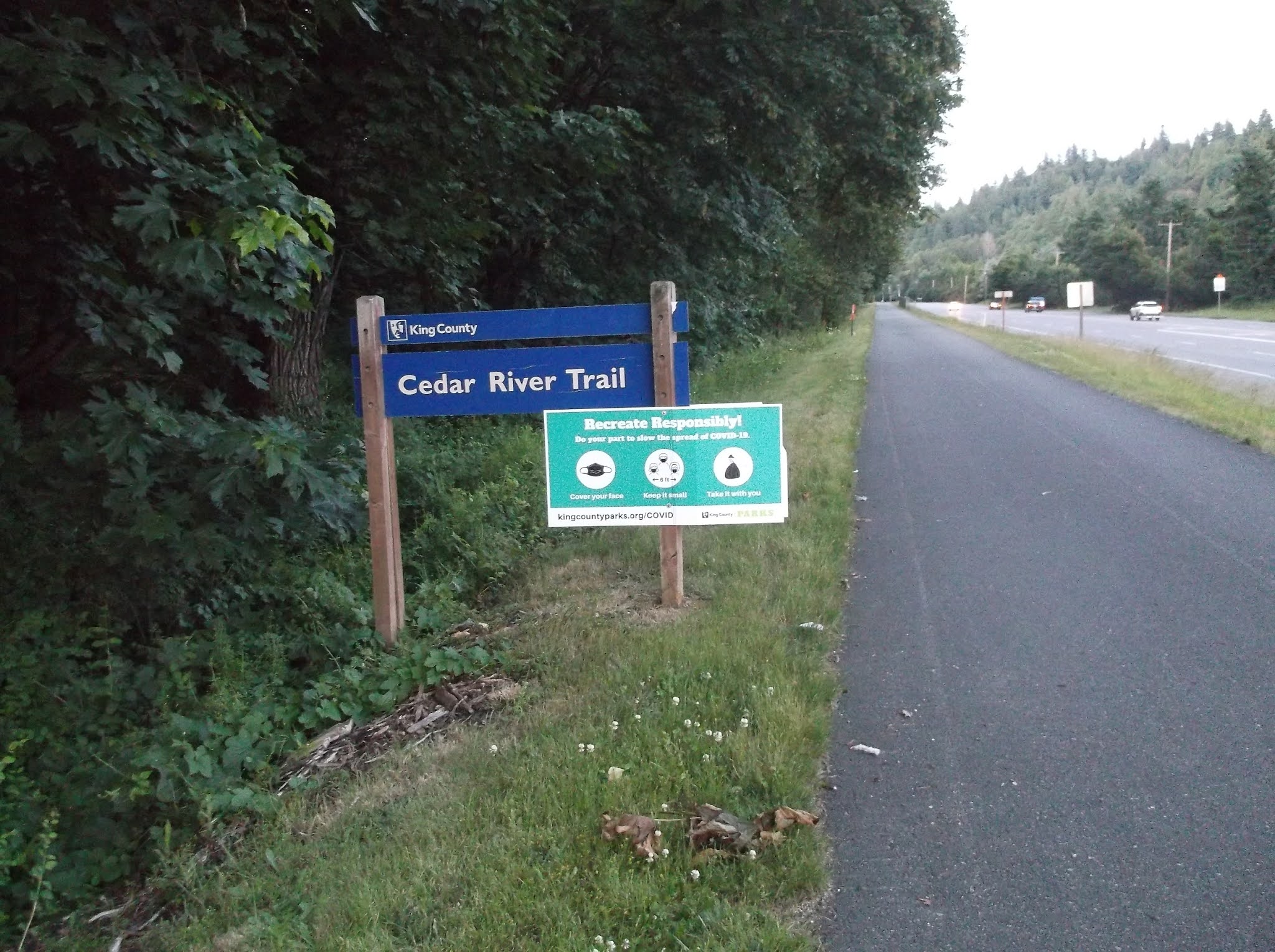
From last year's attempt to close the Trail completely, to this year's "Recreate Responsibly". Progress?

Earlier this evening I took a spin around the Shortwave radio dial, before I took a spin on my trusty, Japanese-made, Zebra-Kenko, purple 10-speed bicycle.

Both events gave me a picture of what may be the 'new normal' -- the second 'spin' being the more positive of the two.

As I rode my bike, the sun was starting to set, but it was warm out, about 68 degrees (around 15C). It was nice out -- there were still some clouds in the sky, but it had been a pleasant day.

When I rode my bike down the trail to a nearby park there was a Softball game in session: two teams of regular folks, wearing team T-shirts, pitching, batting and hitting bright fluorescent green softballs. I saw a few extremely high, foul balls being hit, and a few base runs.

An amateur Softball game taking place. One year ago, all Softball games were banned, because of the Corona lockdowns.

No one was wearing masks, and there was no social distancing. I am guessing that most, if not all of the players, who looked to be in their 30s, were vaccinated. Of course, I didn't ask. But it would have been a natural conclusion to reach. As the players played ball, a few spectators (family, mostly) watched, some of them eating and drinking refreshments -- there were some chips and donuts sitting out on one of the nearby tables. Some kids were drawing figures on the concrete by the bleachers, using colored chalk.

It was really nice seeing a Softball game, and seeing people enjoying themselves. Last year at this time, the parks were closed to all sports, and everyone was under lockdown. This year? It's feeling more 'normal'.

I am due for my second corona vaccine shot this week. Two weeks later, technically, I will be 'fully vaccinated', whatever that means. 

I stopped by an old 100 year-old bridge abutment, which used to support a box-girder bridge. The bridge was torn down in the mid-2000's, so now the concrete abutment (to the right side of this pic) is just a massive 'boulder' near a swimming hole. Across the river some people have their bonfire pit. Sometimes in summer one can see them all sitting around the fire.


A view downriver, as dusk rolled in. The river is low for this time of year. 


The swimming hole. I don't know if it is used much, but it's 3-4 feet deep, about right for a short swim in the summer when the water gets warmer. And there's a nice rock to use to climb into the water.

My own life, personally, hasn't been affected that much by coronavirus, as I live alone, and work in a small office with just one other person. I don't go out to pubs normally, and shopping has just been for necessities once a week or so -- and it's been that way for the past three years, as I was caring for a relative.

Maybe once or twice a month I get a latte at a Starbucks or other espresso stand somewhere. Sometimes I get a burger at a fast food, drive-in window. 

So my life hasn't been personally messed up by coronavirus. And luckily, I haven't caught it. I am not saying this to gloat, by the way. Roughly half of my readers are overseas, and that includes countries which are having severe troubles with Covid-19. My thoughts and prayers go your way. We are all in this together as human beings. We have survived pandemics before. Hopefully enough vaccines will become available that everyone will be able to receive one.

That said -- I'm looking forwards to normalcy here in my region of Washington state. It's nice to see people play a game of Softball or Cricket (which I used to see played in the same park). It's nice to be able to go to a karaoke pub, or a music venue (what few music venues there are left in Seattle, and it's not many -- they were decimated long before coronavirus hit). It'll be nice to go down to the lake and fish for yellow perch with my cheap looking, thrift-store fishing pole -- or swim, or just sightsee, and not worry about a virus. Hopefully, that can happen.

So, during my bike ride this evening, I had a small taste of that sense of 'normalcy'. It was nice.

...AND TAKING A SPIN ON THE RADIO DIAL

Also this evening, I took a spin on my radio dial, and I also had a small taste of the future of Shortwave Radio -- what I fear may be the new 'normal' on the High-Frequency airwaves.

Now, as some of you may know, I posted an article a couple weeks ago on Shortwave Radio, which was subtitled "Get 'Em While You Can," meaning: get those SW radio stations logged, recorded, etc., while they're still out there.

There was a reason for that subtitle -- the reason being that Shortwave Radio, as a broadcasting medium, is dying. It's on its last legs. Part of it is stations not making enough money, or not getting enough government backing. So there are stations cutting hours, and some are going off the air. 

The bigger part of it is sunspots, which make the Shortwave radio spectrum work well.

Now, I hang out at several radio forums, including some inhabited by ham radio guys, MW DXers and SWLs, and right now some of them are talking sunspots. There are even pictures of the new activity on the surface of the sun. This is supposed to mean that things are slowly getting back to 'normal' on the Shortwave bands, which include some of the most important ham radio bands (10 meters, 12 meters, 15 meters, 17 meters, 20 meters, 40 meters, and 80 meters).

I've monitored the SW bands ever since I was a kid. I've monitored the SW amateur ("ham") radio bands during much of that same period. I've monitored SW during the peaks of solar cycles and the bottoms of solar cycles -- and never, in my life, have I seen such abysmal SW conditions as I have the past 4-5 years.

The 19 meter SW broadcast band (15000-15400 Khz) is a good example. Solar cycle in, solar cycle out, in the past there was always activity on the 19 meter band -- usually during the afternoon. Even when the solar cycles were down, there would be a few stations present during the late afternoons -- Radio Moscow, France, the BBC, VOA to Africa and Asia, Deutsche Welle, Radio Canada, Cuba, etc. The 19 meter band was the highest frequency SW broadcast band that was reasonably dependable, year round, even when the sunspots were down.

The past 11 Sunspot Cycles, from 2015 back to 1900. I was an SWL DXer during the past 4 of them, including the 'bottom' periods (2010, 1996, 1987) and I have never heard such atrocious conditions as I've heard curing the past four years -- which are the bottom of the most recent cycle.

Over the past 4-5 years, I often don't even hear WWV on 15 Mhz. And that's with a better radio than I had in 1985 or 1996, when there were dips in the solar cycle, but WWV on 15 Mhz was still generally a regular, no matter what time of the year, no matter whether the sunspots were up or down. Even during those dips in sunspots, the 19 meter band had many more signals than it does now, and WWV would be audible almost 90% of the time.

In the past, even during the bottoms of sunspot cycles, 25 meters and 31 meters were both slammed with signals. Not so recently.

Back in 1996 I was able to hear Radio Turkey (on 31 meters) all night on a radio like this, and 60-100 ft (20-30 meters) of wire. That was even during the bottom of Solar Cycle 22! Over the past four years, the Voice of Greece -- another high-powered station located in the same region of the world, broadcasting on roughly the same beam (towards the EU and ultimately the US), which used to be audible nightly 8-9 years ago -- is mostly MIA. It's at least one indication that Solar activity isn't exactly up to snuff.

Earlier this evening, when I took my spin around the 31, 25, and 19 meter bands, I heard a total of 15 stations, and just over half of them were unreadable -- just traces of audio, where you can't ID the language the person is speaking, or ID the music. Some stations were just signals with no audio heard.

LA VOZ MISSIONARIA!

Now -- I did catch La Voz Missionaria on 9665 Khz, coming in from Brazil -- I could identify the Brazilian Portuguese the guy was speaking. That was cool. There were deep fades, but I could ID the Portuguese language. I have heard this station a few times over the past couple years, usually unreadable, and 'in the mud', but about 8-9 years ago I could pick it up fairly regularly (usually on my Panasonic RF-B45 and 25 ft. indoor wire), and I could hear the preachers talking in Portuguese, and some praise music. I do not understand more than a couple words of Portuguese, but I can ID the language very well as I have heard it on the SW band so much. 

La Voz Missionaria play a lot of Brazilian Christian praise music, and you will also hear preaching in Portuguese -- if you know Spanish (a related Romance Language) you'll be able to pick out the words "Senhor" (Lord), "Deus" (God), "Biblia" (Bible), and other Christian terms, which are similar to the Spanish ones.

Here is La Voz Missionaria's radio website link. It's all in Portuguese, but has some phrases about the station that should be understandable to someone who has taken Spanish. I give these folks credit for staying on the air, especially on the Shortwaves!:

Quem Somos - Rádio Voz Missionária (radiovozmissionaria.com.br)

The antennas and studios of La Voz Missionaria, a Brazilian station located in the city of Camboriu in the southern state of Santa Catarina. La Voz Missionaria broadcasts to the poorer regions of NE Brazil, particularly the Sertao. (Photo courtesy of La Voz Missionaria's website).

La Voz Missionaria is apparently part of a greater Christian ministry that reaches out to the poorer Brazilians in the NE of Brazil -- the Sertao (a dry region where a lot of poor people live) and the regions around the Rio San Francisco, which -- at least according to my Brazil tour and picture book -- has an economy that varies, naturally affecting the lives of the people.

The station itself is located in Camboriu, Santa Catarina state -- a small city just inland from a resort beach city called Balneares Camboriu, which apparently is popular with European, South American, and even North American tourists. For those who are savvy with your geography, Camboriu is just north of the bigger, resort city of Florianopolis (which appears on most world atlases and globes, and is easy to bring up on Bing or Google maps).

Camboriu apparently has a great climate -- an average temperature of 60-70 degrees F (15C-20C) year 'round. :-)

Voz Missionaria's website has a few videos and other information about what they do. With all the negatives we SWLs often hear about the SW medium ("it's useless", "no one listens to Shortwave"), it's refreshing to see an organization of any type using SW to reach people with a message and some entertainment (Voz Missionaria plays music, too).

Speaking of Brazil, earlier this evening I also logged Radio Nacional da Amazonica on 11780 Khz, with an S3-S4 signal but very low modulation. They usually have very clear audio when I hear them. But I think there may be something haywire with their equipment. But they were indeed on the air. That was cool

But otherwise, aside from Cuba and US Domestic broadcasters, the SW bands I tuned across were DEAD.

I can appreciate the enthusiasm of the radio hobbyists who are trumpeting the start of "Solar Cycle 25" (actually there have been millions of solar cycles -- there's only been 24 recent cycles that we humans have tracked since we had the technology to do so), saying we're going to get back to awesome conditions again within a year or two.

I am more guarded. This last solar dip was horrible. It may have been an anomaly. After all, I am not a solar scientist. But what if it isn't an anomaly? After all, solar scientists told us that the last solar cycle, number 24 (which went from 2009 until this past year), was the weakest in a century -- as shown in this NASA graph released in 2014:

A Solar Cycle graph, courtesy of NASA, showing the past three Solar Cycles. Notice that each one has lower peaks, with "Cycle 24" having half the sunspots of "Cycle 22". Some solar scientists think this trend may continue through the next cycle, Solar Cycle 25. If current radio propagation conditions are any indication, they may be right. 

That's why I encourage those of you readers who are radio hobbyists -- Get 'Em While You Can. Stations may be going off the air due to demographics, governmental budgets, church and ministry budgets, and the like. Even those stations with programming you dislike, give them a listen. Because I would wager that in ten years, very few, if any of them, will be on the air, and your SW radio will be a cool looking paperweight or static receiver.

...AND MORSE CODE CAN HELP

I also encourage my fellow SW radio hobbyists to monitor the ham bands, and try to learn Morse Code, even if it's just the basics. The ham bands haven't been exactly crawling with signals the past few years, and any ham will tell you that probably half of the licensed amateurs in the US are inactive -- and undoubtedly moreso because of the miserable conditions over the past several years.

Some of them will come back on the air, and the ham bands will see some more activity from the years 2022-2026. I've found that even when the sideband portions of the ham bands are inactive, the Morse Code sections of the ham bands (CW, as it's called officially) are often fairly, or somewhat, active with signals. These "CW" sections of the ham bands are the lowest portions of the SW ham bands (3500-3700 khz, 7000-7150 khz, 10100-10150 khz, 14000-14100 khz, and 21000-21150 khz seem to have the most CW activity). 

Usually, once you learn enough code, you can at least ID the call letters of most of the guys sending a CQ. It helps that when the ham guys send CQ, they repeat it over and over, along with their callsign. This gives the beginning code learner a chance to get the letters down and ID the station.

Being able to read at least basic Morse Code gives you more to listen to when you're tuning around. Sometimes the SW broadcast bands will be MIA and the nearby ham bands will still have some activity.

Just food for thought. 

I am still editing my article on the Grundig G2, which needed some pics of the menus and the like (my camera, for some reason, had trouble capturing pics of them, possibly due to the brightness of the G2's LCD display). I hope to get that article up on that fun little radio before June is out.

I'm closing this post with a pic of my cat Boots. I had him from 1996 until 2004, when a coyote killed him by the side of the street. He was a talkative character. I still miss him. I had a dream about him a couple nights ago, hence me pulling up this particular cat pic. If you live in coyote country, folks, please keep your cats inside.

Until later, my friends, Peace.

C.C., June 15th, 2021.


Saturday, June 5, 2021

Suddenly, California Weather

Summer Evening on the River...

As I type this, it is still light out and it's past 8:30 in the evening. We've just entered June, the month where the sun goes highest in the sky. That, of course, is a very big deal in a region where sometimes you don't actually see the sun for weeks at a time.

Today it was about 85 degrees outside (about 23-24C), which was a bit hot, being that two weeks ago it still felt like late Winter. It appears that our Summer is kicking in early, after a mostly non-existent Spring. Eighty degrees F in Seattle is wondrous. I call it California Weather.

COTTONWOODS = LATE

The frogs are croaking at night, and the cottonwood trees are trying to let loose with their 'cotton', but when I am riding my bicycle around during late afternoons, early evenings, and/or early mornings, it is hard to shake this bizarre feeling that nature simply can't make up its mind as to where it truly is in the cycle of seasons.

Work for me has slowed down a lot. My employer is taking a several week break after several years of non-stop work. That gives me a little extra time to attempt to get my yard looking like an actual yard, instead of a jungle. I also have more time for fiction writing and slide guitar practice.

My radio hobby has been here and there. I am finishing a blog article on the Grundig G2, a radio that I use mostly for SW listening. SW radio listening conditions have been iffy at best. There are nights where I may hear 10 stations (most of them unreadable or grainy sounding, with a lot of fading), and other nights where there may be five stations and lots of static. MW conditions are about the same as they've been since 2016 or so -- fair.

At around seven in the evening my trusty old Thermometer said that it was 82 degrees F (about 28C).

THE THIRD CHIMPANZEE

When I started this blog, in March of 2015, there was a lot more going on in life, and a lot more to hear on the radio airwaves. Sometimes I look back and wonder at how I got so many ideas for different blog posts. 

In some of the older posts, I talked about what I was reading. Lately I've been reading Jared Diamond's The Third Chimpanzee. 

The Third Chimpanzee is a fascinating book, as it details the bizarre nature of human psychology (sexual selection, tendency for mankind to exterminate various animal species, etc.). There is also a section on language, and a description of the spread of the Indo-European languages from a suspected Indo-European homeland just north of, and in between, the Black and Caspian Seas.

One surprising thing is that Mr. Diamond -- a well-educated academic and geographer -- read the same two books on the Indo-Europeans that I did, and he even quotes them in The Third Chimpanzee. I bought both books new in the 1990's, when I had the money to spare and there was a huge bookstore ten to 15 blocks from where I worked in Downtown Seattle -- Colin Renfrew's Archaeology and Language: The Puzzle of Indo-European Origins and J.P. Mallory's In Search Of The Indo-Europeans: Language, Archaeology and Myth.

Being an amateur linguist and amateur historian, I always found the origins of language and my European ancestors intriguing. It wasn't enough to know my ancestors came from Scotland, Ireland, Germany and England -- I wanted to know where they originally migrated from thousands of years earlier. Those two books helped me understand that. And Mr. Diamond talks about the Indo-European migrations in The Third Chimpanzee.

Jared Diamond is a very good writer for an academic -- he has another book out (available also on eBook), called Collapse, about the Viking colony in Greenland (A.D. 900-1300 or so), and how it prospered before collapsing in the 1300's. 

The medieval Norse Greenland colony is a fascinating story. Started by Viking settlers and adventurers who took off from Iceland in the 900's (when the Faroe Islands were also settled), the colony was able to benefit from a period of warm climate that ended in the 1300's with the "Little Ice Age" -- a period of time when Winters got longer and Summers much shorter and colder.

They still don't know what happened to the original Norse Greenlanders. Some believe the remaining stragglers were taken in by Inuit people who lived farther north.

Jared Diamond's short eBook Collapse is a fascinating look at the Viking Greenland colony -- which lasted over 300 years. 

The sun about to set over the distant hill on a warm, early evening. It felt a little strange to be out on my bike and not need an extra layer of clothing (most evenings and mornings here have been cold over the past nine months -- I'd have to put on an extra coat when riding my 10-speed on the trail).

RECEIVING MY FIRST 'JAB'

On days like today these echoes from a distant past take hold of the imagination -- as there isn't really too much else going on. 

I got my first corona vaccine shot about a week and a half ago. I didn't feel anything when the nurse injected the vaccine, and luckily, I had no side effects. 

And, contrary to some wacky rumors out on the internet, no, my jab is not magnetic. No coins stick to my skin where I got my shot. There is still a certain amount of fear out there concerning the new vaccines. That's nothing new in itself: there was fear with the introduction of the polio vaccine in the 1950's and also the first Swine Flu Vaccine in the mid-1970's. Right now in my county in Washington state, 97% of the corona infections occur in unvaccinated people, which is a sign that the vaccines are working.

A lot of people around here still wear masks, and socially distance. I know that I do. I also do as I have done for years: I take garlic extract pills, zinc tablets, ginseng, Vitamin E, and exercise.... Trying to load the dice in my favor when it comes to health.

I try to keep track of news from Europe and other areas of the world as I have online friends in Europe (Germany, Austria and Norway) and elsewhere. I know that there have been varying lockdowns in Europe, and also lockdowns in Melbourne, Australia (I have some online friends there, also). Canada still has some quarantines. 

The only thing I can say -- to all my readers, American as well as the other half of my readers who are in the rest of the world -- is try to keep up hope. We'll all get through this, and hopefully we shall all be stronger for it.

My cats enjoying the balmy, Summer-like weather. I took all these pics with my Fuji AX-655 camera, which fixed itself after a couple years of not working (its lens was locked in the open position). I have a blog post on how that all happened.

STAY SAFE, STAY POSITIVE

In closing, I hope to have my article on the Grundig G2 published before the end of the month. It just needs a couple more pictures. It is an amazing little receiver -- it picks up Shortwave stations about the same off the whip as it does with my indoor 25 ft. / 10 meter wire clipped to it (with an alligator clip). It does excellently on FM, and is a good MW radio as well. It's the only radio I have used to listen to SW for the last few years.

Until next time, I hope this article finds each and every one of you doing well. Stay safe, and stay positive. Peace.

C.C. 6-2-2021


Wednesday, May 19, 2021

The Rise and Fall of SHORTWAVE RADIO -- Get 'Em While You Can

A Shortwave Radio, sold by Radio Shack in the 1990s -- the DX-398, made by Sangean. With a radio like this, one could hear the world -- before internet streaming replaced it. Sangean still makes an updated version of this radio (the Sangean ATS-909X2), and there still are interesting stations to hear via the Shortwaves.

Imagine a world with no internet, where there is no meaningful access to international news, or meaningful contact with people from other countries -- especially countries on other continents. Your local newspaper maybe has a tiny bit of news from the other side of the planet, and because local radio is so homogenised you never hear anything but the top 100 songs of the most popular, domestic formats, and nothing in a language that is not the local language.

During the evening, you go over to the corner of your room, and grab the end of an antenna you have strung out your window. You plug it into the back of your radio -- a radio with not just AM and FM, but also several other radio bands on it: Shortwave (SW) bands. Switching on your radio, you tune to the SW section of the dial, and suddenly, you hear Chinese, Japanese, Russian, French (both European French and African accented French), Swahili, Dutch, Arabic, German, Brazilian Portuguese, Turkish, Indonesian and Malay, and various Western African languages and various dialects of Spanish -- all within a couple of hours. 

You hear folk and other musics that your neighbors and workmates haven't heard because they just listen to the latest hits on local FM radio. You hear Pidgin English and Australian accented English with pop and rock music that you never have heard before. You tune to the CBC's Northern Service and hear various native languages from the Far North. You tune to talk shows in Mongolian, from the Chinese radio service to Nei Menggu (Inner Mongolia).

You look over your world atlas and see all the countries, cities, regions, islands, and various places where these stations you've just heard are located.

In just an evening or morning, you've heard the world. You didn't leave your chair, but travelled thousands of miles -- as if by magic -- just by turning a dial.

I know that in other countries, and other parts of the world, there has always been a lot of immigration and contact between cultures and exposure to different languages, but here in the United States it wasn't always the case.

There was a time before the mid 1990's -- before the internet started to become commonplace -- that Shortwave Radio was the ONLY way for an average American to get exposed to numerous non-American musics, languages, and cultures. In most major US metros there were a few enclaves of immigrants, and in parts of the US there were many regions with large numbers of Spanish speaking people, but mass immigration didn't occur until after 1990, and it wasn't until after 2000 that immigrants' broadcasting needs were truly met by local media, including domestic radio stations.

Today I can walk down my main street and hear and see people from El Salvador, Mexico, Ethiopia, Brazil, Somalia, India, Pakistan, China, Ukraine and Russia, Sri Lanka, Vietnam, Thailand, the Philippines, Cambodia, and various other countries of the world. 

But it wasn't always this way. 

What I'm describing may seem like another world to many of my readers, but it did exist, and the only window on the outside world for many of us was the magic of Shortwave Radio.

We're just starting to enter a period where the solar activity and solar radiation that Shortwave Radio depends upon may start kicking in again, bringing that medium some new life. Yet, at the same time, Shortwave Radio is declining in popularity and importance, and the number of shortwave stations worldwide is also declining. It prompted me to write this article, not only about my own adventure with Shortwave radio, but also to encourage other SW enthusiasts to remember to tune the bands and log stations, because within a decade they simply might not be there to log and listen to.

MY OWN SHORTWAVE JOURNEY : IT STARTED WITH AN OLD TUBE RADIO

As I've said here on this blog numerous times, I'm a radio hobbyist, and I have been one for many years. Throughout much of my life, a lot of my radio interest has involved Shortwave radio. It started when my father got me my first radio, when I was about three years old. The radio was a big old Silvertone radio (a large radio with vacuum tubes in it), and it received MW, which at night brought in stations from all over the Pacific Northwest, and parts of California. Instantly, my world was changed. It was like travelling far away without leaving your room.

And that Silvertone radio also received Shortwave. Now, for those who don't know what Shortwave radio is -- it's a range of frequencies that start just above the Medium Wave radio band (MW is called AM Radio here in the US and Canada), and they end somewhere down below the FM Radio Band. Shortwave radio is like Medium Wave, in that the signals will 'bounce' off the ionosphere and travel long distances. What you hear at night on Medium Wave, when tuning around the band, is similar to what you can hear on Shortwave (SW) -- distant stations, their signals phasing and fading in and out -- you can hear the distance.

Unlike MW signals, Shortwave radio also will 'bounce' off the ionosphere during the daylight hours, depending on the frequency. In other words, the radio waves hit the ionosphere and bounce back to earth maybe 1000 - 2000 miles away or more, even during the daytime. And sometimes the signals will bounce their way to the opposite side of the Earth. The higher parts of the Shortwave band work better during the daytime, and the lower parts of the Shortwave band work better at night (like MW does).

Two Radio Shack, Realistic brand radios that were fairly inexpensive and could bring in the world. In this pic, both radios are tuned to Radio Rebelde, a music station from Cuba, that is still on the air and easy to hear in most of the US. With the bottom radio, I was able to hear Tunisia and Turkey regularly in the 1990s.

For years, Shortwave radio was one of the only ways Americans could hear new, music, and foreign language broadcasts from other parts of the world. In fact, you could say that until streaming became popular on the internet, Shortwave radio was indeed the ONLY way someone in the US could hear anything Russian, European, Asian, South American or African -- and Shortwave radio was the only way an Eastern European person, Asian person, African person, Middle Eastern person, Australasian or South American person could hear a broadcast from the US and Canada.

For many GenX'ers and Boomers here in the US, Shortwave was their introduction to hearing foreign languages spoken, and musics from distant cultures.

THE COLD WAR: SHORTWAVE'S HEYDAY

Now, when my father gave me that first, big old tube AM-SW radio, it was when the Cold War was still raging, and the Shortwave Radio band was hopping with signals. There were numerous stations on the Shortwave band nearly any time of the day. Many of those stations were International broadcasters, sending out news, information, and even propaganda to the rest of the world, thanks to Cold War politics.

And just with the two to three meters of wire which were stapled to the inside of the back of the cabinet of that big, tube Silvertone radio I could hear Radio Moscow, the Voice of Vietnam (relayed through Cuba), Radio Havana, the Voice of America, the BBC, AFRTS (the radio service for the overseas US Forces), HCJB (a Christian broadcaster in Ecuador), Radio RSA (apartheid-era South Africa's external service broadcasting from Johannesburg), Radio Nederland (from Bonaire in the Caribbean), Deutsche Welle, Radio Canada International, and numerous other stations broadcasting in Spanish, Japanese, Russian, Chinese, and other languages. 

And don't forget WWV: the US time-stamp station, its tik-tik-tik-tik sound always broadcasting day and night on different frequencies.

For a child it was a wonderworld of sounds. Not only did I hear foreign languages and foreign music, I also could hear strange bubbly noises (RTTY), the dots and dashes of Morse Code, and weird sounds of LORAN and other utility services, which an amplitude modulated radio couldn't decode, but could still pick up.


A Penncrest brand AM-FM-SW Multiband transistor radio, Model 1993. In the 1960s and 1970s, analog tuned radios like this one were popular to take camping, out in the yard, or just to listen in the house. On a radio like this, stronger SW stations could be heard with the whip antenna, but with an outdoor wire antenna, one could hear the world. With this radio, I heard Australia, Japan, South America and South Africa, just with 60 feet (20 meters) of wire strung between my windowsill and a tree in our back yard. The bit of thin, black wire plugged into the left side of the radio is the antenna that came with the radio, which I attached to the outdoor antenna with a long piece of speaker wire.

SIXTY FEET OF WIRE BROUGHT IN THE WORLD

After using the big old tube radio, I got a Penncrest transistor AM-FM-SW radio for Christmas one year. It had similar reception to that of the older tube radio. And after reading about antennas in a radio and electronics magazine, I bought some antenna wire and insulators from the local Radio Shack store and put up a 60 foot (20 meter) antenna, stringing it between our house and a nearby locust tree, and I began to hear more countries. This is when I first heard Radio Australia (5995 khz), Papua New Guinea, New Zealand, Singapore (both the BBC and SBS) and Japan (FEN Radio 810, relayed on 6005 khz. I think -- as well as NHK and Radio Tanpa). 

I also heard Russian stations all over the lower part of the SW band -- Radio Mayak and Radiostansiya Rodina -- which were SW broadcasts aimed at Russian mariners and shipmen in the Pacific. These stations were located in Kamchatka, in Petropavlovsk and Magadan. I can still remember hearing their signals, with the (mostly female) announcers announcing the time (Moscow time), and I remember the dramatic sounding music they played. At the time I did not know who these stations were. Later on, in the 1990s and 2000s, I listened to them a lot because they were slowly shutting down -- the last one to shut down was the Magadan station in the 41 meter band.

With that Penncrest radio I also heard some Christian religious broadcast stations that aimed their transmissions into Asia. One station in particular, KNLS, Anchor Point, Alaska, broadcasted in Russian most evenings and mornings. I recorded some of it and put some of it into a song I also recorded several years later (Highway To The Sun).

Highway To The Sun can be heard here:

ChrisCampbellRock | Chris Campbell Rock | Free Listening on SoundCloud

A couple Christmases after getting my Penncrest radio I got my first communications receiver (a high performance SW radio with sideband receiving capability), and heard 'tropical' SW stations from Venezuela, Guatemala, Costa Rica, Colombia, and Brazil. A few years after that I saved up my money and got a Yaesu FRG-7 (my uncle, a ship's radioman, suggested I get one), and I heard more stations, including Radiobras from Brazil, RTM Malaysia broadcasting from Kuala Lumpur, and also another RTM Malaysia station broadcasting from Kuching, in Sarawak (on the island of Borneo -- that station played pop music during the early mornings here). I also heard Africa Number 1, a station out of Gabon that played Highlife and other music.

A 1970's era Comtrek multiband AM-FM-SW-VHF radio, which I bought used in the late-1990s. Just on its whip antenna I was able to hear North Korea, the BBC, and a few other strong SW stations. With a longer wire antenna, many owners of radios like these were able to hear the world, with such simple equipment.

A pic of my Yaesu FRG-7, which still works. This pic was taken when I was cleaning the insides of dust, as it had been in storage for 10 years. In the early 2010's, I listened to MW on this radio, but in earlier years I tuned the SW Broadcast bands and SW ham bands with it frequently.

In the 1990s after getting a couple Radio Shack SW radios I listened to Radio Turkey for several hours every evening, broadcasting in Turkish, with lots of great Turkish music. Through hearing Radio Turkey, I learned about instruments like the saz and cumbus saz.

During the afternoons Greece would broadcast in Greek to the US, as there were many Greek immigrants in the NE US. It was my introduction to hearing the Greek language. During afternoons and evenings Radio France International broadcast in French to Africa for hours at a time. I can still recall their bumper music, which was a dramatic sounding piece that was all synthesizer.

At this time I also discovered amateur radio -- a hobby I've never joined, but I've always listened to 'ham radio' guys on my radios. I've heard hams from Qatar, Franz Josef Land, the South Pole, Borneo and Sarawak, Argentina, Chile, Puerto Rico, Mexico, Northern Ireland, Spain, and even "Santa Claus" talking on his ham radio from Northern Finland!

A Realistic DX-440 AM-FM-SW digitally tuned radio that I bought in 1989. Radios like this became popular with those who wanted to hear the world when there was no internet, just computer BBS's. With this radio I could hear Europe, East Asia, Southeast Asia (including Malaysia and Singapore), India, the Middle East, Southern and Western Africa, and South America (including Brazil and Venezuela). Using headphones, even Shortwave radio stations had a full, rich sound.

A 100 FOOT ANTENNA and a REALISTIC DX-440

Over the years I added to my collection of SW and MW radios: a Realistic DX-440 I got in August of 1989, a Realistic DX-390 I got in 1995, a Realistic DX-398 I got in 1998, and a Panasonic RF-B45 I got in 1996 (I heard the BBC broadcasting Princess Diana's funeral live in September 1997, including Elton John's first performance of the new version of Candle In The Wind), and several other smaller radios.

In the Winter of 2002-2003 I got back into SW listening after a several year break, and this time, I had a 100 foot wire (30 meter antenna). Using my DX-440 mostly, because it had such a great sound through the headphones, I heard Russia, China, India, Pakistan, Thailand, Singapore, Korea, and even heard a regional AIR India station broadcasting tribal chants from their station in Chennai -- which is on the other side of the world from us here in Seattle. I heard Bayern Rundfunk (from Germany) playing 1980s pop music -- this was a few months before they went off the SW band. I heard strange chanting just below the 40 meter ham band (Borneo 'village radio'). 

I began to log my SW catches online, on a "Short Wave Logbook" that still exists, here:

Daily LogBook 2014 (dxworld.com)

Here are links to the pages of the Shortwave Logbook that will show what we all were hearing in the Winter of 2002-2003, including many of my own SW catches:

December 2002 LogBook (tripod.com)

2003 LogBook (dxworld.com)

IT'S THE END OF AN ERA; and AN END OF A VALUABLE MEDIUM

Shortwave radio has always been a part of my life. Now, it hasn't been as much of a hobby as Medium Wave DXing or Medium Wave listening, but Shortwave listening has always been there -- for years it has been the hobby that never completely goes away.

Sadly enough, I can't say that anymore. 

Shortwave radio -- a viable broadcast medium that has been used by hobbyists and governments for 80 years -- is dying. And it may be gone by the end of this decade.

Think about it: the broadcast medium used by all of the major powers during World War Two and the Cold War, and used to reach Third World nations with news and information, and used by Third World nations to educate and entertain Americans and Europeans about their countries and cultures, is about to die out completely.

Millions of people around the world won't know, or even care. It's unfortunate, because Shortwave radio had a definite cultural impact and importance, especially during World War Two and the Cold War years. This cultural impact was felt in Third World countries and Iron Curtain countries much more than it was felt here in the U.S. and Canada. While people in the US, USSR, and Europe had MW and FM radio to rely on for information, many people in parts of Asia, Africa and rural Central and South America relied on Shortwave radios to get reliable news from international broadcasters like the BBC and Deutsche Welle -- either because they didn't have reliable local radio, or they didn't trust their local news agencies.

The Voice of America's Jazz program was extremely popular in Eastern Europe and the Soviet Union during the Cold War years. It was one non-political thing that broadcast to our adversaries at that time that we all have something in common: a love for music. Cultural impacts like that are priceless.

Even though Radio Moscow was considered a propaganda medium by many Americans, Vladimir Pozner and Joe Adamov (big name Radio Moscow commentators) often got away from politics when giving their commentaries. They often told stories, anecdotes, and talked about the culture and character of the Russian, Ukrainian, and other former Soviet Union peoples. Although no one knows how many Americans were listening, I think it gave me a better understanding of the people in the Soviet Union at that time, and I think that the programming I heard was valuable for the cultural benefit alone.

I couldn't have gotten that insight any other way.

IT'S THE INTERNET

Radio in general is starting to fade in importance as a broadcast medium, and for that we can all 'thank' the internet. The internet has a lot of pluses -- one of them being that I can write this blog, and it will be read by readers from all over the world. Roughly half my readers are overseas.

The negatives? The older media -- newspapers, magazines, and radio -- begin to die off and fade away. And that is what we radio hobbyists are now seeing with the demise of Shortwave broadcasting: an old friend is fading into the static.

During the 1990's and 2000's, when SW was still going strong, there was talk in the SWL community of the end of Shortwave. At the time, people were blindsided when the BBC decided, in 2008, to shut down its SW broadcasts to North America (from Antigua) and to Australia. Radio Nederland took over the BBC's frequencies and promised to continue in the BBC's place, but a few years later Radio Nederland also went off the air -- and completely. Then Radio Canada Int'l went off the air, and tore out their antenna system. 

By the early and mid 2000's, the international broadcasters that blanketed the world during the Cold War were mostly gone -- the few remaining broadcasts were aimed at Africa and parts of Asia that the big guns -- BBC, VOA, Deutsche Welle, and China -- still wanted to reach with their message.

My own interest in the Shortwave hobby took a dive in the mid 2000's -- my 100 foot antenna (and a CB antenna I used to talk to the southern US, California, and Mexico) blew down in a windstorm. For a while I just lost interest.

Then, in 2011, I put up a decent indoor antenna, and I cleaned up my radios and fired them up. Soon, every afternoon, morning, and evening I'd turn on my DX-398 and tune around. It was during this time that I began to see that SW was losing its importance as a medium -- it was losing out in many parts of the world because of FM stations being more commonplace -- even in Third World countries FM was replacing SW for foreign news and information, and they naturally listened to their home broadcasts on FM networks.

The Radio Shack / Realistic 200629, Radio Shack's version of the Sangean ATS-505 AM-FM-SW radio, which is still available online. The radio has a portable antenna plugged into the left side, where the external antenna jack is. I've heard parts of Asia and South America with this radio, just with a 10 meter indoor wire antenna (about 25-30 feet long). I bought this at Radio Shack in 2013, just before Radio Shack stores began closing.

Even so, there was still plenty to hear on SW during the early 2010's: I heard Radio Amazonia every evening. I heard CVC Voz Cristiana de Chile (a religious broadcaster) many afternoons. On Saturdays they would play the Spanish Christian top hits, and they had comedy shows. Although I couldn't understand most of it (I do not know a lot of Spanish), it was still fun to hear. Radio Espana del Exterior was on every afternoon on 15110 khz with great music and announcers speaking Castilian Spanish. I was also hearing ham radio signals from everywhere. 

Early mornings, when it was still dark out, I heard SW broadcasters from Vietnam, Thailand, Japan, Korea and China; I heard mysterious single letter, Morse Code beacons from Russia in the 40 meter ham band; I also heard the famous Borneo, 'village radio' chanters on 6999 khz and even higher up in the 40 meter ham band -- numerous radio operators all chanting into their microphones while another operator recorded them, and then played it back over the air so the rest could hear who had the loudest signal. Some hams claim that these chanters are using unlicensed ham radios. Many of them seem to be in Kalimantan, the Indonesian part of Borneo.

I also heard Malaysian and Indonesian ham operators talking to each other on the 40 meter ham band. Although they often spoke in Indonesian and Malay, it was interesting to hear the language. During the evenings I listened to the Voice of Greece on 9420 khz -- they'd play some of the saddest sounding love ballads sung by sweet and sultry voiced female singers. There were slow CW (Morse Code) nets on various ham bands I listened to. On 'sideband' CB I could hear hundreds of operators talking in Spanish, chatting with each other in places like Costa Rica, southern and northern Mexico, Puerto Rico, Panama, Peru, Venezuela, and even Brazil. "Hola Once! Hola Once! Hola Once!" they would often say into their mics in Spanish, looking for others to talk to ('Hola Once' is 'Hello Eleven' in Spanish -- 'Eleven' meaning 11 meters, the CB band).

One afternoon I heard a woman from Colombia or Venezuela talking to a guy from Brazil in broken Spanish, on sideband CB -- on the channels above the 'official' CB band, where a lot of CBers go when they want to 'DX' and talk to the rest of the world.

There was a lot going on.

The Grundig G2, a discontinued AM-FM-SW radio mini-boombox with recording ability and built-in memory, and a mini-SD card slot. A DSP-chip radio, the G2 is excellent on Shortwave off the whip, and also excellent on FM. On the MW/AM band it is very good -- about the same as your average Walkman-style headset radio -- but if you want to DX with a G2 you'll probably need an external loop antenna to get better results. On SW, you can attach a short wire (10-20 ft. / 3-6 meters) to the whip antenna and bring in more signals if needed. The G2 has a rechargeable battery, which is charged via USB cable. You can get a couple weeks or so off the battery between charges, if you're using the G2 an hour or so a night.

The 2010s -- THE LAST BIG GASP FOR FULL SHORTWAVE BROADCAST BANDS

Even later in the 2010's there was still plenty to hear.

In 2014 I got a Grundig G2 digital AM-FM-SW radio, which has 50 memories for SW. When I first switched it on, I was hearing all sorts of SW stations. The radio itself was awesome on SW. There was virtually no interference from nearby stations -- if you tuned to a weak station next to a strong one, you could hear the weak station easily. It sounded good through headphones. I began listening to it every night and early morning.

I soon had all 50 SW memories filled with various stations within a couple weeks. I was hearing Brazil, Greece, the BBC (from Ascension Island and Singapore) and Radio New Zealand. I heard Radio Australia on 9580 every night and morning. I heard China broadcasting to Europe from Kashgar, a somewhat remote area in Xinjiang Province. I heard AIR India, broadcasting to Afghanistan in Dari and Pushto. I heard Vatican Radio. The G2 was a Godsend -- I didn't need an antenna, it was picking up tons of stations just off its whip antenna. Early mornings the 49 meter SW band and 41 meter SW band were both packed with Asian stations. I maxed out all my memories.

Then, some time in late 2016, the sunspots began to dive. Slowly, over the next five years, there were many, many nights I would turn on my G2, scroll through all 50 memories, and hear nothing but static.

No more India, no more Kashgar, no more Amazonia, no more BBC from Singapore, and no more Vatican radio, and no more Australia -- as Radio Australia was shut down. No more Spanish speaking CBers on the 'sideband' CB frequencies. No more chanters from Borneo on the lower fringes of the 40 meter ham band.

During this same time, some other stations were reportedly having monetary troubles, and some left the air. The Canadian broadcaster the CBC used to have SW relays on 6160 khz, including one in British Columbia I used to hear daily. The transmitter had a fire and they just shut the station down.

From 2016 until recently, there were nights I'd turn on my SW radio and hear absolutely nothing but one or two stations at best, usually Cuba and US religious stations, and sometimes they sounded weak and grainy. On top of that, the ham bands were mostly dead. Some Shortwave Listeners (also known as SWL's) south of me in California and the Southern US were still hearing stuff, but I was hearing mostly static.

Now the sunspots are coming back. But even though the sunspots may be coming back, the SW bands still seem dead, especially when compared to the early 2010's, and 2000's.

What do sunspots have to do with anything, you might ask. Good question.


A NOAA chart of the last two Sunspot 'cycles', with the years on the bottom of the graph. To the left side of the graph, you can see the peak of the Solar cycle that happened 2000-2002, where there were the most sunspots. At that time, I was able to hear Germany, Russia, and then later on I would hear some Chinese regional SW stations, with Indian SW stations behind them, during early mornings. The sunspots then dipped -- and solar activity dropped -- between 2006-2010. Solar activity began to climb again after 2011, when I began to get back into my radio hobby. As you can see from the chart, the solar activity peaked roughly between 2012-2015, when I was still able to hear a lot of SW stations, and MW long distance listening was excellent. Then the solar activity dived after 2016. We are about to see more solar activity soon, which should peak again in 4-5 years. (Graph courtesy of NOAA)

THE ALMIGHTY SUNSPOTS, AND THE INTERNET

Shortwave broadcasting, and to a certain extent, long distance Medium Wave broadcasting, depends on sunspots to work well. When the sun has a lot of sunspots, solar radiation affects the ionosphere a lot more than when there are few sunspots. Consequently, when there are no sunspots -- like we saw for about three or four years recently -- the Shortwave band doesn't work so well, especially if you are in far Northern and far Southern latitudes. The sunspot cycle is consequently pretty important to SWLs and ham radio guys. When there are no sunspots, many nights you just as well may turn your radio off.

During this low sunspot period since 2016, radio itself has been feeling the pinch. AM and FM station revenues went down almost 50% from 2005. At the same time, MW and FM radio in the US began to lose audience to internet streaming. 

However, internet streaming has affected SW listening, too. In parts of the world (Asia and Africa) that used to have high concentrations of SW listeners, internet radio and FM has taken SW's place. Consequently, the operators of big SW stations are slowly cutting back on broadcasts even to those areas.

Now we are seeing more sunspots. But the big question is this: will that really make a difference?

SO, GET 'EM WHILE YOU CAN

NOAA, the US governmental agency that reports on weather and solar activity, says we have enough new sunspots that we are now officially in a new sunspot cycle. This should be good news for SW and MW radio enthusiasts, as it means that the conditions necessary for good long distance reception are improving.

This is a NOAA / NASA graph predicting the next Solar 'cycle'. The red lines on the right side of the chart are predictions of how much solar activity there may be, and what years it will be the highest, which appear to be late 2023-2026 or so -- two to five years away. Hopefully, there will still be a lot to hear on the SW bands when that Solar activity peaks.

However, at the same time SW stations are leaving the air. They are seeing less listeners, as people use the internet and FM radio in most of the world to listen to news and music. So, if a SW station's equipment breaks down, or their antenna system breaks, it's expensive to fix or replace, and with less and less listeners a lot of stations don't bother getting the facilities fixed: they just shut down the station.

It's a sad fact for many of us who like to tune around and see what we can hear coming into our radios from the other side of the World.

This is why I say to my fellow SWL's: Get Them While You Can.

We don't know how good this next sunspot cycle will be, but we do know that the trend for SW broadcasting isn't looking good. The sunspots will give us a better ionosphere. But stations may start leaving the air, even though the ionosphere is more cooperative.

It's obvious that there are still millions who listen to Shortwave in various parts of the world, if only to receive news and information from outside their country. Some listen to SW because it's the only way they can get religious or other programming they can't get otherwise. But Shortwave's days are drawing to a close, and I have sincere doubts there will be much to hear on the SW Broadcast bands when 2031 hits. But before then, there will probably still be a lot remaining to hear.

The Realistic / Radio Shack DX-398, showing a memory 'page'. Each 'page' held 9 memory locations. In this one in the picture, I have a page called "India", and I stored nine frequencies where there were SW stations I heard from India, or I knew there were Indian stations and I wanted to hear them. 10330 khz was where I heard a station from Chennai, India, playing villagers chanting, singing and dancing. I can still remember hearing it so clearly -- it was like I was there in the village, hearing them stamp on the floor of the building. That station is no longer audible here in the US, and it may be taken off the air soon. It's an example of how far Shortwave broadcasting has fallen. I keep the memory locations stored in my DX-398 just because there's no reason to replace them. And they remind me of what I used to hear every day.

To understand just how few stations there are on the Shortwave bands, compared to the 1990s and 2000s, think of this: The DX-398 radio (pictured above), which I bought in 1998, has over 200 SW memory locations (where you could store frequencies), including many "pages" where you could store the stations' frequencies by category -- I had pages devoted to Asia, Africa, Europe, Southeast Asia, India, etc. Using a couple buttons, I could label each 'page', and then when listening to the radio, I'd scroll to that 'page' and go through the memories, to see if any stations from that part of the World were on the air.

Today all of those memories I programmed into the DX-398 over the years are TOTALLY USELESS.

There's nothing there.

I can't emphasize enough: If you are a SW aficionado, and maybe your antenna blew down (like my 100 foot antenna did), or you had a radio and shoved it away somewhere during the low sunspots, get your antenna back up, and clean up the radios and turn them on!

Because soon enough -- maybe in just five years -- there may not be anything to hear with them but static.

We don't know how good the ionosphere will be, or how many stations will stay on the air, or how long they will keep operating. I recently downloaded a frequency list from EiBi, an SW website based in Germany. According to EiBi, there are still hundreds of frequencies with stations on them, and something to listen to -- if the ionosphere cooperates. That list may diminish, but it probably won't diminish quickly. If the ionosphere cooperates, we may still have a lot to hear over the next 5-10 years, depending on world events, and the world economy. 

By the way, here is EiBi's web link. The lists are text files. You can even scroll over them using a tablet computer or phone, using a web browser. I use the frequency list. It's a long list.

www.eibispace.de

Another useful site is Short-wave.info. Here is their link.:

Short-Wave Radio Frequency Schedule for BBC in ENGLISH

Short-wave.info is a user friendly site, complete with an active world map, and pull down menus to help you find stations to hear on the SW bands. It not only shows the locations of the SW stations' transmitter sites on the world map, it also lists their beam azimuths -- which direction they are broadcasting, which can help ID an unknown station.

THE OLD TECH IS STARTING TO DISAPPEAR -- IS THAT A GOOD THING?

Some people, including many people who work in the radio business, think that Shortwave is a useless medium. They always bring up the horse and buggy. "We no longer need horse wagons," they say. "It's the same with Shortwave radio."

They have a point. But then, you could say the same about a lot of things. 

Some day, there will be no brick and mortar stores -- everything will be purchased online and delivered by drone. That may be a more efficient way to shop, and perhaps it will save energy. But is it really a great idea to never interact with another person directly like you do now when you shop at a store?

Some day, there will be no more need for automobiles in the US. Everyone will share them, and they will all be electric, and you'll just order one on your smartphone and it will show up and it will be self-driving, and it will automatically dock your bank account for the rental time. This may be great for the environment, but is it really a great thing to lose that much independence, that one has if they have their own car available?

Some day, there will be no cash. Many say that's fine, we don't need it anymore. But cash purchases can't be tracked, hacked, or switched off at the bank -- so that form of independence may be lost. It's a trade-off, obviously, but it's something that many should be thinking about when discarding the older ways of doing things for the new.

Some day, there will be no AM and FM radio, or any cable TV -- it will all be various streams of information and entertainment on your smartphone or tablet. On the outset, this may be a great idea. But on the other hand, having mass media networks and radio stations brings people together. When I was a kid, everyone knew what was on TV last night. Everyone talked about it. Now, everyone is watching something completely different, and there is less in common to talk about. People have less and less in common anymore, and the splitting of mass media into little clusters is part of the problem.

Is that a good thing? Maybe it is, but there is still something lost.

Of course, you can't stop progress, and maybe no one should. But there is still value in the older technology, it has served humanity for millenia in some cases (riding horses) and a hundred years in other cases (radio, for example). 

Either way, when the last Shortwave station goes off the airwaves, I won't be celebrating. It will be a sad time. Even if its inevitable, it will be the closing of an era. 

The past four years have been a taste of a SW band with no stations. Since the Fall of 2016, SW conditions have been abysmal. There have been times I have tuned across the most popular SW bands and heard nothing but static. At the time, it was just because atmospheric conditions were bad -- low sunspots. According to EiBi and other SW frequency sites, there were still SW broadcasts taking place -- it's just that conditions were so bad, the signals weren't strong enough to reach my part of the world.

Some day, that absence of SW signals will be permanent. There will be indeed nothing but static to hear on the SW bands, and it will stay that way.

For those of you who grew up with the internet, think about it: some websites you used to enjoy are now gone forever. I know of some websites I used to go to that no longer exist. Excite.com had personals I used from time to time. Yahoo EGroups was a place I used to hang out. Napster and MP3.com had indie music. There were two rock band forums I used to hang out at around 2001. Those websites and forums are now gone forever. Maybe you're lucky and you can find what's left of them on the Wayback Machine. But as we all know, many sites on the Wayback Machine only give you bits and pieces, with lots of missing chunks. 

And a lot of those lost websites were a big thing just 15 or 20 years ago.

That's what SW radio will soon be like -- except there is no Wayback Machine for SW, except maybe a few sound files on the internet.

So, if you are a radio aficionado like me, and you grew up on Shortwave -- GET 'EM WHILE YOU CAN.

IN OTHER THINGS...

Lately our weather here has been more Spring-like. Night time temperatures are around 50F (8-10C) and during the day we have been seeing more sunshine. At night the frogs have started croaking -- they're about a month late. They usually start croaking and chirruping by the end of March, and this year it was the last week of April that when I took my night-time bike ride I heard all the frogs in the ponds.

My work has slowed, and fiction writing time has picked up. Life has carried on as per usual. I still listen to the AM band nightly while writing or doing tasks around the house, and I also tune the Shortwave band about once every other night or morning, and the results vary from grainy static and a few stations here or there. It's one of the reasons I decided to post this article about Shortwave, and my long history with it. I really think the next few years will be the last blast for the shortwave communications medium.

There are radio companies like Sangean and Tecsun coming out with new radios -- receivers that do stuff that guys in the 1970s and 80s would dream about -- but there is unfortunately less to hear. For those of you that are fortunate to get those new radios -- make sure you use them. After 2030 there may be nothing to hear on them.

The Panasonic RF-B45, the last Japanese-made Panasonic SW radio. This radio is probably the best MW/AM radio I've got, and with an external loop it's virtually matchless. On SW it does well off the whip antenna, but is much better when using an external wire -- even the 15 footer that comes with the radio is a great help. FM is in mono, as is the headphone socket. If you're using stereo headphones (and who isn't?), you need a stereo-to-mono adapter.

I will close this article with a pic of my Panasonic RF-B45 AM-FM-SW radio. This is one of my favorite radios to use. I bought this one when the Electronics Universe store in Auburn, WA, was closing down. The radio was missing its battery door, so I used duct tape instead.

It's excellent on MW / AM -- in fact, it's probably the best AM radio I have. I still remember hearing Princess Diana's funeral on this radio in 1997, when the BBC broadcast it from Antigua during the late morning. At the time I was at my mother's place, recuperating from nasal surgery. I was lying in bed, listening to the radio on headphones, the 15 foot wire antenna plugged in to the radio and strewn out across the bed. It was a sunny day outside the window, but the funeral was a sad occurrence. And I was hearing it live from England.

I still use this radio most evenings, as it's the best radio I have for MW nighttime distance listening. It has very good sensitivity and is selective enough to separate weak stations from a stronger station nearby. It's also the last Panasonic SW radio that was made in Japan. Panasonic's next model was made in China.

So, until next time, dear readers, I hope you all are doing well, staying safe, and let's hope that before the year is through this pandemic will be consigned to history. The World needs to be able to move on to newer and better things.

And, of course, everyone needs a cat picture. :-) This is an old pic of my cat Scooter, who was a great companion. A mischief-maker, she was lost to kidney disease about a year after the pic was taken. She used to wait for me to get home from work, always looking for me. 

Peace to everyone.

C.C. May 17th, 2021