Wednesday, June 5, 2024

DX'ing China Radio Int'l: HEARING ESPERANTO!

The Esperanto flag -- representing the Esperanto language, and the people all over the World who speak it. Esperanto is an international language that was constructed in what is now Poland, in the 1880's. It was intended as an easy-to-learn, second language to unite people all over the world.
Flag courtesy of Wikipedia, flag illustrated by Richard H. Geoghegan

Last weekend -- Saturday a.m. to be precise -- I awoke early., around 7:30 a.m. I couldn't get back to sleep, so I did the next best thing -- I switched on my Radio Shack 200629 AM-FM-SW-LW radio, clipped my indoor wire antenna to the whip, and tuned around the Shortwave bands to see if there was anything on, while I sipped some tea.

I started by checking out the 20 Meter ham band, and heard a few contacts, both on Sideband and CW (Morse Code), including a couple hams from California (N6PF calling CQ CW, and K6MRC talking to some guy in New Zealand I couldn't hear).

Then I tuned to the 25 Meter SW Broadcast band, and heard North Korea in English on 11710 kHz, and NHK Japan broadcasting to South Asia in Hindi on 11655 -- NHK was a weak, semi-readable signal. The language was muddled up by the fading that I wasn't sure what it was, and I had to look it up.

My trusty Radio Shack 200629, which I use nearly every morning or evening to DX the Shortwaves, and often the MW/AM band as well. It has great sound on headphones, with the tone control being very useful in either enhancing the audio or reducing interference. I recently fixed the connection between the whip antenna and the radio's main PCB board, and the radio has worked like a gem ever since.

The North Korean broadcast was fairly loud, with no distortion at the transmitter. They must have fixed it, as it was a good clean signal. Once again, the North Korean music was unique. Every time I hear North Korea I listen to the bass guitar player, because he's really good. I have no idea what bass he's playing -- it sounds like a Fender Precision, but I don't know if they have those in North Korea. I also am not sure if it's one particular bass player I hear in the music played on the Voice Of Korea, or if it's several.

And, of course, there isn't any info available on North Korean musicians on the internet, aside from the Wiki article, which does name some of them, but one is never sure if the list is current or not. And there definitely is no information on the type of equipment the players use.

The bass guitar is pretty prominent in the mix on nearly every pop-style track that is played on the Voice of Korea. I think it's mainly one particular bassist, because there apparently are only one or two official radio music ensembles in the country.

I call the guy the James Jamerson of North Korea. 

After listening to that a while, I tuned my Radio Shack 200629 further up the band, and heard NHK Japan broadcasting to SE Asia in Japanese on 11815, and some Korean language on 11985, which was probably Radio Free Asia being transmitted from the island of Tinian, in the Marianas.

I switched radios to my XHDATA D-328 (+wire antenna) for a bit and heard China Radio International broadcasting to Europe in Turkish, from Kashgar, on 13710 kHz in the 21 Meter Band (around 1605 UTC). I heard Russian language (including the Russian words "radist'" and "pobachiti") on 13650 (around 1555 UTC), which apparently was NHK World Radio Japan broadcasting to European Russia from a transmitter in the United Arab Emirates.

STRANGE SPEECH IN THE 21 METER BAND
I switched back to my 200629 radio and then tuned in to a fairly strong signal on 13670 kHz. I couldn't tell what language woman announcer was speaking. By now it was just after 1700 UTC. The signal was S4-S5 overall, but the fades were deep enough to make the unidentified language appear murky sounding and mysterious. In the background, some Chinese sounding, easy listening instrumental music was playing, so I figured it had to be China Radio International -- but what was this unusual language I was hearing?

It sounded a lot like some sort of accented Spanish.... And sometimes it sounded almost like Lithuanian, too, because of the word endings on many of the words.

For a while I thought it was indeed heavily accented Spanish. But if it was CRI, the language probably wouldn't be accented, as most of CRI's announcers are very close to native speakers in accent.

Some of the words seemed to fit Spanish.... But there were other words and pronunciations that were nothing like Spanish, and nothing like Italian or Romanian, either. There were some odd sounds, and bizarre sounding word endings (many with the endings "-yi" and "-oyi", along with words that didn't seem to fit any language I either was acquainted with or had heard much. Some of the consonants sounded Portuguese or Italian.

I finally had to look up the information on the broadcast on my EiBi text file, which lists SW broadcasts by frequency, station, time in UTC, target area, and language.

It was China Radio International, all right. Broadcasting to Europe, from Beijing.... In Esperanto!

Now, I've heard of Esperanto before. It's a language that was put together by an enterprising guy who wanted to create an easy-to-learn secondary language that he hoped would be a language of international commerce, and also bring people together around Europe -- and the greater world. 

I knew very little about Esperanto, although I was introduced to the concept when I was a kid. I had gotten a science fiction pulp magazine that always featured stories by different authors, and this edition of the magazine had international writers in it -- Soviet, German, French, and even Esperanto writers. I don't remember much about the Esperanto author's story, but there was a little bit of dialogue in Esperanto -- the space people in the tale apparently spoke the language. Cu vi Esperanton? said one character to another in the story ("do you speak Esperanto?"). Apparently, the space people (or time travellers?) in the story were able to speak it.

It's all I remember of the story, and until recently it was all I knew about Esperanto.

But I'd never actually heard Esperanto -- until last weekend. It's an interesting language.

SO, WHAT EXACTLY IS ESPERANTO, ANYWAY?
It turns out that the man who developed Esperanto -- a Jewish opthamologist named L.L. Zamenhof -- knew several languages, as he lived in Poland -- when it was still a part of Czarist Russia. The city he lived in -- Bialystok -- had four main ethnic and language groups -- Poles, Jews, Germans and Russians -- and the four groups apparently didn't get along. Mr. Zamenhof thought that a common, neutral language would help groups like the four peoples in his region get along.

So he created Esperanto out of Spanish, French, Italian, German, Yiddish, Greek, Polish and Russian, and bits and pieces of other languages, trying to make one that would have at least some commonality with the languages that most groups in Europe would be acquainted with. The language gained interest, although it apparently had a connection with leftist politics, so some countries frowned on Esperanto's use in the early 20th Century. Most Esperanto speakers are in the northern and central EU, parts of Brazil and Uruguay, the Far East, and the Eastern US. The number of Esperanto speakers seems to vary according to studied estimate, ranging somewhere in the tens of thousands worldwide.

Here is the Wiki on the Esperanto language. The story is fascinating, really.:

Here is the Esperanto Wikipedia, should you want to read some Esperanto.:

As mentioned, there is a lot of information on Esperanto in the Wiki on Wikipedia. But if you want to actually hear it, and you have a Shortwave radio, you may be able to hear it on China Radio International on 13670 kHz between 1700-1800 UTC, when they beam the program to the EU. If I can hear it here in the PNW US on my limited radio equipment (it came in well on my XHDATA D-328 and 25 ft. indoor antenna), radio listeners in the EU, the Eastern US and Canada, and other parts of the world should be able to pick it up. 

CRI also has other broadcasts in Esperanto, on 7265 (1930 UTC), 7300 (2200 UTC), 9440 (1300 UTC), 9745 (1930 UTC), 9880 (2200 UTC), 11635 (1100 UTC), 11650 (1300 & 1700 UTC), and 15110 (1100 UTC) along with the broadcast I heard on 13670 at 1700 UTC.

Of course, many of these broadcasts may be aimed at different parts of the world. Most seem to be aimed in the direction of the EU, with one broadcast possibly aimed at Siberia or North America. Radio Habana Cuba also has Esperanto broadcasts on 6000 kHz (0700 UTC), 11760 (1500 UTC) and 15140 kHz at 1500 UTC. I have not heard any of those broadcasts yet, though.

You can see the schedules by using the drop downs on the handy Shortwave schedule website, Short-wave.info.:

I've been able to pick up the CRI broadcasts in Esperanto on 13670 on my Tecsun PL-398 just off the whip, so the signal definitely gets out from Kashgar. If you're in the EU or North America it's definitely worth trying.

Lately I've been doing a lot of SW listening to my XHDATA D-328, clipping my 25 ft / 8 meter indoor wire to the whip, and hearing the world with it. Through headphones the radio has a good, clear, and rich sound, and it performs as well as my other radios on SW and FM (no stereo on FM, though). It seems to roughly match my Tecsun PL-398 in performance, with what sounds like 2.5 kHz bandwidth in selectivity (as opposed to the 2 and 3 kHz bandwidth on the Tecsun). 

For just $15 USD, the XHDATA D-328 is a little marvel. And lately, because I'm short on AA batteries, the rechargeable BL-5C battery in the XHDATA has become a very handy feature. :-) The BL-5C lasts maybe a month with daily use. When it gets weak, the D-328's reception weakens, the tuning may not 'latch onto' very weak signals adequately, and the volume also noticeably decreases. It recharges in maybe 2.5 hours, using the radio's charging system.

As for the analog dial, I've been able to ID most SW stations just using this radio and my EiBi text file, being that the SW bands are not super crowded, and a lot of the stronger stations are fairly easy to ID as I've heard them previously. The past few mornings I've heard a lot of stations beaming to and from Asia on this radio. I'm quite impressed.

....AND ESPERANTO MUSIC
While I was listening to their Esperanto program, and taking in the language, CRI played two pop songs -- one of them sounding like a Brazilian jazz-pop piece, and the other one sounding like a 1970's or 1980's pop track, and I think at least one of them was sung in Esperanto.

I'm certain there can't be a ton of Esperanto singing musicians in the world, so hearing those songs is probably a rarity.

It's just another one of those fascinating Shortwave adventures. Like I've said before on this blog -- you never know exactly what you will hear when you tune the SW radio bands.

Since that first reception of CRI in Esperanto on 13670, I've heard the program two more times, and the last time -- Tuesday a.m., June 4th -- it came in SIO445, with just a little fading. This time the woman was talking in Esperanto about Chinese languages and dialects (or at least it seemed she was talking about that, from the few words I understood, including "Chiniyo" and "lingvo" -- 'China' and 'language' in Esperanto), and she was talking over a soft piano solo piece. Then CRI played three pop and folk/pop songs, presumably sung in Esperanto, followed by a couple announcements in Esperanto by a man and a woman. The man finished the broadcast by saying "Dankon", which is apparently "thank you" in Esperanto.

It was cool to hear.

THE 21 METER BAND AND 19 METER BAND WERE DELIVERING
Nearby, on 13760 kHz were two separate broadcasts to the EU in English after 1800 UTC -- North Korea and China Radio International were both battling it out. It's surprising that both of these stations would choose the same frequency, target area, and time slot for their English broadcasts. On 13810 CRI was broadcasting a lot of soft music towards the EU, especially Germany, after 1800 UTC. I've only heard music broadcast by CRI in this time slot, never any talk in German. The music is generally easy listening instrumentals, sometimes with vocals, too.

The 21 Meter Band has been fairly hopping the past couple weeks during the mornings here, after a few years where I didn't hear much on it. Most of what I heard is Asia, along with a very weak Radio Marti low in the band.

The 19 Meter band has been delivering broadcasts to and from Asia during the mornings lately also. although Tuesday a.m. I also heard three religious stations broadcasting to India  from Madagascar and the Philippines, and from China to the EU and Mideast.


MIZORAM STATE, ONCE AGAIN!
Around 1523 UTC, on 15605 kHz, I heard Adventist World Radio broadcasting (from Madagascar) to Mizoram State, India, in the Mizo language, which has around 700,000 speakers. I wrote an article previously about Reach Beyond Australia broadcasting to Mizoram State's 40K~ speakers of Nga La. Here was another case of a religious broadcaster reaching out to a small language group -- in this case, a language spoken by just 700K people in a fairly remote area of India. For the first few minutes I heard a man talking in a language I definitely didn't understand, and then there was a pop-like hymn performed by a few singers and a small band, followed by a woman talking, and then another music piece.

I obviously had to look up the schedule to see which station and language I was actually listening to. I used EiBi, which I keep as a text file on my tablet computer.

EiBi's Shortwave schedules can be found here. I use the frequency listing text file.:


Earlier, around 1440 UTC, I heard Trans World Radio broadcasting to Northern India and Pakistan in the Urdu language on 15440 kHz. They played a couple different musical pieces sung by a man and a woman, in South Asian music scales, and the music included tablas and accordions, along with a sitar and some unison string ensembles. TWR's transmitters were in Madagascar. The signals were fairly readable, SIO 252 on both my Radio Shack 200629 and XHDATA D-328 (I switched between the two to save the AA batteries on my 200629 -- the XHDATA has a rechargeable BL-5C battery). The XHDATA, with its DSP, also sometimes brought in the signal a little more readably.


In the same hour, Radio Vaticana broadcast to India on 15490 kHz in Hindustani, Tamil, and Malayam (and possibly the Kannada language also), the signal making its way to my radios from the transmitter in the Philippines, signal strength SIO 353. They also played some South Asian music that sounded similar to 'movie music'. The Tamil language was interesting to hear, as the broadcast was fairly clear in reception. Tamil sounds slightly like the other South Asian languages to the American ear, although you don't hear the word "hai" (= "be" or "is" in English). The vowel sounds are similar to Hindustani languages, though. During some of the talks, I heard the announcers mention "Francis" a lot (Pope Francis, most probably).


On 15250, around 1550 UTC, I heard a strong broadcast in English, with two men speaking in US accents discussing China's economy, and issues that China has with the US, as well as what the commentators called the gradual "de-dollarization" of the World economy. This was China Radio International's broadcast to the EU in English, from Kashgar. The program cut off abruptly, mid-sentence, at 1557 UTC. Then it immediately continued on CRI's English service to the Middle East, that transmission originating in Urumchi. I heard all this on my Tecsun PL-398 and XHDATA D-328 with my indoor wire antenna.


On 15550 kHz, from 1505 UTC onwards, I heard Radio Tamazuj broadcasting in Sudanese Arabic to the Sudan, from Madagascar. The signal strength was SIO 252. It sounded like a newscast by two people. Later on, there was a lot of talk mentioning "Sudan" and "Khartoum." I heard this mostly on my XHDATA D-328 with the indoor wire antenna. 

These were just a few of the stations I heard in just a couple hours drinking some tea and coffee and tuning around on three of my radios. I used the XHDATA a lot because it's fun to see what it will pull in -- and also, I am short on AA's, so I don't want to use the ones up in my Radio Shack 200629, Tecsun, and Panasonic more quickly than necessary.

I never used to be a fan of rechargeable batteries. But I guess I'm slowly coming around. The BL-5C's are decent batteries. They seem to last a while in my XHDATA D-328 and Grundig G2. 

LAST BUT NOT LEAST, RTTY ON 14001-14002 kHz -- an INTRUDER?
Over the past several weeks I've noticed a fairly strong RTTY (or other FSK / Frequency Shift Keying) station on 14001, or very close to that (two of the BFO/SSB/CW radios I use most often do not show frequencies less than 1 kHz increments -- my most accurate one has dead batteries right now).

From what I understand, RTTY isn't part of any country's 20 Meter Ham band plan in this part of the 20 Meter band. Yet this station seems to be there most mornings, sometimes at S4 or S5 signals, and the signal propagates, indicating that it is hundreds of miles away. 

I heard it on the 26th of May at 0811 UTC; the 28th of May at 0914 UTC and afterwards; May 31st at 1113 UTC (14001 or 14002 kHz on my Radio Shack 200629; the station was very weak that a.m.); June 1st at 1506 UTC (14002~ kHz); June 2nd at 1858 UTC (signal was S2 that morning); on June 3rd it was MIA; and June 4th I heard it at 14002~ kHz at S3, at 1632 UTC. Earlier in the week the signals were more like S4 and S5. Earlier today it was MIA, as was most activity on the 20 Meter Band this a.m.

I'm guessing this station might be a military station somewhere in the Pacific region, or maybe Asia somewhere -- this is because of the propagation pattern, which seems to favor the Asia-Pacific region between 0800-1800 UTC at my location. 

Internet searches on this mysterious transmission come up with nothing. Looking at some of the IARU intrusion reports I can't see an RTTY station reported being that low in the 20 Meter ham band. An Irish ham who monitors the 20 Meter band for intruders (for the IARU) noticed RTTY / FSK transmissions on 14005 kHz, at least once during the same time of the day I've heard them (1200 UTC on March 11th of this year, and "other days as well"; he called the signals "strong and persistent"), but he's in Ireland, and I'm in the NW US hearing something similar at least 3 kHz lower -- I'm certain I'm hearing it around 14001-14002 kHz.

It's just another one of those Shortwave mysteries, I guess.

The QSL card / information card on the mysterious, low power Beacon station the "Desert Whooper".
Courtesy the HFUnderground 'High Frequency Beacon" Wiki

A MYSTERIOUS, 'WHOOPING' SOUND ON SHORTWAVE --
possibly the 'DESERT WHOOPER'!
In one of my last articles -- the one on the Indonesian, chanting "Lima Pirates" -- I mentioned some of the mysteries on SW that can be heard -- one of them being unlicensed 'beacons'. These stations are small operations, usually placed in remote locations (like the SW US desert), and they are solar powered. At night they transmit various noises on the SW band -- some of these beacons transmit an Identifier in Morse Code, and some others can transmit strange, pitch shifting sounds. One of them transmits what can only be called "whoop" noises.

This "whooping", low-power beacon transmitter -- apparently located in the SW US desert somewhere -- is known as the Desert Whooper. 

I heard this 'whooping' last night, on 4096 kHz, using the SSB/BFO on my Radio Shack 200629 (+ 25 ft. wire), just after midnight, local time (0740-0745 UTC). After a few minutes it seemed to put out a "W" and a few other letters or characters in Morse Code, but the fading made it impossible to read the other characters. The signal overall was very weak (less than S1 on a scale of S1-S5), but the whooping was quite audible. It sounded pretty cool. There may have been another beacon in there somewhere, but I only heard the 'whooping' noises and the "W".

Apparently there are a few similar, low power beacons located around 4096 kHz, most of them putting out Morse Code 'dits' or 'dashes'. The beacon chasers give them nicknames. The HF Underground website has an article on them here.:


Here is a YouTube vid posted in 2020 of the Desert Whooper. When I heard it, it sounded a bit similar, although my reception was much, much weaker. This was recorded from California, a lot closer to the location where this small, low power Beacon is located.:


Like I've said, the HF/SW spectrum has a lot of mysterious sounds. You never know what you will hear!

HEARING THE WORLD, JUST FROM YOUR CHAIR
For those of you readers who aren't into radio distance listening, I hope this article gives you an idea of what's out there, bouncing off the ionosphere, from places like Kashgar, Urumchi, Beijing, Shaanxi province, other provinces in China, Madagascar, the Philippines, North Korea, Botswana (VOA broadcasts to Africa from there), Japan, Taiwan, and other places in the world. It's like travelling all over the planet and not leaving your chair. And hearing the signals bounce off the ionosphere is really cool. You can literally hear the distance.

IN CLOSING, SOME ESPERANTO MUSIC...
I'll close this with three tracks I found in Esperanto, as examples of the language. I hadn't heard of any of these artists, nor had I heard them on CRI -- I just did a search for music in Esperanto and they came up. The first one seems to have an anti-war message, the second one sounds Brazilian -- the third one, maybe Brazilian also? As I mentioned, there are Esperanto speakers in Brazil and Uruguay, so a Brazilian sounding Esperanto artist would be plausible.


This track is more Brazilian sounding, a song that seems to be about peace? It's by a singer named Daniel Haddad.:


This track has flutes, acoustic guitars, and various percussion. No idea what it's about. The words are printed onscreen, though.... I think the singer and musicians are Brazilian.:


This next track is also Brazilian, associated with the Brazilian Esperanto league. The singer is Merlin. It's an electronic pop track. Lyrics are there to read -- although, if you're like me, you have little, if any idea, what they are saying.:


It seems that a lot of Esperanto enthusiasts are in the Southern states of Brazil.

I've always found languages fascinating. I can read English (obviously), Norwegian (maybe 80%), Swedish (maybe 70%?), some German, a lot of Spanish, a little bit of Russian, a few words and phrases in Ukrainian, little bit of Dutch and Afrikaans, some Danish, and bits and pieces of other languages here and there. So this Esperanto thing is fascinating to me. I probably won't be trying to learn Esperanto because right now I'm trying to get German down better....

Anyway, with this, I'm going to sign off for right now.

I have a couple other articles I'm still working on, which I will probably post later in the month.

Until next time, my friends, 'dankon' (Esperanto for 'thank you'), and
Peace.

C.C., June 5th, 2024

Edited the title & article on June 6th, as I had misread the schedule and thought the CRI Esperanto broadcast was from Kashgar -- it actually is from Beijing transmitters.



Friday, May 31, 2024

DX'ing Reach Beyond Australia: Hearing a Rare Language; + Oz rock band Died Pretty

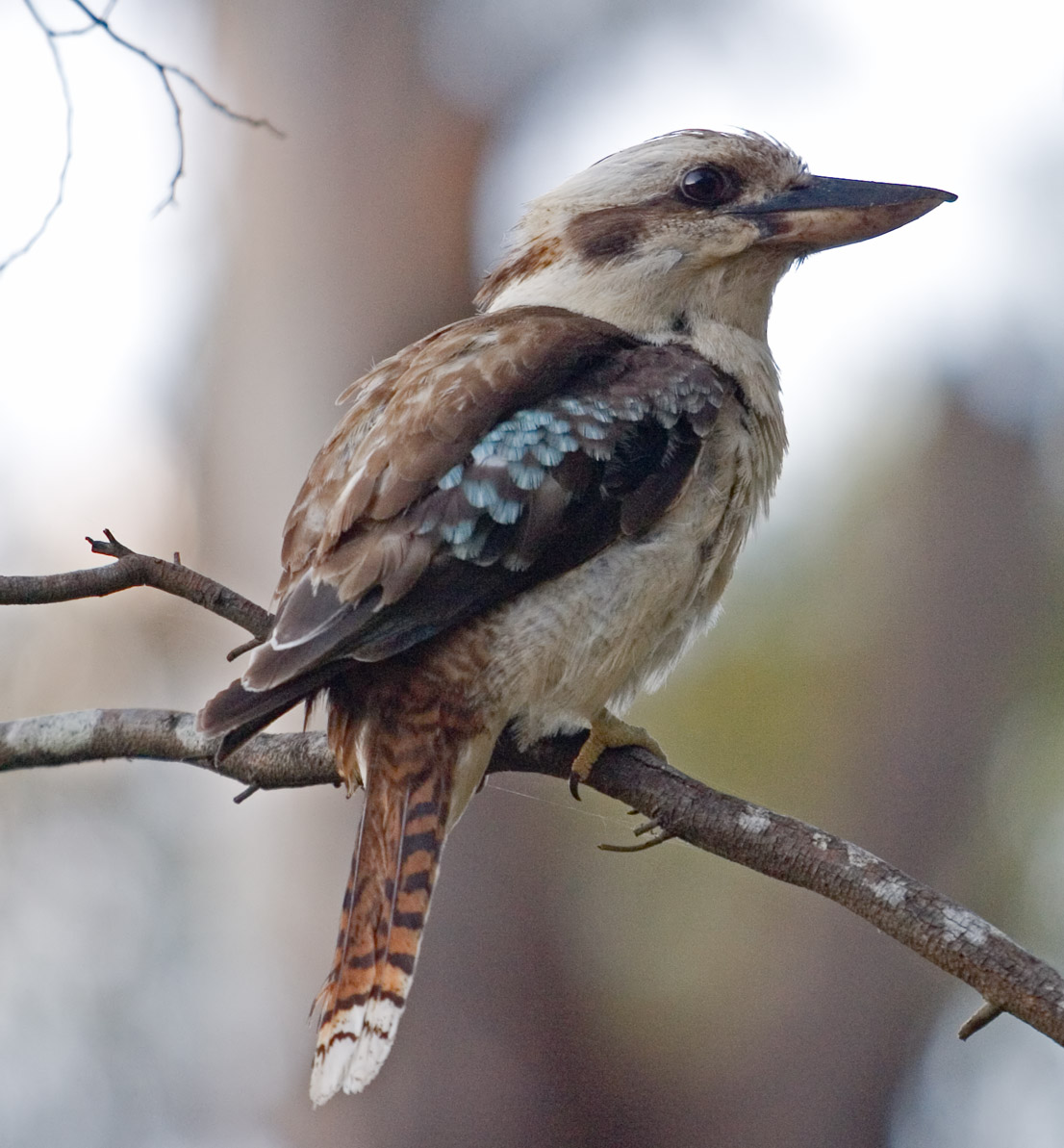
The laughing, cackling call of the Kookaburra used to be an identifier for Radio Australia, which has been off the airwaves for several years. The Kookaburra can again be heard, however, on religious SW broadcaster Reach Beyond Australia.
Photo from Wiki, taken by Diliff.

One of the coolest things about long distance radio listening in general, and Shortwave radio listening in particular, is that it is like travelling all over the PNW, all over the US, and all over the World -- without ever leaving your chair. You hear the signals bouncing to your radio from hundreds, and even thousands of miles away, coming from stations that may very well be on other continents -- even on the opposite side of the world.

For example, I have often heard China Radio International broadcasting to Europe from Kashgar, Xinjiang, China -- a city and region that is in the far western part of that country, and is on the near opposite side of the world from me --11 time zones away. By the time the Kashgar signals have reached my radio -- whether the signals are coming off the front OR the back of their beam -- they've literally crossed half the world.

Early in the morning on May 26th, I was up early (I was still recuperating from my week long illness), so I switched on my Radio Shack 200629, and clipped the indoor wire antenna to the whip, plugged in my headphones, and tuned around. I tuned into the 20 Meter ham band, which was amazingly in working condition at that hour of the morning (3 a.m.+), and heard some stations calling CQ, as it was a CW (Morse Code) radio contest, where ham stations try to get as many contacts as possible.

I heard DA3DR (a German ham) trying to contact Statesiders on 14055 kHz, and his Morse Code signal had a "Polar warble" or slight "Polar flutter", caused by the Auroral Radio Zone. On 14049 I heard K3LR (located in the NE US) calling CQ, and on 14034 I heard Japanese station 7K1MAN, which was cool to hear, as Japan, like Germany, is pretty far away.

Then I tuned to the 25 Meter SW Broadcast band. I heard North Korea (the Voice of Korea) on 11710, with distortion in their signal (they've been having issues with their transmitters over the past few months... it comes and goes). North Korea is always interesting to hear because their music is well produced, but it's also fairly unique to North Korea -- they'll have lots of chick singers with operatic style vocals, and all sorts of backing, from full orchestras to rock bands with horns and strings. North Korean music -- at least that North Korean music on the Voice Of Korea -- sounds like Mitch Miller or the Ray Conniff singers with a Motown bassist, fronted by female opera singers trying to sound like ABBA.

You get the idea. 

On 11780 at around 1050 UTC, it sounded like a religious service in Portuguese, including some folk hymns. The only station that fit was Radio Nacional da Amazonia, and being that it was Sunday morning, I suppose the programming would fit.

The banner / logo for The Voice Of China (known by US SWL's as CNR-1) from the top of their website.

I tuned up the band and heard China's national radio network station CNR-1 and VOA's Chinese program battling it out on 11785, and CNR-1 battling it out with Radio Taiwan International on 11730. China often uses CNR-1 to drown out the Voice Of America, Ratio Taiwan and Radio Free Asia, and during mornings it's usually audible here in the NW US, sometimes with snippets of the other station behind it. On 11795 I heard KBS World Radio's (South Korea) broadcast to South America in slightly accented Spanish (1148 UTC)... You get the idea, the bands were lively that morning.

A CHINESE RADIO PROGRAM FOR KIDS
On 11885 at around 1158 UTC (458 a.m. my time) I heard CNR-1 and PBS Xinjiang and a third station all occupying the channel at the same time, with one of them playing some decent music -- and at the top of the hour I heard three separate sets of time 'pips', and all three stations switched off instantaneously, and there was nothing but static. On 11785 there was a Chinese program (CNR-1, I think) with a woman talking in a kid's voice ("Mama! Mama!"), with happy sounding, light music behind her talking -- it was obviously a kid's story. 

I've heard this a lot on CNR-1. I've often wondered what the kids' stories are about.

Here in the US, anything on radio for kids is consigned to a few religious programs that might run inspirational kids' shows and radio plays, very early Sunday morning. Otherwise, kids' radio programming left the air when Radio Disney yanked the plug on all of their stations in 2015. Children are just another demographic that Radio finds useless, because there is no money to be made from broadcasting to them.

A lot of SWL's seem to tune past CNR-1, viewing it as just a jamming station to note in the logbook and then ignore. However, I've found some of CNR-1's programming interesting, even if I don't know more than seven words of Chinese (Wuh = me, Ni = you, Wuh-men = us, Ni-men = you all, Zhongguo = China, Dien-tai = Broadcasting, and Ni-hao = "hello"). In the early 2010's, every early morning there was a low voiced dude who always spoke softly and closely to the mic, talking over a music bed of romantic piano. I think it was CNR-1's overnight program. I haven't heard that guy -- or that sort of program -- in eight or nine years. CNR-1 is at least two things: well-produced, and it's got a great signal.

Reach Beyond Australia's former, but colorful logo.
From SWLing Post

ANOTHER TONGUE FROM THE POLYGLOT
After I tired of the kid's show, I tuned my Radio Shack 200629 down a few kilohertz, to11875 kHz, around 5:10 a.m. my time (1210 UTC), and I heard a man talking in a very strange language that I'd never heard before.

Now, having listened to Shortwave for several decades, I've heard a LOT of languages, and learned to ID many of them, and at least ID the region if I can't ID the language. I've heard Spanish, Russian, German, Dutch, Afrikaans, French, Hausa, Amharic, Somali, Tigrinya, Swahili, Portuguese, Chinese, Japanese, Korean, Mongolian, Viet, Burmese, Inuit (back when the CBC Northern Service was still on the air a long time ago), Hindi, Urdu, Pashto and Dari. I've heard Punjabi, especially on US AM radio stations that program in Punjabi, and I've probably heard that language on SW as well. I've heard Sindhi on SW. I've heard Tamil (on SBC Singapore, which no longer is on SW). I've heard Tagalog and Malay and Bahasa Indonesia. I've heard Pidgin English (on the Solomon Islands BC and the SW station that used to serve Papua New Guinea). I've heard Fulani and one of the languages spoken in Mali, Bambara. I've heard Arabic.

More than half of those languages I can ID. With the others, I generally can at least ID the continent or region where the language is spoken. Sometimes, though, I am clueless about the language. Burmese always throws me off, as does Mongolian. I never can seem to ID those two languages well. I always have problems ID'ing the Afghan languages Pashto and Dari. They're like a puzzle to my ears. It was the same with this language I heard on 11875. I looked up the frequency on my trusty EiBi SW schedule (a very handy tool to keep on your smartphone or tablet computer). 

It turned out that the station I was hearing was Reach Beyond Australia, a religious broadcaster I've heard maybe twice before, beaming a program in a language I had never heard of before: Nga La.

A pic of Chin State, Burma (Myanmar), a mountainous region near the Indian border. People who speak the Nga La language -- or Nga La related dialects -- live in both Chin State and India's Mizoram State just across the border.
Pic from Wikipedia, photographer: Corto Maltese 1999

EiBi has a "ReadMe.txt" file you can download alongside your Frequency Schedule text file. Both are handy to keep on a tablet or phone. The "ReadMe.txt" has a listing of languages, country codes, and transmitter locations for most of the SWBC stations in the world. You can get the EiBi text files at eibispace.de.

I looked up Nga La in the EiBi readme.txt and it said that Nga La -- also known as Matu-Chin, apparently -- is a language spoken by hill tribes in the Chin Hills region bordering western Burma and India's Mizoram State -- a small area maybe the size of the state of New Jersey, south of India's Assam tea region, and maybe a couple hundred miles east of the Bangladesh coastal city of Chittagong.

And -- get this. Nga La has maybe 40,000 speakers, total, in the World. Some estimates are more like 70,000, if related dialects are included. But you get the idea. Nga La is not a massively spoken language.

Think about it. The people running Reach Beyond Australia are programming half an hour of radio, every day, to a tribal language group that is less than half the size, population wise, than my suburb of 100K people!

I personally wouldn't have know about the Nga La language, Mizoram (although I've seen it on a map before), and Chin State in Myanmar / Burma if it weren't for Shortwave radio. With all the stuff on the internet, I don't think I would have found any info on the language or the region where its people live.

A lot of people, especially  SW DX'ers, are really down on religious broadcasters. One SW DX journalist, who has a weekly radio show and web presence, habitually has referred to all religious broadcasters as "hucksters". On the Shortwave subreddit there are fairly frequent references to the religious broadcasters, and the comments usually weigh negative, although surprisingly there are a few guys on there who say they listen now and then out of curiosity -- and they realise that the religious programming on stations like WRMI, WWCR, and WBCQ helps keep the signals -- and the other, non-religious programs -- on the air.

A pic of Aizawl, the capital of India's Mizoram state, where a lot of Nga La speakers apparently live (or at least speakers of Nga La related, mutually intelligible languages live there). Although Mizoram and Chin states are tropical, because most of the terrain is fairly high up in altitude, temperatures range between 60F-80F, year 'round (15-20C). 
Pic from Wikipedia, Photographer: Nggcha

I personally have no issue with the religious preachers, even if there are some that I do not agree with. I don't always tune into the preaching shows, however. Sometimes they're a little toooooo out there for me. In my view, if one doesn't like the programming, every SW radio has a dial....

But still, these religious broadcasters are important, despite what many may think, because they keep the SW stations on the air, and -- face it: THEY ACTUALLY BELIEVE IN THE SHORTWAVE RADIO MEDIUM. I've even heard some of the religious preachers -- radio veteran Bob Bierman among them -- state that they believe in the medium of Shortwave radio to reach people.

They may not be your cup of tea to listen to, and maybe you disagree with religion, but the religious broadcasters actually believe that the Shortwave Radio medium is valid and useful to reach people with their message. They believe in the SW band as much as we SWL's do. After all, they're paying money to actually use the medium.

And they're doing it even to reach listeners in just one small language group, whose total number of speakers are less than that of an average American city.

And this comes at a time that, right now in the US, there are many who no longer believe in the relevance of Radio, period -- be it FM, AM, or SW. In fact, depending on how one views the data, increasing numbers of listeners in the US also apparently think that Radio is no longer relevant as a medium. The US Radio audience has declined by 10% since 2012, and it may still be declining a certain percentage each year. The big Radio companies that are on the stock market have seen their stock prices plummet, because investors do not see Radio as a terrific investment anymore. Values of the radio stations themselves have dropped -- even many big city FM's are worth less money, when accounted for inflation, than they were worth 20 years ago. Furthermore, advertisers sometimes treat Radio like a redheaded stepchild. 

Meanwhile, the religious broadcasters still think that Radio, including Shortwave Radio, is a valid means to reach people with your message.

Some of you may not like the message, but before you knock the religious firebreathers too much, remember -- they actually believe in the medium that you like to listen to.

Anyway, because of the fading on Reach Beyond Australia's signal (after all, it was coming from about 12,000 miles away), I switched my antenna from the Radio Shack 200629 to my Tecsun PL-398, and tuned in 11875 on the Tecsun to see if the Tecsun's DSP would make Reach Beyond Australia's program more readable. It did help. It was one of those cases when the DSP really works wonders in resolving the signal.

I listened closely to the language, which seemed to be a mix of SE Asian language sounds (think Viet or Thai), with a little bit of Hindustani language sounds mixed in. Most of what I heard was a guy talking -- probably preaching. The signal level was SIO 2-352 with fading. The guy stopped talking and there was a folk song -- presumably a hymn -- sung by some girls backed by a small pop band.

Then a guy gave what sounded like a web address.

The clock on my Tecsun hit 5:29 a.m., local time, and 1229 UTC. An older woman started speaking, and she mentioned "kilohertz", so she was probably giving the station's Nga La broadcast schedule.

Then I heard a full sign-off from Reach Beyond Australia: "...Thank you for tuning into Reach Beyond Australia.... on the 25 Meter Band." Right after that, there was the sound of a Kookaburra, and then the signal cut off promptly at 1230 UTC.

The Kookaburra's cackly call was used by Radio Australia before the Australian government pulled the plug on them. It's cool that this religious broadcaster is using the same sound as an identifier.

Reach Beyond Australia's current logo. 

SO EXACTLY WHO ARE REACH BEYOND AUSTRALIA?
Reach Beyond Australia is apparently an offshoot, or continuation of the old HCJB radio station that was famous for running out of Ecuador in the 1960s-90s. The Australian operation broadcasts in 20 different languages, including some -- like Nga La / Matu-Chin (or just "Matu") -- that I never even heard of. Obviously, they are intent on reaching people in Asia for Jesus Christ. 

On their website they say that they are especially interested in reaching out to people in Burma, like the Matu / Nga La speakers, the Rohinga people, and the Burmese people, with daily services in those languages and others like them.

They must think that the Shortwave medium is worth it, or they wouldn't be doing it. On their website are pictures of the antenna farm, near Kunanurra in the Kimberly region of far NW Australia. Looks like a sunny place, and there are more trees there than I had envisioned. Here is a link to their main website.:


The location of Reach Beyond Australia's SW transmitters is just 6 kilometers west of Kununurra, and it's easy to see on a satellite map. Just follow the main road (the Victoria Highway) west, over the Ord River (located right next to the city), and then aim your browser map a bit SW of the bridge that crosses the river. The transmitter site shows up fairly well on a computer mapping app -- a semi-circle of tall towers, which you can spot by their shadows on the ground.

And if you're interested in tuning in this station -- even if it's just to hear the languages, here is their current schedule.:

Although the religous programming coming out of US domestic broadcasters is of marginal interest to most DX'ers, the foreign language broadcasters are a different matter entirely. I've heard Trans World Radio and Adventist World Radio, and their foreign language broadcasts usually have interesting sounding music -- and the fact that a lot of the broadcasts are out of MADAGASCAR is pretty cool, as it's nearly on the opposite pole of the World from me. US religious broadcaster KNLS / New Life Station broadcasts out of Alaska in Russian to Siberia, and they play a lot of cool pop music from the 2010's and the 1980's. And they also broadcast to European Russia from Madagascar, too, and I've heard a few of those broadcasts -- basically coming to my radios from 12K miles away.

Reach Beyond Australia seems similar in scope. They broadcast in interesting sounding languages, and they play interesting music -- usually they seem to be simple church hymns sung by regular folks. Where the station got the girl group singing a hymn in the Nga La language I have no idea. If there are only 40K to 70K Nga La speakers in the world, that's a small population to put together a singing group. But somebody did. Perhaps it was a local congregation in the area.

SHORTWAVE LEADS TO AN INTEREST IN LANGUAGES AND GEOGRAPHY
To bring this back to the first subject breached in this article: Radio has always been a discovery medium for me. When I was a little kid, and when I first heard radio stations from Oregon (which, to a 4 or 5 year old, seemed like a foreign country), I instantly wanted a map to see where Grants Pass was; where was Albany and Lebanon, Oregon? Where was Corvallis? Where was Eureka, California? 

MW DXing made me interested in geography, and other places. And then, a few years later, when I discovered the Shortwave band, I was digging through the National Geographic maps that my folks stored on the bookshelf, and then using my big World Atlas. I wanted to see where the Netherlands Antilles were, and where the Netherlands was (after all, Radio Nederland's shows were produced in Hilversum. So I looked it up on the map). I wanted to know the geography of South Africa -- Johannesburg, Germiston, Springs, Boksburg -- I saw them on the map when I heard Radio RSA. When I heard Radio Australia, I pulled up the map of Oz to find Melbourne and Shepparton.

Whenever commentators on Radio Moscow talked about the Soviet republics, I'd pull up a map and see where those places were.

I also developed an interest in languages from hearing them on the Shortwave bands. Like I said, on Shortwave you hear a LOT of different languages, even today.

Although there is a ton of information technically available on the internet, I wouldn't have learned about a language -- Nga La -- that's only spoken by 40,000 people if it weren't for Shortwave radio. And I use the internet daily, like many people do.

I'm not certain how much the truly worldwide reach of the internet really helps people get an understanding of other countries -- be it their geography or languages and culture. I say this in the light of the fact that search engines -- the most basic of research tools -- simply aren't what they were just 15 years ago. The WorldWideWeb has turned slowly into the WorldWide-AI-Boosted-Shopping Mall. Social media connects people, but how much connecting does it really do?

I realize that a lot of the old SW broadcasters have gone online. I wonder if their audience has grown since it's gone web-only. I've never seen the data for it, but I have my doubts that audiences for the online version of Radio Canada Int'l or Radio Nederland are any bigger than they were when they were using the Shortwaves.

Going online didn't help Radio Disney, and they hyped up their stream quite a bit before pulling the plug on Over-The-Air Radio. Their stream barely lasted 5 years. Apparently the listeners didn't follow them over to the streaming site.

The internet is a terrific place, and a great tool for learning and exposure to other peoples and cultures. However I sometimes wonder if it's as effective at world discovery today, as turning on a Shortwave radio can be.

IN OTHER LIFE.....
I'm feeling better than I did a week ago. I'm pretty much recuperated from whatever bug I had. I went out for a bike ride this morning -- the first one in three plus weeks -- and that's progress. My trusty car, however, is simply not so trusty anymore. It appears to be turning into a money suck. The fuel system is fine, but it looks like the temperature sensor is faulty, and the computer that runs the car won't run anything correctly if it doesn't see the right temperature. 

This is what happens when you let a computer run your car.

Otherwise, there are a few positives. The weather is improving. As I finish the first draft of this article, it is a sunny morning and it's supposed to be 70F later today.

Weather is OK, and I'm still alive and kicking. Can't beat that, can you?

ONE OF OZ'S BEST EXPORTS, THE BAND DIED PRETTY
I'll close this with a track by an Oz band that I really got into in the 1990's. They're a lesser well-known band, but were one of the best rock bands to come out of Australia. In fact, I first heard of them on Radio Australia: Died Pretty.

Their singer, Ronald S. Peno, had a unique way with words. The words didn't need to be 100% coherent -- the sounds of the words mattered almost as much. I guess Mr. Peno was into poetry, which adopts much the same attitude towards the use of language.

This is their liveliest official video, with a song off Lost, their 1988 album, which was also released in the US. It's called Winterland. Mr. Peno's singing is sort of like Bob Dylan meets Iggy Pop meets Bon Scott meets Jim Morrison:


This is the first song I heard by them, on Radio Australia's Soundabout program, Towers Of Strength.:


This next vid is of the second track on Died Pretty's Lost album, which I played quite a bit in the early 1990's. It's sung by the guitar player and co-songwriter, Brett Myers. It's called Out Of My Hands.:


This track has no active video, but the song is probably one of their best. It's called As Must Have. 
The music actually was an influence on my own songwriting.... plaintive chords, with a lot of E Minor 7ths. Welcome to the Ronald S. Peno method of lyric writing. Mr. Peno unfortunately left us all in August of last year. Mr. Peno, you had a way with words.


This is the best track off Every Brilliant Eye, the Died Pretty album that came out in 1990. The album didn't get much, if any airplay on alternative radio in the US unfortunately, but it should have. One enterprising fan managed to decipher the lyrics to this one -- they're in the comments.

Here's to all this madness, this breeze is blowing cold
The Bible has its new brew, our world has lost its soul....


Well, that's it for now, folks.

Until next time,
Peace.

C.C., June 1st, 2024.


Wednesday, May 29, 2024

May Showers, Solar Flares, et. al.

My flag flies again on Memorial Day. Grey skies, moderate temperatures, hey -- it must be the end of May!

As I start this article, it is around 65F out, and it's lightly raining outside. It's mid-morning here. The neighborhood's rhododendron farmers (folks who have a few rhodie plants out in their yards) have done well -- there are less of them than in previous years, but their bushes are blooming, finally. And yes, you heard that correctly -- there are less of them than before.

There used to be a street in my neighborhood where maybe half of the homes had awesome rhodies, and I have posted pics of those as recently as 2018 or 2019 here on my blog.
 
Here is a couple of those photographs. All the bushes in the next two pictures no longer exist, sadly.:
 
One pic I took in May, 2015, and which I posted on a blog article here back then. All of these beautiful rhodie bushes are now gone. They were torn out some time last year. :-(
I took this picture in April, 2015, and posted it in my blog that month. In fact, it was April 15th. The rhododendrons started flowering a month earlier than they did this year. All of these beautiful rhododendron bushes were torn out maybe two years ago. 
This is a rhododendron that was full of awesome blooms this year. I took this pic in May, and this bush is in one of the few yards where the owners kept all their rhodies intact. :-)
Here is a mixed rhododendron, on a moderately warm, grey morning in May. There were a lot of bumblebees checking out the flowers, but unfortunately none of the pics I took of them came out well. The little guys would either hide inside a bloom, or fly away just before I could get them in focus. This is the one yard left in my neighborhood that has all of its rhododendrons intact.

But over the past two years or so, a lot of those beautiful, tall rhododendron bushes were torn out by more than one neighbor, for unknown reasons. I don't know why anyone would tear out a rhododendron bush, but they apparently do. There used to be about four or five yards in my neighborhood that had 4-6 rhododendrons, and they were always a beautiful thing to see every mid-April. Now there is just one neighbor who has about four or five bushes -- the other neighbors who had multiple rhodies had them removed.

On a personal level, I'm still dealing with the aftermath of tax season, and I'm still recuperating from an illness I got a week and a half ago. And no sooner than I got my car back from the shop after a serious repair to the leaky gas line / dying gas pumps / clogged gas filter, etc., a tire went completely flat. As they say -- when it rains, it pours. My fiction writing has halted, due to the recent illness and a serious case of writer's block. Maybe I need to drink more coffee? I still play my guitars -- both 12 string and electric, but it's mainly to keep the ability going, and relearn a few acoustic songs I wrote in 2011-2013. 

My cat is doing O.K., although she still demands that I watch her eat. 

What was left of the Great Aurora by the time I photographed it. I missed seeing the colors, but I did see these haunting looking rays projecting upwards and outwards from the North, at the time I took this picture on my Nikon L32, around 3:30 a.m.. I wish the rays of light would have shown up in the photo. Oh well.

SOLAR FLARES & THE GREAT AURORA
On the radio side of things, the night-time, long distance radio conditions have been mediocre, with a few notable exceptions. As always, even when overall SW conditions are mediocre, there are some surprises. 

As most MW and SW DXers know, we had a massive Solar Flare about two weeks ago, on May 10th -- the biggest one in 20 years -- and it wiped out all of the SW bands, turning them to quiet hiss. The night of the biggest Flare (and the Aurora, which I could just see early in the a.m.) produced just one SW station out of Mexico, that I could barely hear on two of my radios (my XHDATA D-328 + wire, and Panasonic RF-B45 + wire), so I know it wasn't some sort of overload image. Besides, the MW band was mediocre, so no MW stations would be strong enough to overload SW -- and they don't play Mexicano folk music, which I did hear on 6185 kHz, fading in an out in the grainy, Auroral static. 

So here's to Mexico's Radio Educacion: you were the only station on SW heard in my part of the world during the 'killer' Solar Flare. PS, your music and programming is cool.

Since the Solar Flare of May 10th subsided it's still mostly poor to fair DX conditions on the MW and SW bands, so even though I tune them to see what's out there, it's not like I'm hearing a ton of new and interesting stuff.

The MW band in general has been sounding like poor summer evening conditions since the flare, although I did hear a Las Vegas station really well a couple nights ago, KMZQ, on 670. It was the loudest and most consistent signal I'd ever heard from that station. Other nights? It's nothing but staticky hiss in KBOI Boise's extremely tight 'null' spot on 670. And for those not acquainted with 'nulling' a station, it's what one does on the AM band to reduce one station's signal to nothing, so you can hear a second or third station in its place. It's a trick I discovered on my Sanyo M9926 Boombox in 1983 or so. I had read about it previously, but hadn't actually tried it.

Even a simple AM-FM-SW radio like this XHDATA is probably capable of FM DXing, as this radio pulls in FM almost better than most of my other FM portables, thanks to an excellent DSP chip inside.
This XHDATA D-328 pulls in a few fringe region FM stations really well at my location, just off the whip antenna. No real FM DX on any radio, yet, though. A lot of FM DX depends on location, location, location.

On the FM side of things, I haven't really done any attempts at FM DXing, although in other parts of the US there are guys who have started doing it. Spring and Summer are apparently the best times to hear Ionospheric E-Layer skip on the FM band, which is a bit more sporadic than the D- and F-layer skip that we MW and SW DXer's experience. Some of the catches FM DXer's get in other parts of the country are fairly spectacular, considering.... One WA state FM DXer has heard most of the Western US states on FM. Any time I've tuned around it's locals, fringe stations, or nothing. Sometimes Tropospheric 'ducting' will bring in Canadian stations from Victoria fairly well -- well, two of them. One time I heard a station out of The Dalles, Oregon -- I can't remember which one. It had to be either really good Tropospheric ducting, or perhaps some E-skip, as The Dalles is over 200 miles away and there are a lot of mountains in the way. That station is my best catch on FM, on my GE Superadio 1, a long long time ago.

I suppose I should try a lot more at the FM DX hobby. Some day, maybe....
 
I've also entertained the notion of eventually becoming a ham radio operator, although I don't presently have the finances to get a decent rig. If I do eventually take that step, it will be some years away, when finances permit. I already know that it would be a simple, bare-bones operation. One simple rig, a code key, and one simple antenna. Make the best out of whatever you've got.

But I have other, more pressing tasks to deal with before I even consider something like that.

My mystery bush -- some sort of Wild Rose, I think -- that blooms around this time every year. A friend of my father's planted it next to our birch tree one year a long time ago, and it's bloomed every year, ever since.

Despite the mediocre SW and MW conditions, things did improve over the past week or so, and there always are a few gems that appear even when SW and MW conditions are mediocre. The DSP in the DSP radios can help, but I've also done a lot of listening to two of my analog portables, my Panasonic RF-B45 and Radio Shack 200629, and the readability of the weak SW stations is still pretty good -- usually more than enough to ID the station. 

The ham bands have been a wash, before, and after the Solar Flares. 160M, 80M and the bands above 20M have been mostly dead with few exceptions. 20 meters has had a few DX stations present on different afternoons and evenings, but it hasn't exactly been slammed with signals.

30M sometimes has a CW QSO, but the past few nights the 'beacon' to the EU, the RTTY station at Pinneberg, Germany (10100 kHz), has been MIA. The other beacon, NAU, RTTY in Puerto Rico (10155 kHz), has been in at varying strengths.

In the past weekend (May 25-26), SW conditions did pick up. I heard several Japanese hams on the 41 and 20 Meter band during a ham CW contest, and I also heard a German ham and a few American guys talking about stuff. I also heard Reach Beyond Australia, broadcasting to a small population of people in the hills between India and Burma, in a language I'd never heard before (Nga La -- maybe 40,000 speakers total). That was cool. Reach Beyond Australia transmits from the old Radio Australia transmitters in Kunnunura, in the Pilbara region of Western Australia. Like Radio Australia, they use the cackle of the Kookaburra bird in their ID's. Pretty cool.

The DX-350A radio -- like a lot of smaller portables -- sometimes can overload on really strong SW signals. At the same time, just using the whip antenna sometimes just isn't enough to bring in a lot of stations on the SW bands. Clipping a wire to the whip antenna can help, but it can also overload the radio's front end amplifier transistors.
Placing resistors in between the wire antenna and whip antenna can help with this. The resistors lower the signal levels just enough to keep the radio from overloading.
I'm using two resistors here because I didn't have a small enough value one. 200-500 or 1000 ohms or so would probably be just right -- both of these resistors were over 33K ohms. Clipping them in parallel like this dropped the resistance to around 19K ohms. It got the job done -- it worked!

USING A WIRE ANTENNA WITH MY REALISTIC DX-350A
& NO OVERLOAD!
After a while of not using them, I fired up my Realistic DX-350 and DX-350A earlier this past week, trying my indoor, 25 ft. wire antenna by clipping it to the whip. Normally, the 350A would overload with a wire antenna, but this time I had my drop-down resistors that I rigged up to experiment with, and the results were pretty satisfactory. It's pretty easy to rig up an antenna drop down resistor -- all you need is an alligator clip. Being that most alligator clips have set screws, there is no soldering necessary. Run one resistor lead through the 'handle' of the alligator clip, loop the lead around the set screw, and screw it down, and make a small loop or hook with the other resistor lead to give your wire antenna's alligator clip something to clip onto.

It worked really well. My 350A, as I mentioned, will often overload on SW if you use an external wire antenna. Sometimes you'll get lots of extra hiss and FM transmitter hash (one of the two major FM transmitter locations is about 5 miles N of me, and it can slam the 31 and 25 Meter bands with hash in a couple places). 

With the drop-down resistor, the overload was eliminated. I had to use both of my resistors in parallel because the only ones I had in my parts box were pretty high value -- 47K ohm and 33K ohm. Ideal resistance would be 250 ohms to 1-2K ohms or so. But with both of my resistors in parallel, I got roughly 19K Ohms, which wasn't bad. It got the job done.


PANDORA: WHERE 2010's E.D.M. POP LIVES STILL
As I've stated here on this blog in the past, for some reason the pop music of the early 2010's really appealed to me, and -- to be honest -- it still does. I wrote a blog about this over a year ago, where I was commenting on the general state of music at the time -- and to be blunt, the general state of popular CHR and rock music hasn't really improved. There are a few bright spots here and there, but overall, it seems about as dull as the grey weather outside.

And the pop music of 2012 was so upbeat, so emotion-tinged, so technically concise, so well produced and put together, and often technically edgy -- but it was also so easy to listen to and enjoy. And, face it -- much of it was PARTY MUSIC. Nowadays, the pop music isn't really party music. Neither is the rock music. Country music has its party moments, but it's not really my cup of tea.

The autotune which was popular in the 2010's was overused, but it gave the singers a nearly super-human quality to their voice. They sounded more AI than AI, but in a good way. Every note perfect. It seemed to fit the high tech tenor and delivery of the computer-driven EDM music that backed the singers.


2010's pop is miles from Rose Tattoo, of course (and Rose Tattoo is my favorite artist anymore), but it's still good. The pop music today is nowhere near as fun.

Where is Pitbull when we need him around?

On local FM radio today the 2010's hits that were so cool to hear -- Katy Perry's Part Of Me, Cobra Starship's You Make Me Feel, Calvin Harris's Feel So Close, Taio Cruz's Dynamite, Ollie Murs' Heart Skips A Beat, and the like -- get rare airplay, and some of them get NO airplay because they didn't pass the radio company's beloved "research". 2010's pop hits also are too new for Classic Hits and too old for Recurrents. It may take ten more years for a 2010's heavy pop format to show up on FM. And some songs that were so cool back then -- anyone remember the Gym Class Heroes? Or Andy Grammer? -- would never make it to a 2010's Radio format because everything on radio is researched to a crisp.

Well, rest assured, yours truly has discovered the appeal of streaming. My Android phone came with Pandora installed. I never used it until this weekend, when I decided to give the service a spin. I mean -- it's on my phone, so why not try it? So I did. Instantly, I was taken back to 2011-2012, when I discovered Pop Music again.

Within minutes I heard the Chainsmokers w/ Daya in Don't Let Me Down, Nick Jonas's Jealous, Taio Cruz's Break Your Heart, Nico & Vinz's Am I Wrong, and Ke$ha's Tik Tok, Nicky Minaj's Starships, One Republic's Counting Stars -- you get the idea. A lot of them I hadn't really heard before, like Flo Rida's Wild Ones. I'd heard a couple of his other hits but not that one. And I heard Pitbull within the first half hour -- on an Usher song. And Adele's classic, well-written hit Set Fire To The Rain played -- all within the first 45 minutes.

Here's a link to the 2010's Pop Channel on Pandora, for those interested.:

I can see clearly now, how Radio is being replaced, and redefined. 

Do I like it? Not necessarily. After all, I'm still a radio guy. I've always listened to radio, DX'ed radio, and I worked in the business for 20 years. You don't work in a business for 20 years and not have some feelings for its future.

But when I can tap an icon on my phone and hear my favorite, 2010's hits, one after another, do I like it? Well, yeah, I do like it. I see the appeal.

On the airwaves, an all-2010's pop channel probably wouldn't get good enough ratings to get a radio station agency buys. That's why there are no 2010's pop-heavy FM radio stations. But on a streaming platform, ratings isn't so much a concern that all music is researched to death. Online streaming platforms are a totally different animal.

Even the 'curated' music channels, like Pandora's 2010's Pop channel has a feature where you can give a song a thumbs up or thumbs down, so the algorithm will alter the music it sends to you. So it's like listening to a 2010's Pop radio station, where you can send in requests and they actually alter their playlist for you. 

I realise that for a lot of you this is already second nature -- as millions use Pandora, Spotify, and other streaming platforms. But I see now why people are into this.

Streaming platforms like Pandora have sizeable -- and growing -- chunks of the listening public for a reason.

I have heard the future, and the future is now.

Here's the Gym Class Heroes, by the way. The Fighter. Excellent song, released in late 2011. I heard it on local pop station KBKS 106.1 FM in early 2012. Wish I could find my CD copy of it. Better yet: I wish there were more songs being released like this today.:


In 2011 Andy Grammer said "Keep Your Head Up". I first heard this track on Radio Disney in 2012. Keeping your head up -- it's still a good idea.:

Yep, with inflation the way it is nowadays, we definitely have to keep our heads up, don't we.

I used to sing that Keep Your Head Up in karaoke at Uncle Mo's Pub in Renton back in the mid to late 2010's, sometimes closing the karaoke show with it. It's a good feeling song to sing.

As I pointed out in my second-to-last posting here, I was sick for a week. I'm mostly recuperated. This last Monday was Memorial Day. At first I wasn't sure whether I wanted to put my flag(s) out, which generally was my custom. Partly because it was going to rain, and partly because I didn't know if I wanted to risk my flags getting messed with or stolen. I was certain that one of my flags was stolen last year. I even wrote a post about it. I had literally thought it was stolen. But it turned out that someone had shoved it into the hedge, and I found it a while after I had written up the blog post.

I finally decided to go halfway, this year: I put out one flag, my newest one. And I kept an eye on it.


Happy end of May. 

Peace,
C.C., May 26th & 29th, 2024.