Monday, August 26, 2024

Top Billing Station WCBS 880 Flips To Sports -- What That Means For Radio in the US


WCBS 880 AM, a powerhouse station that New York City depended on for News. The station made almost $30 Million a year, and it was one of the top billing Radio stations, AM or FM, in the country.
A good reason to kill it, right? 
Right.

Over the past several months, I've posted articles here about AM radio stations in the US either going dark, or flipping to syndicated, automated formats like Sports Bet talk.

Since the start of last year, Bell Media in Canada turned off 6 or 7 AM stations; KNPT Newport Oregon (which had a stream and an FM translator) switched off permanently -- along with a couple sister, AM and FM stations; KUTI Yakima (ESPN Yakima -- an already syndicated station) turned off; CKGO Vancouver and CHQT Edmonton saw their staff fired and the two stations went to a simulcast, and may end up going off the air; 50KW station KDWN in Las Vegas went off the air permanently (their stream didn't help them survive); CHML Hamilton, Ontario went off the air permanently; another company in Canada sold off a ton of AM stations last year.

It seems that a lot of Radio companies are downsizing and AM radio is bearing the brunt of it; the others bearing the brunt, naturally, are the laid off airstaff and other laid off workers, the majority of whom will never work in Radio ever again.

So, as you can see, it's been a fairly dark year or so for AM radio in the US and Canada. In one case, where Bell Media got rid of so many stations (some of which had OK ratings), their leadership said that "radio isn't a viable media anymore". It seems that they no longer believed in Radio as a relevant medium with any future. 

It wouldn't be the first time, of course, that a large media company has shown that it no longer believes in Radio -- Radio Disney proved that when they sold off all of their AM radio stations, then turned off all their HD Radio channels nationwide, and then finally cut off their Radio Disney stream.

Radio Disney went from being an Over-The-Air radio player, to pulling the plug on all Radio operations -- OTA or online streaming -- completely in just under 5 years.


WCBS 880's most recent logo, used until Midnight, the morning of August 26th, 2024.

In many cases, the stations that I wrote about last year weren't really making enough money to stay in operation -- that was the case with KNPT Newport (50% decline in ad revenues after the Pandemic was over), and it is said the KUTI / ESPN Yakima had a deteriorating antenna system and it probably wasn't worth all the money needed to rebuild it. The return on investment just wasn't there.

Radio in general is in a tough spot economically. Anyone who is acquainted with the economics of Radio knows that. But it turns out that even if you are a Top Billing Station in the US, your owners will lay off staff, and flip the station.

And this has happened in the US's "Market #1", New York City. WCBS 880, a mainstay in New York City media culture, is flipping from All-News to Sports.

WCBS was a TOP BILLING AM RADIO STATION in New York City. They are one of the top 20 billing radio stations in the United States.


Here is a list of the Top Ten Billing Radio Stations in the United States, last year.
WCBS 880 is #10, with $29.7 Million in revenues.


And WCBS 880 was the #2 Top Billing AM Radio station in the United States last year, also (competitor WINS in NYC is FM as well as AM).
It naturally begs the question: What company risks throwing $29.7 Million away?

Here is a link to the RadioInk article where I got those two charts. It's a roundup of Radio revenues for last year.:

Despite the fact that WCBS 880 pulled in over $29 million a year, their owners have fired 22 people and have just switched WCBS to Sports -- with part of that programming being syndicated, and some of it appearing to be a simulcast of another station in NYC. And on top of that, they changed the call letters to generic and forgettable sounding ones, WHSQ.

On the radio forums there are all sorts of reasons given for this flip. "They're saving money this way" seems to be the general mantra. Being that WCBS's owners, Audacy, Inc., also runs WINS in New York -- another All-News station -- they figure that the WCBS newsies will migrate to WINS and WINS will get even more revenue from it.

And that begs the question: when you treat your listeners like shit, why are they going to stick around and migrate to one of your other stations?

After all, News is not confined to a Radio station. You can easily get your news from your smartphone or laptop computer. There are alternatives, and even older demos who love radio know about the alternatives, many of which are right on their phone.

Pissing off your listeners doesn't always work well. When Radio ditched several music formats for older listeners in the late 2000's -- Smooth Jazz, AAA, Oldies, Alternative Rock, Motown, Old-School R&B, Standards, Beautiful Music, and even other niche formats like Kid's radio and Heavy Metal -- many of those listeners left Radio completely, and went to streaming services like Pandora, Spotify and YouTube. 

If I want to hear all 2010's pop music (like Radio Disney used to play a lot), there's a Pandora channel for that. It's a great channel to listen to, if you want to slip back into 2012 when things didn't suck as much as they do now.  If I want to hear Metal, thanks to the local FM rocker pulling the plug on their HD2 Metal Militia channel, I just go to YouTube or Pandora for that kind of music.

No Radio necessary.

Here's the article I wrote on Radio Disney, and Radio Disney's demise. It is a capsule of everything wrong with Radio today.:

Thanks for giving me the finger over the last few years, Radio. I guess in a way -- by going online to get the music I like -- I'm giving you the finger right back. And I'm not apparently alone. Now, I still listen to radio. I still tune around. I listen to some talk, some music, a little bit of religious radio from time to time, and a lot of the Sikh prayer music at night on KVRI 1600, and sometimes the CBC. There's also an classic alternative HD2, as well as a Classical Christmas HD2 channel I like. 

But it is a bit jarring to read some of the attitudes of radio people towards folks in my age range (I'm a Generation Joneser), along with Boomers and Gen X'ers -- people who grew up with and love radio -- to where they seem to view us with disdain. If often feels like they are indeed giving us the finger.

And right now, WCBS's owners are giving the WCBS listeners the big middle finger. Despite the money they were making, they're cutting staff, cutting costs, and hoping that in the end it will still pencil out for the corporation.

I suppose time will tell.

For those interested, here is a link to ESPN New York's website, where there is a list of the shows on both WEPN 1050 and WCBS 880.:


The new logo for ex-WCBS, WHSQ 880. 


OK, IT'S A BUSINESS. BUT IS IT A GOOD BUSINESS PRACTICE TO KILL A MONEY-MAKER?
You know, on the Radio forums, they keep repeating the mantra that "Radio is a Business".

OK. I get it. It is indeed a business. And power bills, airstaff -- they all need to be paid. And that means you have to have ad revenue.

But what business -- that is making big money, and is a top revenue earner in its market -- gives the finger to its consumer base?

Of course, in Radio, they say "our customers are the advertisers -- you listeners are the product, which we deliver to the advertisers". OK, you're doing a great job, Radio. Too often you're telling your "product" -- the listeners -- to go away. You are giving your "product", the listeners, less reason to tune in to your stations, and many of them are indeed leaving. You really think your "customers", the advertisers, are still going to pay you for that smooth move?

Thankfully, my own livelihood is not on the line. My last job in the Radio industry ended on December 31st, 2006. Since then I've just been an interested observer with nearly 20 years of working in the Radio industry (a 3 month internship, 3 years at one station, 16 years at a radio format company) under my belt.

And -- for the life of me -- I just can't wrap my head around a company taking a gamble by killing a Top Billing Radio station in America's #1 city. It just doesn't add up.

But I suppose I could be wrong.

My headline poses the question: What does this mean for Radio in the US?

I think it's a sure sign of Radio's decline. If the industry truly thinks that Radio listeners don't really count -- even when you have a top billing station in Market #1 -- then you're going to increase the decline of Radio listeners.

Oh, and to those who run the Radio industry: The listeners aren't migrating to your online platforms. They're going to Spotify, YT, Pandora, and online podcasting. This includes older demographics (who traditionally love Radio) as well as the younger ones. They not only are finding Radio to be irrelevant because it's older tech -- they're finding it irrelevant because Radio is making itself irrelevant to the listener. From 2012 to 2022 Radio lost 10% of its listeners. They didn't leave just because of Spotify. They also left because Radio itself is too homogenized and blah to listen to.

The local rock station situation in Seattle is a classic example. Seattle is a Rock town. AC/DC sold out the 20K seater, Seattle Center Coliseum 4 nights in a row in 1981. Grunge was born here. 


Rock 98.9's Logo and website banner. The station lasted about a year and a half.

In 2016 there was a new station, KVRQ Rock 98.9, that played Rock aimed at Gen X, and the mix was better than that at the mainstay, KISW, which has an afternoon show of yakkers who play little music, and the yakking simply isn't that entertaining to listen to. Most of the Gen Xers and Boomers I knew who liked rock listened to Rock 98.9 instead. They liked the mix of music, and they preferred the artists that were 98.9's core artists (80's through 00's hard rock, with some Grunge, Nu-Metal, and classic Metal).

The owners of KVRQ Rock 98.9 didn't promote the station well. There were no billboards, no advertising. No real visibility outside of the FM band. They thought that just flipping the format and putting up a website was adequate.

It wasn't. Since then KVRQ Rock 98.9 turned into KNUC The Bull (Modern country); into KPNW (Alt Rock - AAA); and into The Bull (Modern Country) again. With none of these changes did the company ever advertise outside of the FM radio dial. They seemed to take it for granted that if they just put a format on the air, it would draw listeners.

Here's the 2016 article I wrote on KVRQ Rock 98.9 when it was still a new station in town.:

Many in Radio have lost touch with the concept how to grow and run a business. Part of that aspect is advertising your product, to gain more consumers or customers. Too many in Radio have lost it. They think it's 1970 and if they just build it, they will come. That worked in 1975, but it doesn't work anymore. Too many Radio owners seem to be stuck in a 1970's Radio mindset, combined with the early 2000's "just put up a website and we'll make tons of money off the New Economy" mindset. 

Neither mindset applies today.

For example, a lot of stations still "stunt" when changing formats. WCBS 880 didn't, but there have been some stations doing this as late as last year. It was pertinent in 1980 when people literally tuned the FM dial with analog tuning mechanisms, and could pick up a new station by chance -- but in today's smartphone, smartscreen, virtual pushbutton environment, the idea that people are tuning around on the dial looking for something to listen to are long gone.

The days of "stunting" to flip a format were over 15 years ago, but some stations still do it.

News flash: Today's radio listeners don't tune around anymore, looking for new stations. The older demographics that Radio experts make fun of do that, sure, but your 18-49 demos don't do that anymore. 

They go online.

That's why you need to advertise.

Wake up, Radio.

A VID CLIP OF WCBS 880's LAST MINUTES
I will end this article with a vid taken by a guy on a radio forum I go to, a guy named Dalton, who lives in Pennsylvania. Like me, he likes older radios, and he likes AM radio. He recorded this clip of WCBS signing off for the last time, on a classic old 1960's AM portable radio. During the clip, one of their announcers is telling a tale -- a tale of how he always loved WCBS ever since he was a kid -- and he ended up working there. His voice is the last one heard before the WCBS ID at Midnight, and the plug is pulled, before the station ID's as "WHSQ".

Because there seems to be an issue with Blogger's YT search function (they changed it, and their Blogger/YT search function is basically broken -- all results, instead of being specific, are now completely useless), here is a link to the vid. It's worth checking out.:

EDIT: I found a way to embed the YouTube video. Had to use quotes around my search terms. The panel should play when you click the arrow.


IN OTHER LIFE....

My two cats I lost last year and this year: Fluffy is on the left, and Squeakers is on the right. They were pals. As you can tell, I was working on my GE Superadio 1, and also had some cleanup to do. You can tell I still read newspapers, and there were a couple books I was reading, too. The cats, of course, helped themselves to the table to take a nice rest from playing mouse. 
This was in 2011. Such a long, long time ago.

In other life, yeah, it's been pretty shitty around here. My cat Squeakers died, and I had to bury her earlier today. It really sucks to lose your little friend, after dealing with her sickness for over a year, and all the joy she brought to my life before that. I still have a couple other cats, but Squeakers was my little pal.

Losing this one really hurts.

There's not much more to say.  I still have a few new articles written, that just need editing, and some pics added. I'll get around to it eventually.

C.C. August 25th, 2024.


Saturday, August 24, 2024

R.I.P My Little Friend


It hurts, of course, when your little pal is gone, and Squeakers was my little pal. She was sick for two years, got better, and then got worse, and nothing I could do really helped. She seemed to be getting better and stronger again last night, and when I checked on her this morning, she was gone. 

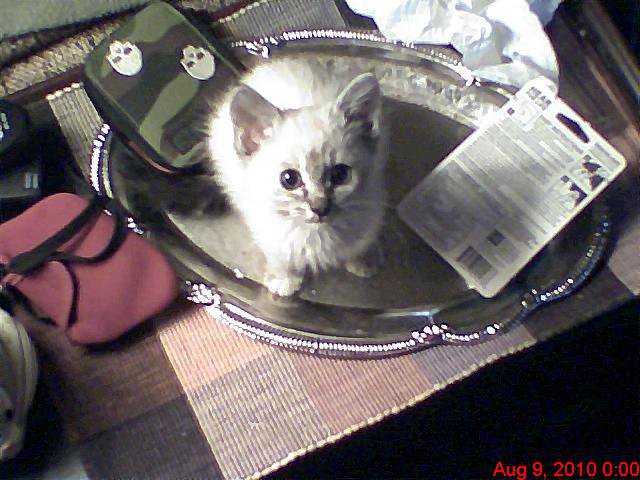
Squeakers was a good cat. My little friend. I got her on August 9th, 2010. She was still a very small kitten. My former girlfriend's son had her, they had gotten her for free when someone had a box of kittens they were trying to give away, standing with a box by the side of the road with a Free Kittens sign -- there were just two kittens left, both Siamese mixes -- and so they got the littler one. Soon they found they had their hands full with two toddlers and a big dog, and so my former girlfriend texted me and said "you want a playful, people kitten?"

I said sure -- and soon enough, Sheryl brought over Squeakers (top picture).

And Squeakers was indeed a playful, people kitten. She loved to play mouse (sixth picture), and she was a lot of fun. She truly was my little pal. She was also quite sensitive to my moods. She didn't like it if my Mom and I got into an argument (we both had loud voices). Squeakers would complain until we stopped. She also didn't like my bagpipes. Over time I sensed that Squeakers knew when I was stressed, which happened a lot when I was taking care of my mother 24/7/365 with very little sleep.

One thing I've learned is that Cats key in on your moods. Sometimes they respond to your stress. They really are good and true companions.

Squeakers died on August 23rd, 2024, roughly 14 years old. In cat years, that's a long time -- 72 cat years. I was hoping she would be around for another few months at least, at least a year or two longer -- but it didn't happen.

So long my little pal. See you on the other side. 


Tuesday, July 30, 2024

Radio Morning Shows Experiencing Decline -- another moneymaker for Radio is fading


KZZU-FM, Spokane, WA, was one of the Adult Contemporary stations that got rid of their local Morning show, to replace it with national syndication or podcast-based syndicated shows.

I frequent a couple different online radio forums, and on one of them a guy posted a link to an article in Billboard magazine, dealing with the decline of the Radio morning show.

Radio 'morning drive' shows, along with the 'afternoon drive' shows, historically were the biggest revenue drivers for radio stations. Many stations' fortunes revolved around the ratings of their Morning show especially. If the Morning show team split up, or somehow the hosts/DJ's lost their touch and ability to entertain, ratings dropped, and station revenues would be affected as well.

In this case, the Billboard article talks about several morning shows across the US and Canada losing their Morning shows, and replacing them with podcasts / shows from other regions of the country. This happened even when the shows were still apparently getting decent ratings. The problem is that Radio isn't making enough money to cover salaries.

One radio expert on the forum where I got the Billboard link said that the decline mentioned in the article also pertains mostly to Contemporary Hit Radio stations, whose ratings have seen gradual declines nationwide over the past couple years. Pop stations don't have the same pull that they used to. No one seems to know exactly why this is. 

In my view, it's probably a reflection of the decline in Pop music quality since the early part of the previous decade -- but that may just be my own musical preferences coming into play. In the case of the morning shows that are talked about on the Billboard article, the stations are not all Top 40. The Spokane, Washington station, KZZU-FM, is Adult Top 40 (normally known as "Hot AC"). So is CKCE-FM in Calgary -- they are "Hot Adult Contemporary". And, in the case of CKCE Calgary, the station apparently gets good ratings.

Either way, the fact is that there are issues with pop music radio, and Morning shows, and this decline probably will continue in other formats, as the Radio audience continues to migrate to online podcasts and music streaming platforms.

Here is a link to the Billboard story.:
Morning Radio Hosts Are Losing Their Jobs as Stations Struggle (billboard.com)


CKCE-FM's Logo. CKCE-FM is a "Hot Adult Contemporary" station in booming Calgary, Alberta, Canada.

This loss of morning personality shows mentioned in the article also hit fairly close to home, as Spokane, a city in my state, about 300 miles east of me, is where the KZZU-FM Dave, Ken & Molly morning show cast was let go in favor of a national, podcast based show (called Joey & Lauren).

Here is a link to KZZU-FM's webpage:

And here is a link to Joey & Lauren's show promoting website.:

They also have clips on their Facebook, here.:

THE PODCAST VERSION OF RADIO -- THE FUTURE
Joey & Lauren look like they're an entertaining, young married couple doing podcast radio and having the time of their lives. And this podcast version of radio seems to be the future of Radio, where everything is time shifted, nothing is actually live, and the average listener doesn't care. It's like voice tracking on steroids, because the podcast is often available outside the Over-The-Air Radio medium, meaning you don't actually need Radio to hear it or enjoy it.

In other words, with podcasting, you don't need Radio at all. This is the future, folks. Podcasting and Streaming -- that is where it is all headed. 

So, although the title to this blog article may be exaggerating slightly when it says Morning shows are 'fading' -- especially when they are being replaced by nationally syndicated shows and podcasts -- it really is accurate, because the concept of the local Morning show was a driver for radio listening going back to the late 1950's, and probably even further back than that. The local Morning show probably reached its apex in the 1980's and 1990's, when the concept of the "Morning Zoo" became popular -- where there were at least three on-air presenters, usually engaging in on-air pranks, talking about edgy subjects as well as day to day life, taking in a few callers, and the like. Many Morning shows still adhere to a version of the "Morning Zoo".

Here's a Wiki on the "Morning Zoo" concept.:

Now the concept is gradually being replaced, and it looks like it's going to be replaced by the Podcast. Podcasting is king. And a station subscribing to Podcasts, compared to having a Morning air-staff, is apparently a cheaper way of getting content on the air than paying any air-staff. And that's a big deal when Radio revenues are down.

Some shows I've heard, like the Free Beer & Hot Wings Show, a rock radio morning show, are navigating their way towards a completely webcasting and podcasting based model. I first heard the Free Beer & Hot Wings Show on Spokane's KJRB "The Bear" 790, before they drastically cut power at night, and then I heard them when Merced, California's KBRE "The Bear" 1660 adopted the show a few years ago.

Here's the website of the Free Beer & Hot Wings Show, and you can see that there are five presenters, and you need a subscription to watch the web feeds and hear the podcasts (although they do have a free podcast section on their site). It's an example of the Subscription-based audio entertainment model -- which is de rigeur for most content creators and content sites.:


Of course, the subscription-based audio entertainment business model has been a thing since the 2000's. Phil Hendrie had a website where you could subscribe and have access to MP3's of all his funny skits, and that was in 2005. 'Shock jock' talk host Tom Leykis also started a streaming site where he would conduct his show for subscribers only, when his on-air Radio show ended in 2009.

So the notion of a subscription based, web content "Radio" model isn't exactly new. But at the same time, it's not exactly the norm. But it's getting there.

This is the future of "Radio".

RADIO STILL TAKING AN ECONOMIC HIT
It's no secret that Radio has taken a big hit from the post-Pandemic economy, as advertising revenues have dropped. The post-Pandemic economic hit added to the previous decline since the mid 2000's, when Radio made about 60% more revenue than it makes today (when accounted for inflation in real dollars -- in nominal dollars, the drop is more like 25-30%).

This drop in ad revenues isn't just a Radio related phenomenon; it's also affecting other media -- be it print, or even online media like online newspapers and social media sites. Because the internet is the definition of market saturation, the law of supply and demand seems to come into play when it comes to advertising revenues: there is basically an infinite supply, and a nearly infinite number of advertisement slots on all the websites.

I go into some of these factors in my article Who Killed Radio?, which I published three or four months ago. You can read that here.:

The issues facing Radio, along with the processes, people, and decisions that have been aiding Radio's decline -- as described in that article -- are still ongoing today. The decline in Morning shows is an example of lower revenues and increased internet use combining to change the way "Radio" is consumed. And that trend will continue until it is all online, and there will be no FM or AM radio at all.

In the case of Calgary's CKCE-FM, the station replaced their Morning show "Mornings with Bo and Jess" with a podcasted version of another show out of Edmonton.

Here is CKCE-FM's website. It's fairly active with animated stuff, social media chatter, and the like.:

The saddest part of this story -- of Morning shows being replaced with national, podcast based syndicators -- is that most of the on-air staff who worked the Morning shows probably will never find air gigs in Radio again. If they already have a podcast, they may be able to survive via the internet, but -- as any internet content creator can tell you -- competition is nearly infinite, and selling online content is not always the panacea that many make it out to be.

As I've stated before, I'm in the indie, eBook publishing business, part time, and the indie publishing community is full of stories of people who sold thousands of books and maybe made a couple thousand bucks over ten years. It's a thousand bucks they wouldn't have had otherwise, but you don't always make a lot of money doing internet content.

In fact, most internet content creators probably don't make much.


CUTS IN MORNING SHOWS EVEN HAVE HIT CLOSE TO HOME, IN SEATTLE
The ad revenue issue and Morning show cuts have hit locally, here in Seattle, recently. Popular morning show talk host Bryan Suits, who was the 6 a.m. to 9 a.m. guy on local station KTTH 770, was let go about two months ago, even though the 6+ ratings for KTTH were OK, and he had a show-related stream that had around 200K viewers. I used to listen to Suits' show many mornings and he and his producer had a humorous way of presenting the news and events of the day from a conservative perspective.

But with the Radio revenues falling as they have been, KTTH's owners were not immune to the idea of doing some cost cutting. They replaced Suits' show with a syndicated, California based show, Armstrong & Getty, based out of Sacramento, with stations in California, Oregon, and now Washington, too.

You can read about Suits' show being cut here.:


And, of course, one could include the slashing of the entire on-air crew at KPNW-FM a couple months ago, when the Alternative/AAA station was flipped to country. Although format flips happen in Radio all the time, KPNW-FM tried to have veteran, Seattle on-air radio personalities to bring in listeners. Their morning show also starred a DJ who was fairly well known in the Seattle area.

However, having DJ veterans, and known Morning show hosts didn't save the station. The Country music replacement for KPNW-FM, "The Bull", seems to be doing a bit better in the ratings, as Country music seems to be on the increase in national and apparently local popularity. Still, it remains to be seen just how long FM radio can survive the same revenue and listener migration storms that AM radio has been dealing with for the past decade and a half.

The revenue problem has even hit public radio, as local NPR affiliate KUOW, a highly rated FM station (they usually are in the top 5 ratings, 6+) has had to cut staff because their revenues -- which had increased slightly -- were outpaced by their costs.

Here's KUOW's story on the cuts, which happened in May of this year.:

It's tough to make it in Radio. Heck, it's tough to make it in any media today. Even news websites are loaded with video ads and all sorts of animated crap that make the websites look like less like a news site and more and more like a Spam-o-rama. It's because they're desperate. Subscription fees don't bring in the revenues that the old print and TV newscast model did, and ad revenues are low because there are literally a gazillion slots, everywhere on the internet. 

Welcome to the Future. The Future Is Now.

IN OTHER LIFE...
Recently, the weather has cooled. Right now it's raining out. Light rain. July has been iffy, weather wise, but at least it's not 110F out like it is in Phoenix and Las Vegas. I'm working on an article about my Radio Shack DX-394, a radio I've had since 1998 but never used regularly (I don't know why -- it's a good radio), but have recently been using a lot, especially when monitoring the Shortwave ham radio bands.

I'll try to get that one out within the next week.  A couple other radio-related articles are in the works as well.

Until then, my friends,
Peace.

C.C. July 29th, 2024.


Wednesday, July 24, 2024

Shortwave Mystery: Roaring Jet Noises in 20 Meter & 10 Meter Ham Bands

A pic of my Radio Shack DX-394, when I was tuned to a mystery, RTTY signal on 14002 kHz (the readout on USB on a DX-394 reads 1 kHz low -- so '14000.8' = 14002, roughly) (Readout on LSB is pretty accurate, within 50-100 Hz).

The past few evenings and mornings I've been tuning my Radio Shack DX-394 into the Shortwave ham bands. The DX-394 is a pretty good radio if you live in a low signals area, as I do. I got my DX-394 a long time ago -- in 1998. It was made in March of 1997, about a year before they discontinued the DX-394.

That said, at least three times I've noticed this strange, noise anomaly just outside the top edge of the 20 Meter Ham Band. I also recently noticed the same -- or similar -- anomaly at least once in the middle of the 10 Meter Ham Band. The noise propagates, and there is some fading, which indicates it probably isn't local RFI -- although I won't rule that out, as I'm not necessarily an RFI expert (RFI is Radio Frequency Interference, for those of you who aren't SW Radio aficionados). Interference from your neighbor's house isn't going to fade from S0.5 to S4 and back down again, irregularly.

First I noticed this anomaly on 14356 kHz, just over a week ago. The second frequency where I heard it was 28191 kHz, and there the noise/signal was definitely fading, from S4 down to S0 and back up again, and it wasn't regular in its fading pattern. Ten minutes later when I checked for it, it was gone.

It's one of those mystery noises we Shortwave and Ham Listeners encounter when we tune the bands. Sometimes it can be a noise from your electronics in your home, or your neighbor's home, or even somewhere in your neighborhood. Some radios have internal noises that can interfere with genuine signals coming over the atmosphere. Some noises -- like Over The Horizon Radar (called 'OTHR' by SWL's) -- can have distant sources (like China, Russia, or the US) and be intermittent, and they do not always sound the same. They can sound like pulsing noises, or even buzzing noises -- as OTHR can be sent with different numbers of signal pulses per second.

There are also noises on the Shortwave bands that may be military or scientific in origin -- and there are SW enthusiasts who spend a lot of time trying to ID or track them.

I'm not one of those people. I can ID most of the sounds I heard on the Ham Bands (CW, USB/LSB, FT8, Olivia, RTTY, etc.), and I can ID the sound of an OTHR (usually), and I can ID coastal CODAR noises (which sound like sweeping noises that often cover wide swaths of the SW spectrum; it is used to measure ocean waves near the coastline), and a lot of RFI I can ID, but I can't always ID the stranger noises I hear on HF and SW.

UNIDENTIFIED JET NOISE -- PHASING AND PROPAGATING on 14356 kHz
And this is one of those occasions. It is a roaring, phasing, propagating 'jet noise'. It sometimes appears just above the 20 Meter Ham band. I asked a Radio forum about this -- I posted a question about the mystery noise on the HF Underground, an excellent forum for anyone who is a Radio hobbyist, DX'er, SWL, or SW anomaly enthusiast. One of the guys who responded asked if I had any recordings. I had made two recordings, taken from my phone -- so they sound tinny. The two clips, sounding as they do, are the best I've got. Being that I couldn't post them on the HFU site, and that I don't have a YouTube, I figured I'd post the clips here, for what it's worth.

Here's a link to HFU, for those interested. If you like SW or Radio DXing at all, there will probably be something of interest here on this site. The HFU Wiki also has a lot of info on the stranger stations and noises you'll often hear. I found out about the Desert Whooper using the Wiki on this site (as well as a thread dedicated to that cool sounding, 4096 kHz, mini-beacon).:

So, here are the clips of the 'Jet Noise', centered on 14356-14357 kHz, the first of which I took after 2 a.m. Pacific Time, about a week ago, on July 19th, UTC. This signal was fairly wide, ranging about 3-5 kHz each side of 14356 kHz. That is why on one clip the readout says 14356, the other says 14355 -- the signal is fairly wide in spectrum.

'Jet' noise, Radio Shack DX-394 + 25 ft. indoor wire, 14357 kHz, 0916 UTC (2:16 a.m. Pacific). July 19th, 2024.

'Jet noise', 14356 kHz, Radio Shack DX-394 (+ 25 ft., indoor, second story wire), July 17th, 2024, 11:05 p.m. Pacific, 0605 UTC.

A MYSTERY RTTY TRANSMISSION ON 14001 kHz
Here is another recording, that I took this morning, when I was tuning the high HF ham bands on my DX-394 again. This was in the 20 Meter Ham band -- some RTTY (Radioteletype / FSK sounds) at 14001-14002 kHz. I first noticed it around 1418 UTC (7:18 a.m. Pacific Time). It was propagating, and a weak signal, less than S1 on a scale of S1-S5. It was getting stronger and weaker as I listened to it. It was weaker when I checked it again at 1438 UTC. I did get a phone recording of it, so I am posting it here. As for the frequency being reported as 14001-14002, I never know exactly where to zero the signal, and even if I did, I can't read it anyway....


UNID RTTY/FSK, weak, inside the lowest reaches of the 20 Meter Ham Band, Radio Shack DX-394 + 25 ft. indoor, 2nd story wire; July 24th, 2024, 7:08 a.m. Pacific, 1408 UTC.

The reason this is interesting is because RTTY and FSK (Frequency Shift Keying, which is a term that covers all sorts of RTTY style modes) aren't allowed (or just aren't done) in the lowest part of the 20 Meter Ham band. Two to three weeks ago I heard a very loud RTTY / FSK station on this same exact frequency, around 2 a.m. my time, 0900+ UTC. Another DXer said he had logged that station also, and he believed it was some sort of 'intruder', which can happen in the Shortwave ham bands.

Being that the propagation would probably favor either the Western half of the US, or Asia, my guess is that this RTTY intruder may be Asian in origin, but that is just a guess. The times I've heard it, there usually is some Asian activity either on the 20 Meter ham band, or the SWBC bands are open to Asia. 

These "intruder" stations can be fascinating to hear, be they ham pirates (illegal stations using the ham bands), or government and military agencies, and the like. The most famous intruders are the mysterious "Lima Pirates", operators who chant together on the airwaves (it's a type of game, actually), in the lower reaches of the 40 Meter Ham Band. I wrote about them in an article last month, which you can read here. The article also has some pretty good YouTube sound recordings of them.:

There are plenty of mysteries and anomalies that occur in the Shortwave spectrum. A lot of the strange sounding signals are explainable by those in the know. There are SWL's who thrive on recording and ID'ing these signals, usually lumped under the term "Utility Signals", because they serve a purpose other than entertainment -- they are military, aeronautical, scientific, or maritime transmissions.

Often you need special equipment to ID or otherwise decipher these signals, and many -- because of their military and governmental nature -- are not decipherable at all, but the experts usually can ID the type and mode of signal they are.

For the rest of us? You just learn to track them by ear and log them down. :-)

FIRING UP MY YAESU FRG-7!
Well, that's the latest Shortwave goings-on that have been happening here at my location. I still have an article on the DX-394 in the works, and I've also started one on my venerable 1979 Yaesu FRG-7, which I recently fired up again after years just sitting in the corner of my DX room.

After exercising the controls to clear the dust and oxidation from them, the radio worked perfectly! I am working on an article about it that I will post in a couple weeks. Here are two vid clips, one of an Indonesian ham sending Morse Code in the lower reaches of the 20 Meter Ham Band, and another clip of China Radio International's broadcast in Turkish.

This morning had a couple surprises. First off, the 40 Meter Band was mostly dead, except for some Californians talking on LSB on 7199 and 7185 kHz. 40 Meters is usually fairly open to Asia in the early mornings here. 


The logo of a Brunei ham I heard earlier this morning on my DX-394, on 14013 kHz. Unfortunately, I wasn't able to get a recording of him. He sent good, clean CW/Morse code, and had a good, S1-S2, mostly readable signal. A little later I heard YB0E_T contacting US hams in CW also on 14013 kHz.

On 20 Meters, though, I heard the Indonesian ham, and a different guy contacting US and other hams in Morse Code, and he was in Brunei, sending Code on 14005 kHz. For those who aren't geographically savvy, Brunei Darussalam is a small, independent country on the northwest coast of Borneo, surrounded by Sarawak, East Malaysia. I looked up the ham after I logged his callsign, V85NPV, and V85NPV builds all of his own radios. Quite good, obviously, with electronics!

Here is a link to his QRZ page, where there are pics of all the radios he has built from plans, and from scratch.:

This following clip is of the Indonesian ham sending Morse Code early this morning. His call was YB0E_T (because of his fast sending speed and the fading I couldn't ID the entire call accurately) and he was looking for contacts with US stations. He had a solid CW signal both on my DX-394 and FRG-7, and got a few contacts, mainly from Californians. Here you can hear him sending "CQ USA". As you can tell, the FRG-7 is a great receiver for CW, although the bandwidth can be a bit wide for separating out signals. This particular a.m., there wasn't a ton of activity in that part of the 20 Meter Band to have to separate signals, though.:

Indonesian ham YB0E_T sending "CQ USA" in CW/Morse code. Approx. 14013 kHz, FRG-7, 25 ft indoor wire. After 1410 UTC.

This is a recording of China Radio International broadcasting to Turkey and the EU in Turkish. The location of the transmitter is probably Kunming, in Yunnan province in south central China. The frequency is 13710 kHz in the 21 Meter Band, and the time I heard this was 1504 UTC (9:04 a.m., Pacific Time):

Well, that's about all for this time around.

Until next installment,
Peace.

C.C. July 24th, 2024.


ADDENDUM, September 17th, 2024:
I neglected to update this article after a guy on HFU -- Thomas in Germany -- listened to my MP4 vid clips on here, and he said it sounded like a STANAG mode used by military (probably from an Australian military transmitter, at Humpty Doo, in northern Australia). The STANAG in question may be STANAG4285. 

There are a lot of modes used by military operations, and STANAG is one of them. I'd heard of STANAG, but never learned to identify it. Apparently buried in the jet noise is a form of digital transmission. 

Humpty Doo would fit, propagation-wise, as the time I heard the transmission was when the 20 Meter Band was open to Asia and Oceania.

Here's the link to the HFU thread I made about the 'Jet Noise'.:

A shout out to everyone from HFU who has visited the blog -- from my Stats page I can tell there are at least a couple. Peace.


Saturday, July 13, 2024

Two More Canadian AM Stations in Major Cities -- CKGO Vancouver and CHQT Edmonton -- Will Bite The Dust


Once again, the AM Radio plug puller strikes, this time -- once again -- it's striking in my second motherland: Canada.

The Canadian media company Corus has decided to eliminate some staff and then eventually switch off -- or sell, if they can find buyers -- two AM stations in two major, Western Canadian cities, Vancouver and Edmonton.

The stations are CKGO 730 (All Traffic), and CHQT 880, Edmonton (News and Traffic). I usually can hear CKGO day, or night, on 730. It's a constant traffic report, basically. They even run traffic reports overnights. It sounds like they use live announcers, too. I'm not sure what sort of ratings they get, but they've been All Traffic for at least a couple decades. I've never heard CHQT, though. A local 50KW station on 880, KIXI, is in the way.

The fact that Corus is deciding to eliminate these two large stations in two of Canada's major metros is telling. For one, it is an indicator of the state of radio today, where advertising revenues are probably 60% less than they were in 2005, and listenership -- even to highly rated FM stations -- is dropping year by year.

And running a News station, News - Talk station, or All Traffic station is NOT cheap.

For the next few months Corus will continue to keep the stations on the air -- CKGO will be a simulcast of Vancouver's popular News-Talker CKNW 980 (which comes in well into the Seattle area), and CHQT will simulcast CHED 630 (which I also hear most nights fairly clearly).

Then Corus will pull the plug on CKGO and CHQT. If they can't sell the stations, the stations will become permanently silent.

CKGO has a fairly long history in Vancouver, B.C. Back in the 1960's and 70's it was the pop and rock station CKLG, playing Top 40. And being that CanCon (the Canadian content rule for Radio) hit in the 1970's, you could hear bands on CKLG you wouldn't hear on US Top 40 stations, as well as Canadian hits that never made it big south of the 49th Parallel. There were hits by the Stampeders and Guess Who that were played on CKLG that never got played on the Seattle stations, for example.

But around the turn of the Century CKLG had morphed into an All Traffic station. When I got back into MW DXing in 2011 that's when I noticed that CKLG was now All Traffic. It was hard to listen to it for longer than maybe 4-5 minutes. It also had new call letters, which were non-memorable (CHMJ).

Now CKGO will be a carbon copy of CKNW before they pull the plug. It is possible they may sell the station. The market, however, for AM stations in Canada is not robust. AM 730 does have good coverage of the Vancouver, B.C. market, so it is possible that another company could buy the station and put a different format on it. Maybe an ethnic format, like Punjabi or Hindi, will fill the bill on CKGO. Time will tell.


CHQT 880 Edmonton's previous logo, before it started simulcasting CHED 630 last week

The staff, by the time you read this, probably will already have been laid off. Radio in general, is an industry in contraction. One could also say it's in decline. I hate that, of course, because I always wanted to work in radio when I was a kid, and I ended up being able to work in the field for nearly 20 years.

But the tastes of music and audio entertainment consumers is changing, and it's not just the internet -- even the internet is changing. Websites shut down; eGroups disappear, and what's left of them have no activity; newspaper websites make a go of it and then close -- the internet and the online world is in a constant state of flux, and Radio is just one of the industries that's taking a massive hit from those constant changes.

Here is a Canadian news article on the changes at CKGO and CHQT.:


In other Radio news, local Alternative Rock AM station KGRG-1 is off the air, due to a transmitter malfunction. KGRG-1 is an AM college radio station in Enumclaw, WA, maybe 25 miles / 30 km South of me. KGRG-1 run at low power, about 500 Watts days, and 26 Watts at night. During the day I can usually hear them weakly, but readably, especially on my Superadios or Sangean PR-D5. 

KGRG-1 used to play a lot of Grunge era, Classic Alternative music. Then they changed formats about six months or so ago, to newer Alternative, which wasn't bad, although I really liked the Classic Alternative from the 1990's and 2000's. Now they are temporarily silent.

Their engineer said online that KGRG-1 plan to return to the air by September. The number of listeners KGRG-1 has is a good question. They might have had the potential to draw an audience, as they used to play a significant amount of Grunge music, and Seattle is the home of Grunge. But their signal is limited to South King County, and there is the issue of the station being on AM. 

KGRG-FM 89.9 plays more modern alternative, but their signals don't reach quite as far as the AM station does. They are in HD, though. Right now they may have a problem with the location of their transmitter, so their future is in flux.

I wish them well. Radio is a tough sell to college students these days. According to some educators in the field, the students are more interested in podcasting. The problem with that, is that you don't need to go to college to learn to podcast. Any day I can peruse hundreds of channels on YT and see podcasters who didn't get their skills in college. Many of them just have a Smartphone and an internet connection. They talk into their phone's camera, and... Voila!... Podcast!

College Radio programs and newspaper programs aren't just seeing declining importance in the eyes of students, but colleges in general are starting to see falling enrollments as the GenZ'ers are a smaller population than the Millennials before them.

So I suppose the question is: who will be on the Radio airwaves in 30 years? Will anyone? And who will be staffing newspapers (a definitely declining field, numbers wise)? Will radio and newspaper programs really be necessary if those fields are continuing to decline?

Time will tell.

RE: KITI 1420 Centralia, WA -- Classic Hits & Oldies; & KUJ Walla Walla
Being that I finally figured out how to get one on Blogger without it sounding completely tinny, or it being cut off as being too long. This is my Sangean PR-D4W playing 1420 KITI, Centralia, Washington, playing some oldies. Local station KRIZ, Renton, is off the air because of transmitter issues (as I mentioned in my last blog article). 

In the second vid clip, you can hear the talk show on KUJ, Walla Walla, on the other side of the state.

I had the PR-D4W set to 2.5 kHz bandwidth here in both of these clips. 4 kHz sounded a little trebly, and 2.5 kHz is a good compromise, especially using the speaker. With 4 kHz, you hear the bass more -- but that's through the headphones, not so much the speaker. And being that my phone's mic isn't particularly high fidelity, I went with the compromise

When DXing with this radio, I always use headphones, and start out with 2.5 kHz bandwidth, and then widen or narrow it to taste, depending on the strength of the signal, adjacent channel interference, and other factors.


KITI 1420, Centralia-Chehalis, WA. Around 1:30 a.m. KUJ, Walla Walla, WA is the faint talk station in back.

This vid clip has more KUJ Walla Walla talk in it. It was kind of fun to record these. I haven't done much recording of radio catches -- not like a lot of other DXers do. One issue is the tinniness of the sound that the phone sometimes produces. Another is just me getting used to the technique of recording a short clip and posting it.

I have a PR-D4W article in the works. I'll probably post it in a few weeks.

Until next installment, my friends and readers,
Peace.

C.C. July 13th, 2024.

Edited on July 14th, 2024.


- - - - - - - - -
July 14th: The following I just Edited out, & replaced. It was the bottom paragraphs of the article. For some reason, at the time I was not able to upload a couple short vid clips. It turns out that the videos wouldn't load because I hit the wrong 'insert' button. My bad.:

I was going to close this article with a couple short vid clips. As you may be aware, I was able to upload a ten second video clip yesterday, of my Realistic SW-60 playing China's National Broadcaster CNR-1. I thought I'd upload a clip of my PR-D4W playing KITI Centralia, being that some MW DXers out there might like to see what it sounds like, but for some reason this website doesn't seem to support MP4's anymore. I can't even reload the MP4 vid clip I posted on my last article yesterday, the one with CNR-1 playing. Even after following all directions to a T. Very odd.

This is what happens when you're a bit frazzled and keep hitting the "photo" insert button instead of the "video" insert button. Sorry Blogger. It was my mistake, not yours.

I also added some location information here and there that I had inadvertently left out.
I also had to straighten out some formatting on July 16th.
Peace.