Monday, December 21, 2020

SO LONG, RADIO DISNEY. You had a good run.

Radio Disney, a pop music radio network that was aimed towards young people and children, recently announced that it will end all of its broadcasting at the end of this year. The Radio Disney network, which started out on a large network of AM radio stations across the US -- and stayed on the AM band for almost 20 years -- will be completely eliminated. Being online-only for about four years, their stream will be dumped. People will be fired. 

Radio Disney will be no more. Mickey Mouse is kissing radio goodbye.

The news, of course -- pandemic or no pandemic -- came as a shock to many, if not most of us who enjoy radio and otherwise follow the industry.

After all, Disney is a well heeled, gigantic entertainment company. And it openly embraced, and touted online streaming as the future of radio. That was just over four and a half years ago, when the last of its over-the-air radio stations was sold. One would think that if anyone can make streaming radio work, it would be one of the largest entertainment corporations in the world.

ALL DIGITAL DIDN'T APPARENTLY DELIVER

But some of us got the feeling Disney was having second thoughts about broadcasting in general when they got rid of their AM stations in the latter part of the last decade.

In 2014, Disney announced they would be selling all their Radio Disney radio stations, and effectively taking Radio Disney off the air, except for some FM HD2 channels in various metros across the US, where the network would remain. For all intents and purposes, Radio Disney would be an all-digital operation -- concentrating on their streaming website, with the HD2's providing token support to over the air radio broadcasting.

But, obviously, the new improved model didn't last.

It's an interesting example of a broadcast operation supposedly embracing the online future, only to find that the online 'future' does not deliver on its promises.

To explain the irony of this news, a bit of background about Radio Disney is necessary.

RE-DISCOVERING MY RADIOS, AND DISCOVERING RADIO DISNEY

To start out with -- the subject of Radio Disney is a complex one when MW / AM fans talk about it. Some guys say the station was pointless -- they'll say the music was for kids, it was stupid, a waste of airwaves, etc.

Others, like myself, found it fun to listen to at times, if only because they played pop music over the MW band. The first time I got into listening to Radio Disney was in the Fall and early Winter of 2011, when I got back into the radio hobby after a long pause (maybe 10 years).

I had pulled a lot of radios out of the closet -- older transistor radios, several boomboxes, and even a CB radio I hadn't used since 1990 -- including some radios which I'd forgotten I had. I then cleaned them all up, including my Yaesu FRG-7, which is an excellent MW receiver. I put out a 150 ft. low wire, out in the yard, stringing it over a hedge, and through this antenna, the FRG-7 was a MW DXing monster. Yes, even through a low wire.

My Yaesu FRG-7 communications receiver after cleaning it up, spraying air in the tuner controls, etc. Soon I was DXing the MW/AM band with it, through a 150 ft. low wire, and heard Phoenix, Arizona's Radio Disney station wafting over the atmosphere.

It was one night, probably in September or October 2011, I fired up my FRG-7. With a good set of headphones plugged into the headphone jack on the front of the radio, I tuned across the MW band. I was taking notes, of course, because I was re-discovering forgotten territory. In my years of not DXing the MW band, the band sounded different. The band itself hadn't changed much, but the stations had.

Anyway, this one particular night in 2011 I just tuned in to 1580 khz, which by now I knew was the territory of a talk station in Oregon, KGAL. Suddenly I heard the pop music coming into my FRG-7's headphones like a distant wave.

To my surprise, instead of hearing the usual conservative talk that KGAL played, there was this upbeat 'thump, thump, thump!' of dance pop, and the cheery vocals of pop singer Carly Rae Jepsen. Looking up my DX records, there was a station in Phoenix, Arizona which I'd heard on that channel in the past, if only rarely -- in the 80's it was called KNIX, and it was a country station. A quick peek at the internet showed me that the station had now changed their call letters to KMIK -- for Mickey Mouse.

Soon enough, I heard the cheery, female voice of the DJ in my headphones: I had just tuned into Radio Disney.

Being up here in Rain-land and hearing a station from warm and dry weather Phoenix, Arizona was cool enough. But what made it cooler was this distant station from the land of non-stop sunshine played pop music.

I kept listening to KMIK after that, which, because of its 50 KW signal, often boomed up here from the Valley of the Sun. I also discovered several other Radio Disney stations at night, including the one in Portland on 1640, which often came in strong during the daytime as well.

RE-DISCOVERING GOOD POP -- INCLUDING DISNEY'S OWN POP MUSIC

And to my surprise, most of the pop music I heard on Radio Disney was very, very good -- much of it electronic dance music, by artists as diverse as Taio Cruz ("Dynamite"), Owl City ("Good Time"), Selena Gomez ("A Year Without Rain"), 3OH!3 ("Follow Me Down"), Cobra Starship ("You Make Me Feel"), Pitbull ("Back In Time"), Calvin Harris ("Feel So Close"), Rihanna ("Love in a Hopeless Place") and numerous others, including a bunch of Disney artists whose songs were also surprisingly quite good (Shane Harper's "Dancin' In The Rain" being one of them; "Guardian Angel" by a couple Disney singing stars, Tyler James Williams and Coco Jones being another).

Here is the video for "Guardian Angel", which got heavy airplay on Radio Disney in 2012. I was impressed with the song, and its performance. To my knowledge, this song didn't get much airplay on regular CHR / Pop Hit radio.

Up until 2011 and 2012 I had never enjoyed pop music, actually, especially after the mid 1980's, when I lost interest in it completely. Now it seemed a lot of the pop music was really creative and worth hearing.

All that aside, I managed to log most, if not all, the Radio Disney stations in the Western US, and I'd listen to the local Disney outlet (KKDZ 1250, now South Asian programming) from time to time as well. 

Fast forward two years. As most radio aficionados know, the AM band is slowly dying. It's hurting because radio revenues industry wide (both AM and FM) have been dropping since 2005. The core audience for the AM band is older GenXers and Boomers, people over age 45-50. It's difficult for many AM stations to find good advertisers.

Disney didn't have this problem. They used the radio stations to keep kids interested in their music stars, and for a while, the strategy worked. When Disney got into radio in 1996 they bought AM's in every major metro. It was a cheap way to get your in-house pop music played on the air. And a lot of kids apparently tuned in to hear their favorite Disney stars' songs play 24/7 on these stations.

Even in 2014, when Disney decided to pull the plug on their AM stations, almost a fifth of their audience was still listening to the AM stations (18%, according to their own data).

NO ADVERTISING REVENUE NECESSARY

The stations, and Disney, also didn't need to depend on advertising. Not only was Disney a multinational, corporate powerhouse with bottomless pockets, the Radio Disney stations WERE the advertising -- advertising for their brand, for their music machine that turned young TV and Disney movie stars into pop singers, and the network of Disney stations provided instant airplay, and free promotion for their singers.

Unlike most other music production and recording companies, which had to jostle for airplay on commercial radio, Disney already owned stations in every major metro in the US. And Disney stars got their airplay, lots of promotion, and it obviously drove sales of those artists' music. No payola needed!

And the quality of the programming, as I said previously, was excellent. Even the Disney actors' pop hits were good. There was one track I recall that was sung by a young Disney star -- I had to look up her name, it was Coco Jones -- but her voice was as powerful, as gritty and soulful as Amy Winehouse or any other, well-known, bluesy pop diva.  

When I finally found out who the singer was, it turned out that when she made that record, she wasn't even out of her teens.

The Disney machine definitely knew how to make quality music for quality airplay. Which stands to reason -- they had the recording facilities (including a high tech studio in Orlando, where the nu-metal band Skrape recorded their first album), and they had the personnel, the writers and musicians, to put it all together.

DIGITAL, HD, and Rose Tinted Glasses

So, what happened? According to Disney, by the end of 2014, it was time for a change. After all, streaming was the 'future'. They could afford to ditch the fifth of their listeners who listened via the AM radio, believing that they would easily pull them over to the internet stream.

To fill the over-the-air void, they contracted with a large, US radio company to have Radio Disney broadcast on FM HD2s in most major metros.

But there was a problem, Houston. :-)

A big problem, it apparently turned out.

Apparently not enough kids and pre-teens and 'tween's were using their phones to listen to Radio Disney's stream. As for the switch from AM radio to FM-HD2's, HD radios were still hard to find, especially for kids. After I finally got my HD radio, Radio Disney only remained on a local HD2 for a couple months, before Disney yanked it off the air.

One radio industry expert on a forum online thinks that Disney believed their own faulty data. They thought, like many, that no one was listening to the AM stations. They may have misinterpreted the streaming data as well. Perhaps not as many listeners were streaming as they thought. Maybe more of the kids and 'tweens' were listening to the AM stations than they originally thought. When the stations went dark, and switched to conservative talk, Asian, Punjabi, Spanish, religion, money talk, or sports, the kids apparently just gave up on Disney-broadcast music altogether.

After all, every city in the US already has a slick CHR, commercial pop station. Many have two or three of them.

A DECEMBER OF REMORSE

Either way, I have to admit I lament the loss of Radio Disney, even though they don't lament giving up on all broadcasting whatsoever. They certainly didn't lament losing those few AM listeners who were out of their demographic, and there were probably more than a few of them. Some of them might have been parents, or grandparents, of the kids who were the primary target audience.

I still have about an hour of recordings of the Radio Disney station in Portland, 1640 KDZR, when it was blasting Disney's flavor of pop up and down the I-5 corridor every night. The recordings were made in October 2015, a few months before the last five Disney AM stations went off the air. When I heard the tracks after downloading them off my Grundig G2 radio, the recordings were a nice glimpse of pop music as it was that year. It brought back a lot of memories of the mid-part of the 2010's.

KDZR in Portland were one of the last five Radio Disney holdouts, if only because they were one of the last stations to sell. Salem radio bought KDZR for about $250K in 2016, and before the end of that year, Disney left the AM band for good.

Now KDZR are "The Patriot", a conservative talk station. I sometimes tune past it, and maybe hang out on that channel for a minute or two, but it's definitely not the same.

RIP, Disney. You almost had a 25 year run -- 20 of those years being on the AM broadcast band. You don't miss radio, but part of it misses you.

I'll end this article on Radio Disney on an upbeat note -- a video of one of their better pop songs. Earlier in this article I mentioned Shane Harper, one of the Disney singing stars who had a 'hit' that got a lot of airplay on Radio Disney in 2012. The song was a catchy, infections and upbeat, and well put-together tune called "Dancin' In The Rain". Like the other track I mentioned -- "Guardian Angel", I don't think this song got regular Hit Radio airplay, but in my opinion, it should have. It was a good track.:


MICKEY MOUSE FINALLY LEAVES MY WINDOW :-)

Almost fitting -- just before starting on this blog article -- I took down the last of my electric Jack O' Lanterns, which I left up a couple months late this year -- well, because. The outdoor ones went into the closet first, and the last one was my Mickey Mouse electric pumpkin, which I bought in October 2016.

Mickey Mouse says goodbye to radio, 2016 -- Mickey Mouse says goodbye to Halloween, December 2020.

Christmas lights still have to go up on my Hawthorn tree. That will happen later tonight.

Right now it's around 45F / 8C outside. The terminal rain stopped for a while, but it's supposed to come back soon. Now it's time to put up a few Christmas lights for a holiday I'm not really celebrating in less than five days. :-)
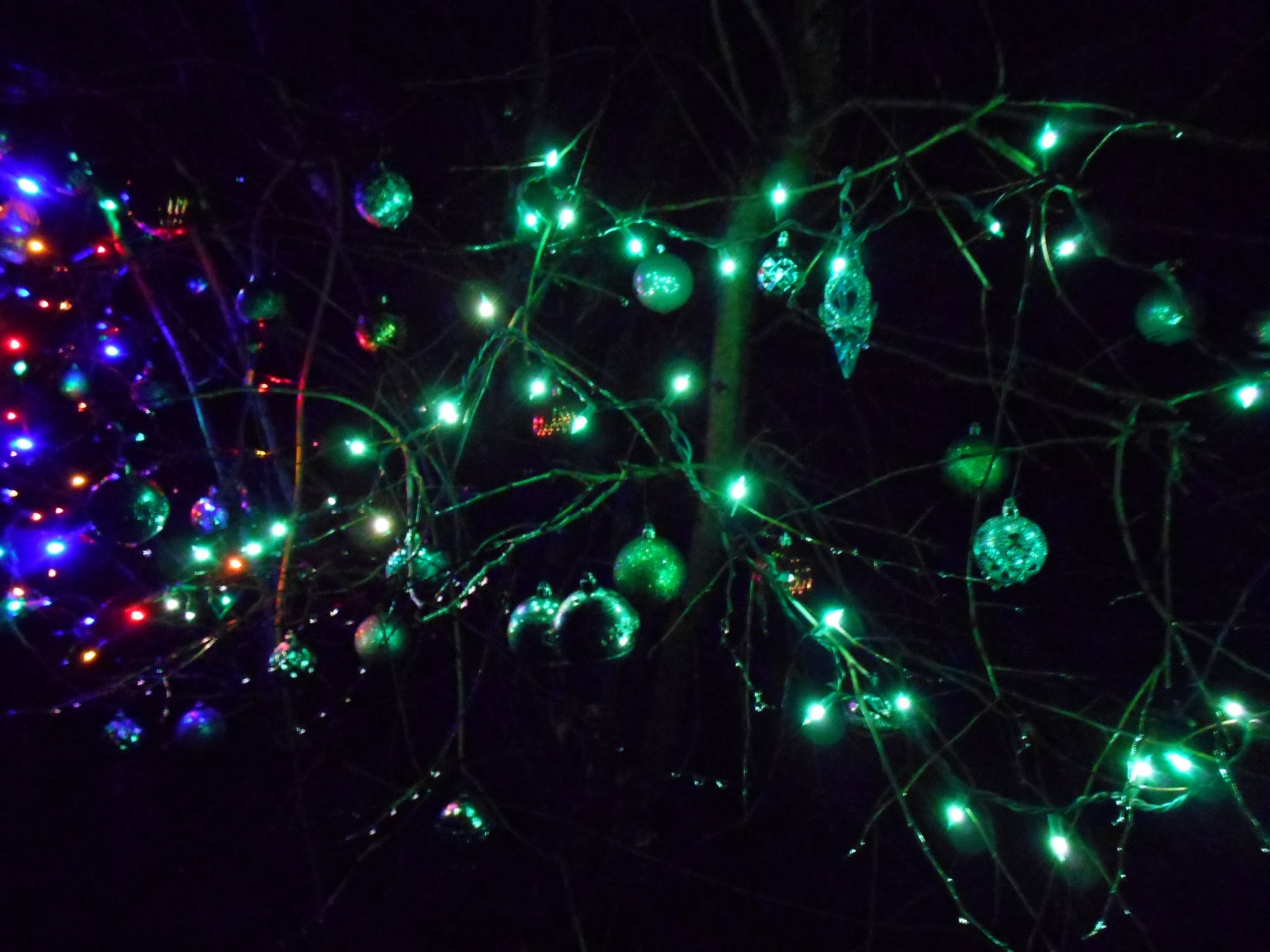
...And there were Christmas lights.
And an extra string... 

In fact, the bigger lights in the upper right corner of the bottom pic were the last string of colored lights for sale at a local drugstore -- in fact, some of the last Christmas items in the sole aisle of holiday decorations this year. Whereas in earlier years, there were a lot more lights available as late as the 23rd of December, these past several years the Christmas decoration pickings -- especially when it comes to lights -- have been slim even a week or two before Christmas at most stores. 

Whether it's the trade war, or just the general state of brick-and-mortar retail, I have no idea. The drugstore in question used to be like Christmas-land in the 2000's. In 2004 I got my tree there on the 22nd or 23rd -- it was one of several trees that were on display near the window. Now the window of that store is bare.

Late last decade it began to have less and less Christmas stuff -- no trees, no ornaments, no bins of stuffed animals for kids and lovers -- just candy and a few boxes of lights and trinkets.

Very sad, really.

And with that, this finally gets posted Lille Julafton, December 23rd, 2020.

Until later, my friends,

Peace.

C.C. 12-19-2020, & 12-23-2020

Addendum: April 5th, 2022: I added the video of the song "Guardian Angel" by Tyler James Williams and Coco Jones, two of Disney's own stable of pop singers. I also added the video link to 'Dancin' In The Rain' by Shane Harper, another Disney pop singer. At the time I wrote this blog article in 2020, I didn't know how to add videos to an article, and these songs I think were worth including.


Thursday, December 17, 2020

On GUITAR DISTORTION BOXES -- and the Discontinuation of EXCELLENT PRODUCTS

An old pic from 2015 or 2016 or so, taken right after Christmas. A frost covered yard, and lights and ornaments on my favorite Hawthorn tree -- it looks like Christmas, doesn't it. I may put the lights back up, but from the crappy, rainy weather we've been having lately I doubt it will look this Christmassy this year.

As many of my readers are probably aware, I write mostly about guitar and radio stuff -- sometimes veering into other things -- Holidays, weather, etc.

The past few months, especially since the coronavirus shutdowns and slowdowns, I've had a lot of time to play guitar, and tons of time to practice. Most of it has been working on my slide guitar proficiency, which has improved a lot since the beginning of the year. Daily practice for two hours or so a day really helps.

I also have been trying new things in my guitar's signal chain, to make it more consistent in any situation.

One of the few pictures I took this Summer. I call him Socks the Cat. I don't know who this cute little cat belongs to -- he showed up on my front porch one night, and my cats didn't seem to mind him being there. I next saw him about two blocks away, hunting mice in a grassy area near some neighbors' houses. A week later I was out on my bike at night and saw Socks about five or six blocks in the other direction, hanging out by a grassy area near the local Trail. I haven't seen Socks for a few weeks... I certainly hope nothing bad happened to him.

To explain this, I need to take us back to late last year, when I had the opportunity to participate in a local music project.

Although I had my small Marshall Valvestate amp in the car, they instead pointed me to a 20 watt model that was tilted back towards the wall where I couldn't really access the controls. The amp wasn't very loud. My performance was probably not up to snuff, because I simply could not hear myself.

THREE THINGS TO INSIST UPON WHEN PLAYING WITH OTHERS

I learned three basic things from that experience: first off -- never, ever play with others if you can not hear yourself. Get up and walk out if you can't fix the situation otherwise! Because if you can't really hear yourself, you're just wasting your time.

Another thing I learned was to always insist on using your own equipment. Unless it's absolutely necessary, or super inconvenient -- or unless you really know the equipment used -- never play through someone else's amp or signal chain when playing with other musicians, especially if you're playing with them for the first time. If you aren't allowed to sound like yourself, then you are probably wasting your time.

The third thing I learned was that it's a good idea to make sure your guitar's audio chain is already sounding as close to perfect as possible before it goes through ANY amp. Anywhere.

This includes not just your guitar, but any boxes in your signal chain. A lot of guys depend on their favorite amplifier's sound. Although this is fine if you're established in a group, there are other situations where you don't have that luxury. This means you have to make sure that the signal coming out of the end of your guitar cable already sounds like you want it to, regardless of the amplifier you are using. If you're a rock player, as I am, that means you have the right distortion or dirt box.

So, after the debacle I described above, I set about finding the right stompboxes to ensure my guitar's sound will sound good, and sound like ME, through ANY amp, through any clean or dirty channel. I already had stompboxes -- a Boss DS-1, a Marshall Guv'nor Plus, a Boss DD-3 delay and a couple chorus boxes, but aside from the delay and chorus I'd never bothered with dirt boxes at home. I just depended on either my Marshall Valvestate, or the gain channel in my Fender practice amp.

The Boss BD-2 Blues Driver, a recent acquisition here, and probably one of the best and most versatile distortion boxes ever made. I was pleasantly surprised at its sound and versatility. Even when you turn down the volume on your guitar's controls it has clarity. With the distortion level kicked up a notch, the chords blast out of your amplifier, with each string heard distinctly, and with picking dynamics clearly audible. The tone overall is what I would call Marshall and Vox-like, in other words it has a British edge to it. The box has six different clipping diodes distributed over two stages (4 in the gain stage, and 2 more in the final stage), and the amp transistors are all FET's, which probably account for its characteristics. At around $100, it's an excellent addition to any guitarists trove. I run mine in between the guitar and my Boss SD-1, which I use in place of a guitar pre-amp. The combination of the two boxes, which work well together, really gives blues and rock notes a great snarl, similar to Mick Ronson's, or a similar enough bite to Eric Clapton's tones in the Bluesbreakers and Cream.

The experience with the other guys showed me that I needed to change the way I viewed my signal chain. If I wanted to play with other people, I needed to take a closer look at it. The experience also gave me a new appreciation for having the right dirt box as part of your sound.

So, over the past several months I've added to my dirt box collection. I got a Boss SD-1, in early Spring, because it's an reasonably priced overdrive, and because schematically it was reasonably close to the gain channel on my favorite amp, a solid state Fender Tweed Bronco (made in the 1990's). I also bought a Boss Blues Driver BD-2, and a Joyo British Sound character pedal.

The SD-1 itself was a good idea. It had just enough compression to bring out the nuances of slide playing. The tone was also good. A little midrangy, but still useful. The Blues Driver is an excellent pedal, with distinct dynamics, and it works great with the SD-1. It's like having two gain channels in front of your amp's clean channel. The Joyo (around $35) sounds very Marshall-like, and makes the amp sound louder than it really is. At first, I got it as a backup for my Guv'nor, but it has different characteristics. It's a louder sounding dirt box, for one of them.

So, over the months I've put together a pretty good chain. It sounds good through the clean channels of both of my amps. I had never bothered with clean channels before, actually. Being a blues and hard rock player, I had no use for clean channels. But now I see their merit -- if you can get a good dirt tone through an amp's clean channel, you are pretty much set, anywhere.

CLEAN CHANNELS = USELESS to CLEAN CHANNELS = USEFUL

Which leads to the point of this blog post: both of my favorite distortion units -- my Fender Bronco, and my Marshall Guv'nor Plus, are no longer made.

Now, before you guitar nuts start laughing, read further first. :-)

There is something to be said for an amp or dirt box that puts out great sound. Marshall and Fender amps aren't consistent great sellers because they sound bad. You could say the same thing for some stomp boxes -- like the famous Ibanez Tube Screamer, or the ubiquitous Boss Overdrive and Distortion boxes. They sell all the time because they sound good.

So -- why do some of these manufacturers discontinue a good thing?


My standard guitar signal chain: a Boss DD-3 for just a bit of atmosphere, a Marshall-like dirt box in the middle for color and crunch, and my Boss SD-1 for a final push into whichever amp's clean channel I'm using. Often I'll substitute the Boss BD-2 Blues Driver in the middle position -- it has a bit less sharp high-midrange than the Joyo British Sound, but still provides a Marshall or Vox like crunch. The JOYO British Sound box is a new purchase: it has a Marshall-like roar, and individual notes have a distinct bite. The lower middle control, 'Voice', adjusts the way the midrange reacts with the distortion -- in fact, all three lower controls interact with each other. The pedal is a little bright for my tastes -- I still prefer the older Marshall Guv'nor Plus -- the Joyo probably sounds more like older Marshalls -- think Malcolm Young of AC/DC on the first US album "High Voltage", and you get the idea. As for any extra brightness, I just turn down the treble on the amp or guitar. It may not be so with other guitarists, who do not prefer a darker sound.

ADDENDUM: JOYO BRITISH SOUND and excess HISS:
After playing guitar with the Joyo for the past several months, I've noticed a couple things -- first, that it's a good pedal for older Marshall sounds. Second, that the LED will still remain bright when the battery is low.

Most Boss pedals and Boss style pedals (my old Ibanez pedals, for example) have the red power LED dimming significantly before the battery craps out. Not so with Mr. Joyo.

Earlier tonight (March 27) I was playing with my Joyo (Guitar > Joyo British Sound > Boss SD-1 > Fender Bronco clean channel) when I noticed I was getting a LOT of HISS. Now, most gain pedals, and some amps, put out hiss. But not so much that it's in the way of the music. But my Joyo was putting out more hiss than a pressure cooker blowing its top. It definitely wasn't doing that before. Something had obviously changed.

The red power LED was a little bit dim, but not considerably dimmer than it was the previous evening of playing guitar. However, the only variable was the 9V battery. So I changed it.

Instantly: problem solved! I was back in Malcolm Young territory again.

GOODBYE FENDER BRONCO, and GOODBYE SPEAKER JACKS

When discussing this tendency of a great item being curiously discontinued, the tweed Fender Bronco is a case in point. The amp puts out 20 watts. Its distortion channel appears modelled after the famous original Marshall Bluesbreaker pedal, with similar layout in circuitry and the same op amps used (TL072's). It's a great sounding amp -- once you plug it into a speaker box.

See, the amp, although it's a practice amp -- has an EXTERNAL SPEAKER JACK.

None of the current Fender or Marshall practice amps have them. 

Why? They have all this useless shit -- digital modelling, which -- although it has its uses -- really doesn't make up for a great, regular distortion channel. And now most of them have Bluetooth. Really? It's a guitar amp, not a smartphone or MP3 player!

And even if they want to include those features -- which some people apparently want -- why do none of them have an External Speaker Jack?

When I bought my Fender Bronco in the late 1990's, I was just looking for a small amp that would sound decent, so I wouldn't burn out the tubes on my 50 Watt Marshall just practicing or song writing. When I went into Guitar Center to check out amps I noticed this tweed thing -- solid state, so no tubes would burn out -- and it seemed to sound OK through its speaker. The gain channel had plenty of crunch, which meant I could use my favorite single-coil guitar through it.

Then I noticed it had an external speaker jack.

I took the amp into Guitar Center's amp room and plugged the little Fender into a Marshall 4 X 12 box. I was astounded by the sound I was now getting! It sounded like a cross between a Vox and a Marshall, with a rich, full, and gnarly rock tone, not too different from what you hear on hard rock CD's.

I was instantly sold.

To my surprise, a few years later Fender not only discontinued the tweed, solid state Bronco, they never replaced it with another amp that had an external speaker jack. And that is crazy, as a speaker jack can't cost THAT much to install on an amplifier at the factory.

My Marshall Guv'nor Plus, sitting next to a newer Joyo British Sound pedal. The two pedals do indeed sound like Marshalls, with the Joyo being brighter, with more clarity in the notes and chords, and the Guv'nor Plus having a bit more of that Marshall-like roar.  Think JTM45/Plexi (Joyo) vs. JCM800 (Guv'Nor). The pedal on the left is available at most online stores for $35-45 new. The Guv'nor -- if you can find one -- goes for several hundred USD. In fact, the last time I saw one for sale, it was over $400!

GUV'NOR PLUS -- From $80 to $400

Another discontinued device that mystifies me is the Marshall Guv'nor Plus.

I got mine in 2000 or 2001. I was looking for a box that would give my single coils an extra boost, but also sound Marshall-like. I was pleasantly surprised. I think I got the thing for around 70-80 dollars US.

It makes any amp sound like a Marshall JCM800 or 900. It has that much gain. It also has a ton of versatility -- the tone controls are robust, and a battery lasts a long time. On top of that, the 2000's series of Marshall pedals -- the Guv'nor Plus, the Bluesbreaker, the Jackhammer, etc. -- all are built like tanks, with solid steel enclosures that are so tough a Mack Truck could probably run over them and they would still probably work.

A lot of guys online complain about a bleed capacitor inside the box, which cuts the highs down. I actually like the fact it's there -- it gives the Guv'nor Plus a darker sound. Marshall amps were fairly dark sounding amps when they started getting popular in the late 1960's. I think this is why they darkened the sound of the Guv'nor -- it was to match the 'dark' sound of an early Marshall amp through an even-more dark sounding Marshall speaker box.

From what I can tell, most guys loved their Guv'nor Pluses. Some, who didn't like the bleed capacitor, merely had them removed to get the extra highs. The boxes were big sellers. There still is a demand for them now.

But Marshall, to my amazement, discontinued them some time around 2008 or 2009.

You can't even find a Guv'nor Plus online, used for less than $400!

Why aren't they making them now?

PRODUCT = GOOD? PRODUCT OFTEN = DISCONTINUED.

It's one of those things that always puzzles me. A product works well, is probably easy to make, the factory already is tooled up for production, and they cancel the product after a few years and either replace it with other models that don't have the same positive features (Fender) or don't replace it at all (Marshall).

Over the years I've seen picks discontinued (Fender Delrin Red .50mm picks -- they were great picks), cables have been discontinued and replaced with other ones that are twice the price and don't work any better, and good luck trying to find green guitar straps!

I almost bought a $900 Gibson 'Topaz' Les Paul. Then I got this Lotus L520 for $360 instead.

Then you have the guitars that come and go. In 1996 I almost bought a Gibson Topaz Les Paul. For those of you who don't know what a Topaz is, it was part of Gibson's "Gem" series, where they gave the Les Paul different colored finishes, and installed the guitars with single coil P-90's, some of the best sounding pickups out there.

The Topaz was the red sunburst version. It played and sounded great. It was on sale, at a no-longer existent music store in Southcenter (a massive complex south of Seattle) for around $900, which was a good price for any Les Paul at the time. I passed on it, not being able to justify spending that much on a guitar. A couple months later I got my red, Lotus L-520 Les Paul copy at another no-longer existent music store on First Avenue in Seattle. The L-520 probably was a much better buy, as it sounds just as good as the Topaz did, and it has served me well over the years since 1996.

Here is a Gibson Topaz. It was an awesome playing and awesome sounding guitar. Why Gibson quit making them is a mystery. They were beautiful guitars, and sounded good. Perhaps this tendency of guitar manufacturers to change out designs and models like most of us change lightbulbs is a reason they are having some financial troubles lately.

Anyway, shortly after that year, the Topaz, and all of the Gibson 'Gem' models were discontinued. Good luck finding one, even used, now.

I suppose in the minds of the manufacturers it is a matter of keeping up demand with newer and more 'exciting' products. But it still is irritating when a great product becomes discontinued, and then the value of the used versions skyrocket, as happened with the Guv'nor Plus.

My Sony ICF-38, a terrific AM-FM radio. It pulls in nearly every station a Superadio will, and has terrific battery life. Bought new at Fry's Electronics for $34 in 2014, it is now a discontinued radio. The last time I saw one for sale online in the used marketplace, it was going for over $200.

This thing also happens with radios. One of my most useful DX and emergency radios, my Sony ICF-38, I bought at Fry's Electronics about eight years ago for $35. Now you can only find them used for around $200 or more. The prices for them now are INSANE.

A perfectly good product, discontinued.

I guess it's the way of the world, and I suppose one last lesson to be gained from all of this is if you come across a product that you really use or rely on -- make sure you get a backup, or make sure you take excellent care of the one you've got.

One of my three electric Jack O' Lanterns that's still outside, glowing in early December. I simply haven't gotten around to wanting to take them down. I presently prefer Halloween to Christmas, anyway.

IN OTHER LIFE.....

Overall, it's been a rainy, crappy Fall and Winter here in the Seattle region. I suppose that's better than freezing weather all the time, but the constant rain and grey is a real downer.

After finishing typing this blog post, I'm going to take the last few electric Jack O' Lanterns down (yes, I left a few of them up), and put out some Christmas lights and ornaments on my Hawthorn tree out front -- not too far from where I buried my cat just after Thanksgiving.

I don't really feel like putting up lights, though. Christmas hasn't been much of a celebratory Holiday to me in several years. But the colored lights are nice. In shitty weather you take all the bright and cheeriness you can get. :-)

I have no Christmas plans, really. The family cancelled theirs due to corona. Sometimes, even though I'm not Catholic, I have gone to Midnight Mass to be somewhere with other people on Christmas Eve, but some Catholic churches shut down before midnight now, and that was before coronavirus. Now, because of corona, they're shut down, period.

Aside from that, I continue with my usual... Work has slackened because of corona slowdowns, so I have been doing things around the house, fiction writing, and practicing on guitar. MW DX hasn't been on the front burner, as conditions have been fair to middling for the most part.

I did hear KNZZ Grand Junction, Colorado a few days back when I was finishing another blog post. KNZZ is a rare catch, and it's always nice to hear a station from Colorado that isn't KOA 850. I have nothing against KOA, but it's usually heard year-round here in Seattle -- all you have to do is turn your AM radio into KHHO Tacoma's null and 'poof!' Colorado!

Snow on the lights and ornaments on my Hawthorn tree, Lille Julafton (Dec. 23rd), 2016. The way the weather is looking this year, it will be continued rain. Oh well.

Until next time, I hope my readers are all doing well.

Peace,

C.C. 12-17-2020


Monday, December 14, 2020

The SANGEAN PR-D14 -- an excellent MW DX and Emergency Radio

The Sangean PR-D14 AM-FM Radio, a great performer and great emergency radio -- with FM Stereo through headphones.

Before the Coronavirus slammed us in February of this year, I rediscovered the local Fry's Electronics store, which in the 2010's was THE place to go for electronics, but in recent years has been struggling to survive in an increasingly online retail world. 

To explain this, I need to take you back a few years.

During the 2010's, I rediscovered my radio hobby after several years of not really listening to MW and SW much. In fact, for about a ten year period I didn't DX much at all.

In September of 2011, I finally pulled all of my radios out of their storage closet, and started fixing some of them -- or trying to fix some I didn't end up fixing. :-)  It's also when I modified my GE Superadios slightly -- something I talk about in this blog post:

Interrock Nation: Boosting the antenna circuit of a GE SUPERADIO 1 & 2

To get parts for these projects, I went to Fry's, as our local Radio Shack was closing and didn't have many parts.

I also bought a couple radios at Fry's: my Sangean PR-D5, my Grundig G2, and my Sony ICF-38 -- all of which got heavy use. I bought my now broken Sangean PR-D6 there on sale. I bought a few CDs, blank CDR's, USB drives, a printer for my old computer -- for these things, Fry's was THE place to go. They had a little bit of everything electronic, and they even had a coffeeshop in the middle of the store. Early in the 2010's -- even with the Recession on -- the store was full of shoppers, had loads of employees, and it was always a busy place with plenty of good deals on everything from USB drives to computer parts to phone chargers.

My PR-D14 with its back off -- the radio comes apart very easily -- it's built well, like boomboxes in the 1980s used to be built. There are five main screws, and two tiny ones near the top, that come out fairly easy. There are no user serviceable parts, except maybe the volume control might need a shot of De-oxit in a few years. It would probably be easier to shoot some down the side of the shaft, as I do with my GE Superadios when they need it. I don't like taking apart radios unless absolutely necessary. Too easy to break something.

For a while after 2015 or so, I didn't go to Fry's much. But just before the corona shutdowns in February, I went into the store, and it wasn't the same place. A lot of the shelves were partially empty of goods. It didn't have the same festive, upbeat atmosphere, and wasn't as busy. It was very sad, to the point that it depressed me. It seemed to reflect the general state of brick-and-mortar retail in the US today -- on the brink. They still had a few Sangean and Sony radios for sale, and a few computers for sale here and there in the computer section, and a few TV's in the TV department, but Fry's seemed to have taken a hit -- probably by online purchasing, which has hurt a lot of brick-and-mortar retail.

Along with online shopping hurting Fry's, the trade war with China, of course, didn't help, as they apparently had special arrangements with Chinese suppliers. And the recent Coronavirus shutdowns naturally didn't help their situation any.

ENTER THE PR-D14 -- Like I Needed Another Radio....

All that said, right before the first corona shutdown in my state, Washington, I made a couple trips to Fry's to get some electronics -- USB drives, batteries, and the like. I also checked out their dwindling radio shelf, looking over the few Sangean and Sony models still on display.

The one that caught my eye was the Sangean PR-D14, which looks like a mono version of the famous DXer, the PR-D5.

Now, I probably needed another radio like I need another hole in my head, but I went ahead and got one of the PR-D14's right before the shutdown. It was a way to try to keep myself out of the Corona doldrums, and also give Fry's just a little customer support, because I like the store, and -- after all -- there are people who work there who need jobs, too.

The Sangean PR-D14 runs off a 6-Volt NOISE-FREE AC Adapter or 4 D-Cell batteries. The batteries fit securely in the back of the radio. The top one is a tight fit because Sangean outfitted it with a large, strong spring. Consequently, the batteries don't jiggle around inside the radio at all.
 
D CELLS = GOOD!

When I got the PR-D14 home and I took it out of the box, the first thing that impressed me was that the radio takes D CELLS. When I was younger, during boombox and GE Superadio days, D Cells were pretty standard in radio portables. Now, to see a radio that takes D Cells is a rarity -- probably because the industry is going more towards rechargeables, or they think that radios with D Cells are too heavy.

I found the D Cells to be a great idea. D Cells last longer than AA's in the same radio, which is a plus in emergencies if and when the power is off for any length of time (see my previous posts on power outages and radio).:

Interrock Nation: WRITING IN THE DARK -- thoughts about the power grid

Interrock Nation: A LESSON IN PREPAREDNESS -- 30 Hours Without Power, and a Sony Radio.

And the use of D Cells in the PR-D14 is indeed one of is pluses: a set of batteries in a PR-D14 will last a long time. As my readers probably know, I like to promote emergency radios, being that I live in an earthquake prone area, where they say the power grid may some day be vulnerable when an 8.0 or 9.0 earthquake hits. Such a shaker could take the grid down for weeks, if not months in places. In such areas prone to grid failures, emergency radios -- particularly ones with an AM band in them -- are a good idea.

A couple years ago, I posted an article on why AM / MW radio is important during disasters and emergencies, and it illustrates why a radio with good performance and good battery life would be essential.:

Interrock Nation: AM/MW RADIO AND THE CASCADIA 'BIG ONE' -- The Importance of a Dying Broadcast Band During Major Earthquakes & Other National Disasters

Sangean's decision to power the PR-D14 with D-Cells makes it an excellent choice, not just for emergencies and disasters, but it would be a great camping radio for the same reason, as campers don't always have boxes of batteries handy when out in the bush. The PR-D14's ability to hear distant AM and FM stations also makes it a great camping and travel radio.

For home, plug-in use, the Sangean PR-D14 comes with an interference free AC adapter. Sangean has been able to develop switching power supplies that do not interfere with AM radio reception. I am listening to my PR-D14 on its AC adapter as I write this: there is no RFI interference whatsoever.

HOW DOES IT PERFORM? VERY WELL

After noticing the fact the radio uses D-Cells, the next thing I noticed about the PR-D14 was its relative simplicity of use. The power button is not recessed, like some other Sangean models -- making it more positive to the touch. The tuning is done via an up and down button on the front of the radio -- making for less parts to break. The sole non-button control is the volume knob on the side of the radio, which is easy to find even in the dark.

The PR-D14 will play music off AM, FM, AUX IN, or even a USB stick (the USB port is in the top of the radio). Although most users probably wouldn't play music through a mono speaker (although it's still stereo in headphones) from a USB stick, it's still a cool feature.

The main question many of my readers may be asking is how does the PR-D14 perform on FM and AM? The answer is very well. The PR-D14 is obviously DSP equipped, as nearly all new Sangeans are -- in fact, the radio will put out RF 'chirps' on other, nearby radios when you tune it across the band -- just like every other DSP radio I have does (it's an artifact, not a defect in the radio -- DSP tuners will chirp on other nearby radios).

The Sangean PR-D14 with its back off, where the main PCB, speaker, and controls are located. The MW / AM loopstick antenna is clearly visible at top -- it has a single sense-coil, and is 100mm long (it measures out about 100mm on my ruler). The speaker is capable of handling 3 watts of power -- more than the 1 watt that the radio's audio chip puts out.

100 millimeter MW LOOPSTICK INSIDE

The AM side of the PR-D14 appears to be almost identical with that in the well known Sangean PR-D5 -- the limitation being the antenna length inside the radio. The size of the case indicates that the loopstick is shorter than the PR-D5's 200mm loopstick. From the outside of the radio, of course, it's impossible to tell if the PR-D14's loopstick is a twin coil or single coil (the PR-D5's loopsticks since 2012 are twin coil). 

Taking off the back of the radio reveals that the PR-D14's MW loopstick is about 9mm thick, and measures out to be 100 mm long. It's obviously enough for the radio to pull in DX on the MW band -- largely because of the DSP chip (probably a SiLabs chip) that the radio uses. DSP chips usually make a radio perform very well on both AM and FM.

Either way, my PR-D14 will pull in anything my PR-D5 hears, although the weakest stations are noticeably weaker by a dB or so -- if that.

Still, it's a handy DX radio on MW. Using an external loop with the PR-D14 is a bit easier than it is with a PR-D5. Why this is, I don't really know. It may have something to do with the dual coils in the PR-D5, or some other factor. I use my Select-A-Tenna with the PR-D14 and it responds very similarly to the way an analog IF-chipped radio responds.

The PR-D14's MW Loop antenna with my ruler next to it -- the loopstick measures out to 100mm. I use metric when measuring antennas and other smaller items, as it makes more sense than fractions of an inch. For bigger stuff, like bicycle parts and car parts, I use both systems. Temperature is always Fahrenheit although I post it here in Centigrade for my overseas friends. :-)

Right now, as I finish typing this blog article in my den, I have the PR-D14 playing in the corner of the room. For no particular reason, I tuned it to 1100 KHz, which often is covered in splash on some radios, because we have a local 50 KW station here in Seattle on 1090.

I am able to clearly hear KFAX San Francisco, a religious station, as well as the audio of a station behind it, coming from the East -- the news-talk station in Grand Junction, Colorado, KNZZ, which is about 900 or more miles (1000 km) away. I am hearing the stations with minimal splash.

I also have my PR-D5 fired up, and the two radios are practically pulling the stations in the same. KNZZ isn't a common catch here. And the fact it's coming in on my PR-D14 is an indication it works very well.

One last thing about DXing with the radio -- the headphones work well with DXing. I haven't had the issue with this radio where nearly empty DX channels do not have enough headphone volume, as I got with the PR-D5. If the PR-D14 has drop-down resistors on the headphone circuit, they must have adjusted them a little.

For more on low headphone volume, I posted an article on the PR-D5's peculiarities here, and a possible fix, if your own PR-D5 has low headphone volume on quiet MWDX channels:

Interrock Nation: Fixing the SANGEAN PR-D5's low headphone volume

No such mod is needed on the PR-D14.

CHANGING MW / AM CHANNEL SPACING

Those of us here in the US and most of the Western Hemisphere listen to MW with 10 kHz spacing between channels. I.e., my local stations' frequencies are 10 kHz apart. In Europe, Asia, Africa and other parts of the world, MW is in 9 kHz spacing.

The PR-D14 comes to your country generally programmed to receive MW with the channel spacing in your region. But you can change it fairly easily.

You press the MENU button and hold it. You will hear a soft 'beep'. Then you use the TUNE up or down button to reach "AM 10 Khz" (or "AM 9 Khz" if you're outside the Western Hemisphere). Press the SCAN button. The "10 Khz" or "9 Khz" will flash. Use the tuner buttons to toggle to 9 or 10 khz. Press the SCAN button. This sets the channel spacing. Press the MENU button again. You're set.

Here in North America a lot of guys switch their radios to 9 khz spacing to DX stations from across the Atlantic or Pacific Oceans. If your radio doesn't tune in 1 Khz increments, switching to 9 Khz spacing is a cheap way to DX the overseas channels. You might get splash, or heterodynes from local stations, but you'd get those anyway. I switched my PR-D5 to 9 KHz once to hear the Korean station that sometimes makes it here on 1566 khz.

The changing of spacing on MW is also described in the PR-D14 User Manual, which I have linked later in this article.

FM PULLS IN FRINGE STATIONS EXCELLENTLY

On FM, the PR-D14 pulls in fringe and distant FM stations better than my best analog FM radios, but slightly less than my Grundig G2 (which is also DSP). Why there is a difference between the two radios' reception on FM I do not know. Still, I was able to hear a classic rock station from Vancouver, B.C., Canada (about 130 miles / 200 km away) on my PR-D14 off the whip antenna, and I'd never heard that station before in my life. 

I am not an FM DXer, but sometimes Victoria, B.C. stations come in when tropospheric conditions exist. On rarer occasions, stations from farther away can be heard, but due to local terrain, FM DX is almost impossible. The fact the PR-D14 pulled in a station from 120 air miles away, with a hill in the way, says a lot. The only other time I heard a Vancouver, B.C. station was in the late 1980's when I took my boombox to a distant hillside facing north, where the back of that hill blocked out all the local FM interference, and I was able to hear CBUF, the French CBC station from Vancouver, which was very cool to hear!

Vancouver, B.C. stations are exceedingly rare at my home location, as there is a big hill in the way.

Maybe tropospheric conditions were exceptional when I heard the Vancouver rocker, but the fact I heard a Vancouver, B.C. station at all is an example of the PR-D14's ability to pull in FM.

Although the PR-D14 is a mono radio with just one speaker, through headphones FM is in crisp, clear stereo.

EMERGENCY RADIO? YES

As I noted before, in case of emergencies, a good AM radio is a must. During grid failures, cell systems can even lose power, as some hams noted during the recent wildfires in Oregon. Local FM and AM stations could be off the air. However, not only will AM stations be heard from 100-200 miles away during the daytime, at night skywave reception will bring in numerous stations from other regions, which may be vital for news and information if there is a widespread power outage, as would be expected during a major earthquake -- especially here in the PNW (the Pacific Northwest, for those of you not in the United States), where we have several major faults expected to slip at any time.

So far, I've had my PR-D14 for over eight months and I'm still on the first set of D Cells, and I use the radio for at least 15-20 minutes nearly every day, at least half of that time listening on headphones. There have been a few nights where I left it on while sleeping, and the radio, several months later, is still on one bar for battery power -- the PR-D14 will indeed last a while on a set of D-Cells.

The fact I use headphones a lot is probably why my batteries have lasted so long.

OPERATION IS A SNAP -- INCLUDING LISTENING TO MUSIC FROM A USB DRIVE

Operating the PR-D14 is very easy. The on-off button is not recessed, so it is easy to turn on and off, unlike the PR-D5's concave, somewhat recessed button. The only rotary control is a volume control on the side of the radio. The FM sounds good through headphones (in stereo) and pretty good through the large (4 inch?) speaker. AM sounds good through the speaker, and OK through headphones -- the bandwidth on MW/AM seems to be similar to the PR-D5, maybe 4-5 Khz, which is great for selectivity, but the highs are a little muffled, but not quite as much as my PR-D5.

TEN STATION PRE-SETS -- 5 AM & 5 FM

There are five station preset buttons on the front of the radio which are easy to set, or re-set: you just tune to the station you want, and press a button for a second or two until you hear a beep. That's it.

There are five pre-sets for the AM band, and five for the FM band. When you fire the radio up after taking it out of the box, there are five factory pre-sets for each band, interspersed across the band, although not all the way. On the AM band, for example, the factory pre-sets are 520, 1710, 600, 1000, and 1400. On FM they're 87.5, 108.0, 90.0, 98.0, and 106.0. They're probably set up that way for test purposes. I usually program mine for several favorite stations or channels across each band: my favorite DX and regional channels on AM, and rock, pop, and news stations on FM.

When you take out the batteries with the AC adapter unplugged it will re-set the radio. This also deletes your presets, which isn't that big a deal, being that there are only 5 on each band.

USB JACK on top for MUSIC

There is a USB music play capability I haven't yet used. There is a USB port on the top of the radio, and one of the play options is USB -- you access the USB by hitting the bandswitch button in the top row -- it toggles between AM / AUX / USB / FM. Other buttons on the front select your music folder, and then the music file you want to play.

'POWER FAIL' - Don't Panic -- SHOWS WHEN BATTERIES ARE GETTING VERY WEAK

If you have low batteries, like mine are right now (I'm still on the first set, and they're finally down to zero bars -- the radio still is working, though...), when you hit the bandswitch, it will go to USB and then you may get a "POWER FAIL" warning on the radio's display. The radio then powers off. Then, if you hit the power button, it will toggle to USB, AUX, and FM as per usual. Apparently the switching function requires a little more power, causing the "POWER FAIL" warning to show up whenever your batteries are low enough, or it's just a software glitch that occurs when batteries are low.

It doesn't disable the radio, however. The radio will still operate normally. In these cases, when you see the "POWER FAIL" occur when toggling from band to band, just hit the main Power button and you're on your way to FM. Or use the AC power adapter.... Or, change the batteries. :-)

All the radio is doing is letting you know that the batteries are low for some functions. Although it hasn't happened to me yet, I'm sure that the POWER FAIL warning comes on when the batteries are too low to operate the radio, and it probably cuts the radio off.

AUX IN for MUSIC and RDS

The PR-D14, just like the PR-D5 and other Sangean radios, has an AUX IN function, which uses the mini jack on the side of the radio for playing music off of a tablet computer, MP3 player, or cell phone.

LCD PECULIARITIES; FM-RDS 

The only negative in this radio is that the LCD display turns into a clock after a few seconds when you have tuned in a station. They do this because a lot of people apparently like their radios to double as clocks... and also it's to save power in some way. With the PR-D14, if you have been DXing and listening to a frequency, and temporarily forget which channel it was, you glance at the dial and you'll just see the clock.

But all you have to do in such cases is just press the "INFO" button near the tuner button, and the LCD lights up and the frequency reappears for about 7-8 seconds.

Also, although the PR-D14 has RDS, the RDS doesn't stay up long enough to scroll to ID song titles. :-( This is unusual, because the PR-D5, which also has FM-RDS, keeps the RDS scrolling for as long as you are tuned to the FM station.

The LCD light is helpful, and has two separate delay times: if the radio is running off of batteries, the light stays on for about 2-3 seconds; if it is plugged into the AC adapter, the light stays on for 7-8 seconds.

DIFFERENT VERSIONS? OIRT / JAPANESE channel capability on FM

According to the Sangean website, the PR-D14 is capable of OIRT / Eastern European FM reception, and also reception of the Japanese FM band, which goes lower in frequency than the FM band in the rest of the world.

The PR-D14 User Manual (which is available on Sangean's website here: UM_20121106_3A81VU100000A_PR-D14USB_GB_R1.pdf (sangean.com), shows how to switch the FM band to 64-108 MHz if you want. It's fairly easy, by using the INFO button, SCAN button (a small button next to the tuner button) and Tuner button.

I have mine set for 64-108 MHz just for the fun of it -- it's useless, of course, as not even the best of FM conditions are going to bring Japanese or OIRT / Eastern European FM stations here. It might be a useful function if you have a PR-D14 and either live in those areas, or travel there.

You can also switch the FM channel spacing, something I've never done. And, finally, you can force the PR-D14 to receive FM in Mono, something I've also never done. The way to do this is in the User Manual linked above.

A GOOD OVERALL DX AND EMERGENCY RADIO

But, overall, for a carry-around AM/FM radio with stereo headphone and DX capability, and good battery life, the PR-D14 is hard to beat. There aren't a lot of portables available today with good reception and good battery life combined -- and increasing numbers of portable radios have rechargeable batteries, which is a wash if there is an extended power outage. I know there are battery packs one can buy that will recharge rechargeables -- but in my view it's much cheaper and easier to buy a few spare sets of D cells (or AA's if you radio uses AA's) and keep them in a drawer somewhere.

I know as the years progress the idea of listening to radio on an actual radio seems more and more passe, and I understand that. Still, radios have their uses, and many of us who are GenX and older (I'm in Generation Jones) still think of "radio" as something you get from a plastic box with a dial and speakers on it. And for such people, the PR-D14 is a worthy addition -- for hearing music or sports when out in the yard, camping, travelling, or otherwise when the power is off and your cell service and internet is dead.

The PR-D14 is moderately priced, easy on batteries, sounds good, and is easy to use. If you're into radios, it's well worth it to check the PR-D14 out. You probably won't be disappointed.

AS FOR NON-RADIO TOPICS....

In other news, life is carrying on in 2020. I have been loaded with work at my job, and have recently been taking care of a family member full time. I have been practicing my slide guitar playing, which takes my mind off of a) politics, which we are inundated with here in the US, and b) life in general, which really has had few bright spots as of late.

I'm looking forwards to Halloween, although I still have to clean up and decorate my front yard, and wonder if we'll have any trick-or-treaters this year because of coronavirus.

Here is hoping that those of you who are reading this are coming through the Pandemic OK and your year is at least passably palatable.

Until next time, Peace.

C.C. 10-9-2020

Naturally, it took me a while to get this article published on my blog. In December I added the photos of the outside and inside of the radio, and accompanying text.

Right now it appears we are headed for another corona lockdown, even though a vaccine may be available later this month, and more available in January. Work has slowed down at my job, so I've been doing a lot more things at home, and concentrating on my writing hobby. 

The weather here has been dreary -- cold, generally, and rain. The past couple nights have been warmer, though, which is nice.

I probably won't put up Christmas lights or decorations this year. I'm just not enthused about the holiday. My hawthorn tree might get some lights, and that's about it. Right now a glowing Halloween pumpkin still sits in the tree. :-) 

I'll end this post with a pic of my two grey kittens which I got in late September, 2011 -- about the time I rediscovered my radio hobby. The one on the left is Pudge, who died on November 15th. The kitten on the right I named Fluffy. She is doing OK.


Peace.

C.C 12-10-2020


ADDENDUM, April 2022 -- POWER BUTTON ISSUE:
I have been using my Sangean PR-D14 as a kitchen radio for the past year or so, usually leaving it on 24/7. I started noticing an issue when turning it off -- instead of the radio turning off, the radio would tune down a frequency. I'd press the POWER button again, and it would, once again, tune downwards one channel.

After a couple months of this happening fairly frequently, I pulled the battery and pulled the AC plug, and re-set the radio. The first time I did it, I didn't allow the radio enough time without power for the re-set to work. The second time, it reset fine, and the power button glitch disappeared, and all was normal again. :-)

The key to knowing if the radio re-sets properly is when you plug the radio back in, all the characters on the LCD readout will light up and you my hear a 'beep'.

This is very similar to the POWER Button issue I encountered with my Sangean PR-D5, and I would bet that this issue sometimes occurs on other Sangean radios.

Sangean's radio operating firmware seems to have periodic button glitches. Even my PR-D18 (a small, almost pocket sized, decent DX-er, grey radio) has exhibited this issue at least twice, as when I hit one of the volume buttons once to turn down the radio, and it sent me to the alarm-setting function instead. A second press of the volume-down button worked properly. This has happened twice, actually. No big deal, but...

Sometimes the button scan function on these Sangean radios glitches. Usually a reset will clear it all up if it persists.

I have a blog article on the Sangean PR-D5 Power Button issue here.:

ADDENDUM, March 2023 -- more on the Power Button Glitch:
I still have the issue at least every other time I power off my PR-D14, only it will tune UP one channel instead of down one channel. No big deal. Radio works fine otherwise. It's my 24/7 kitchen radio, and sometimes I'll check DX on it. 

It's powered up all the time, via the AC adaptor that came with the radio, so that's probably one of the reasons it can glitch.... as I explained in the linked article up above, it seems that having the radio powered up all the time can cause the microprocessor to glitch eventually, and the solution is to remove all power, let the radio sit for 20-30 seconds, and then power it back up. I still think PR-D14's are well worth the money. PR-D14's are good DXers and work well as kitchen radios and the like.

Thursday, December 3, 2020

Fourth of July and Drop C

As I write this, I have just set my guitar down after playing it for an hour or two.
My 2000 Ibby Gio, which I re-tuned and re-set up for Drop-C and Open-F tuning.

As I have noted previously in this blog, I play guitar and sometimes write and record my own music. I haven't written or recorded anything in over a year or two -- just haven't found the time to do it, or had the inclination. But I still play -- mostly rhythm and slide, bluesy hard rock guitar parts. I do it for relaxation, and to keep my ability.

Lately I've been relearning guitar, by exploring the tunings of Drop-C and Drop-D. For those of my readers not into guitars or rock music, this post may get a little tedious. You've been warned. :-)
A pic of my older Ibby (not my GRX40 Gio -- it's an 882 model with Matao pickguard and pickups), and my 2000 Marshall Valvestate amp, a very versatile amplifier that sounds decent through its own speaker and even bigger through a speaker box. The stomp boxes on top of the amp are two of my standbys -- a Boss DD3 delay and Boss CE5 chorus, which I always have plugged into my signal chain. The yellow thing is an old Ibanez Flanger which I was using a lot when I originally wrote this article in 2018, to attempt to duplicate the sounds Andy Summers got in the Police.

REDISCOVERING MUSIC FROM THE NU-METAL ERA
A couple weeks ago I was going through my CD collection and found a slug of discs that brought back memories of the turn of the Century -- mainly the nu-metal years 2000-2001.

It is an era I remember fondly. It was that time period after Y2K and before 9-11 hit. It was actually a heady time for rock music. Sort of it's last big gasp.

After a period in the mid-to-late 1990's where life seemed to be dragging, things were looking up. I remember that the music around 1999-2000 seemed to be on the verge of a new wave of heavy hitting rock -- what is now termed 'nu-metal'. There was a vibrancy and punch to the sound -- including the use of industrial sounds (admittedly used on earlier records by bands like Nine Inch Nails) and detuned guitars -- the guitars usually tuned as low as B or A, and with a lot of heavy power chords mixed with octaves. The nu-metal sound really peaked around Summer 2001.

I think what turned me on to the nu-metal sound was hearing Saliva's hit "Your Disease". It seemed that the music was so upbeat in feel compared to much of what was popular during the 1990's. A lot of the other bands of that era -- POD, Linkin Park, Skrape, The Cult's Beyond Good And Evil CD, Buckcherry, Apartment 26, Sunna, Filter, Fear Factory, Eighteen Visions, Korn, Slipknot, Creed, Rage, Static X, Linkin Park, and the like -- generally tuned their guitars down to D, C, B, and even lower to achieve a boomy growl that when multilayered had a very cool feel to it.

All through the 1990's and 2000's I played my electric guitars almost exclusively in Open G (DGDGBD). Before that I always played in E or E-flat standard, but after a spate of tendonitis in my left ring finger in early 1990 I switched to Open G to keep the tendonitis at bay (Open G lends itself to treat your ring finger more kindly). After re-learning how to play chords, slide, and lead in Open G I stuck with that tuning for years. On acoustic guitar, I messed around with different tunings (DADGAD, EADGAD, EADGBD, etc.), but on electric my guitars were set up for Open G exclusively and stayed that way. The tendonitis went away, but the G tuning stayed. :-)

That was until a month or so ago. I dug out my old 2000-2001 CDs in a stint of nostalgia, and realized that the guitars on those CDs were not only tuned down a couple steps, but they often weren't tuned to standard tunings (D standard, C standard, etc.).

A lot of these guys used "dropped" tunings, where you tune the guitar to a standard tuning (E standard, D standard, etc.) and then you drop the low E string another whole step to DADGBE, CGCFAD, etc.

The 7-string guys (Korn, for example) usually tuned to Low A-Standard (ADGCFAD), but the 6-string guys, like the guitarist in Linkin Park, for example, tuned to Drop-C or Drop-D  -- and sometimes even lower. Slipknot reportedly tunes their 6-strings to Drop-A and Drop-B.

DROP-D AND DROP-C
The Drop-D tuning (DADGBE) has been around a while -- Neil Young used it on the Crosby, Stills, Nash and Young song "Ohio" in 1970. There's also a YouTube of Canned Heat playing in Europe somewhere in 1969 or '70, and one of the guitarists drops his E-string to D to get Drop-D.

But the grunge bands Pearl Jam, Soundgarden, and Alice In Chains made Drop-D popular again in the early 1990's, and the sound struck a chord with many bands after that: Rage Against The Machine used Drop-D extensively, for example.

Before this summer, I had naturally heard of Drop-D but never really got into it. It just didn't seem all that useful. Any time I tried it, it just seemed pointless.

After listening to my nu-metal CDs I decided to give drop tunings another try.

As I've mentioned on here before, I have an Ibby Gio GRX40 which is a 2000 model, which was given me by a friend of my mother in 2003. For the past few years I've had it tuned to D-standard for a couple reasons. First, it was tuned that way when I got the guitar, primarily because the strings were thick (.52-.12 gauge). Second, it was my only standard tuned electric guitar, so I decided to keep it that way so I'd have a standard-tuned electric to play.

For a long time I merely did the usual Strat things with it, Robin Trower and similar bluesy, jazzy styles of playing.

I decided a week ago to detune it to Drop-C. This meant I would drop the low E string from D to C. Simple. DGCFAD to CGCFAD.

To do this and have it sound OK I had to re-set the low 'E' string's saddle, to increase the string tension slightly, and re-compensate the intonation after raising the string a bit. To intonate it right I had to file the saddle a bit shorter than it was -- the 2000 Gio was apparently designed for E-standard and lighter strings, and Drop-C is a bit lower than I think it was designed to handle correctly.

After a few weeks of fine tuning, I had to readjust the Low-E string's saddle to where I actually removed the spring. Problem finally solved. :-)


A pic of the humbucking pickup and bridge of my Ibanez GRX-40 Gio. The pickup is a Powersound -- stock humbucker, which I've left on. It sounds best adjusted away from the strings about 4-5 mm. The bridge is adjusted for a mix of playability and string tension... to get the lowest string to intonate right I had to file the saddle short, and then remove the spring, as can be seen. The heads of the adjusting screws were rounded off with a needle file to keep them from digging into my hand when playing. If one does that sort of 'modification', one must be careful, because the hex indents (for a hex adjustment tool) aren't very deep. The string gauges here are 52-11 or 12.

I had already shortened the saddle a bit to get the guitar to tune right in D standard. Dropping the .52 gauge string to C presented a bit more of a problem, especially as I have ten-ton wrists -- years of playing hard rock rhythm (I sound like a fast Malcolm Young or slow Mick Cocks for the most part), even with the Fender thin celluloid and Dunlap Delrin thin picks I use, it is so easy to make a low E string 'wow'.  A string which is at reasonably low tension is going to 'wow' that much easier.

I had this problem in the early 80's when the E string would wow all the time. I took my guitar to Mike Lull, a local luthier, thinking there was something wrong with it. He looked it over, and finally told me to play a few chords. Then he told me "it's not the guitar -- you're hitting it too hard."

Part of the problem is that slamming the strings the way I do gives me a certain sound, a certain quality of break-up through the amps that I like, and it sounds like me. But with these new tunings, I have to learn to adjust. Over the years I've learned to lighten my touch just enough, and use heavier gauges (.50-.12 usually, depending on the guitar).

With the Ibby tuned to C it only made me have to learn to play even lighter. Let the pick do more of the work than the wrist. Live and learn.

After a week or two of playing in Drop-C, it's a different world. It's like relearning guitar almost completely. My fingers want to revert to either standard-tuning or Open G chord configurations. At times it is a bit frustrating, but eventually the fingers re-learn their positions.

It's kind of cool to get that low growl out of my guitar when I hit a Dropped C chord. I can play along with my Skrape CD and learn the chords (Skrape was one of the second tier of 2001-era nu-metal bands -- it's well worth checking out their Tokyo live video on YouTube:
Skrape live in Tokyo Japan - August 19, 2001 - YouTube).

Lately I've been getting back into Fear Factory, a band I got into in 2001 when their Digimortal CD came out. I love that mix of nu-metal and industrial sound they get. Their guitarist, Dino Cazares, started out detuning his Ibby 6-strings to B or A, and then went onto Ibby 7-strings. He now plays his Ibby 7-string tuned to low B or low A. He only uses a .54 on the lowest string, which presently is usually tuned to B. How he can play it that low without making the string wow I have no idea.

Here is a cool YouTube clip of Fear Factory playing their song "Replica" live at Ozzfest, probably Devore (N. of San Bernardino), California, 1996:
Fear Factory - Replica (Live At Ozzfest '96) - YouTube

DROP-D EXPERIMENT ON MY LOTUS L520 GUITAR
Playing in this new Drop-C tuning has been the highlight here for the past few weeks.

I have also took the liberty of retuning my Lotus L520 (a terrific sounding Les Paul copy) from Open G to Drop D, taking a cue from Pearl Jam, who used Drop D a lot, especially early on. It took a bit of getting used to going from DGDGBD to DADGBE. The fingers have difficulty quickly switching from a tuning I've used since 1990 to a tuning I'm just learning now. So far, with that guitar, it's been little more than an experiment.

My Lotus L520 was an impulse buy in 1996 or so. It was a heavy guitar, and sounded good. It has an ash body, and it's heavier than a Gibson. The wood and (probably Korean) humbucker pickups give it a nice heavy snarl. It's what I call a 'short-tail' L520, as the distance between the bridge and tailpiece is shorter than any of the other L520's I've seen online. Whether this is due to a glitch at the manufacturer, or was a design change near the end of its run, I don't know. Information on these Indian made wonders is few and far between on the internet.

I started out tuning my L520 to E-standard but switched to Open-G after about six months. I recorded it on one song in Standard (a song called "Here Alone", it's the guitar on the right channel). Then I switched it to Open G.

Now I have it in either Drop-D, or Open G, depending on how I want it to sound.

GUITARS DON'T LIKE CHANGE -- 'CHANGE BAD'
One thing I found right after retuning the Lotus was that the guitar didn't hold tune as well. When you have a guitar set up for a certain tuning, and it's set up right, it tends to stay that way: tuned. If you retune more than one string permanently, it will often act up for a little while. The neck shifts a hair, the saddles on those strings may not intonate 100%, and the pickups or pole pieces may or may not need readjusting. The strings themselves probably also readjust to the new tension. And then, your fingers have to adjust as well.

For a few months, I dropped my Lotus to Open-F#, a step lower than Open G -- I was aiming for a heavier, Nu-Metal sound. It worked well after the guitar settled into the tuning. But that tuning wasn't quite so useful, as I'm not much of a Nu-Metal player. I'm more of a blues rock player. So back to Open G / Drop D the guitar went. And when I switched the guitar back up to the higher tuning, it took a while for the guitar to settle back in and stabilise at the higher tuning. This happens.

One thing I've found over the years is that every component of a guitar works together: bridge, string gauge, string tension, nut, height of the strings -- change one component, often you have to adjust one of the others. This also goes with the pickups -- if they're too high and you have thick strings, the strings may act wonky.

"STRAT-ITIS"
With single coils this can be a famous issue ("Strat-itis"). With humbuckers, because of the 'balanced' magnetic field, it's not so much an issue. However, "Strat-itis" can still happen if your magnet is ceramic, and you're using thick strings, as I found to my surprise with my Ibby Gio. One day recently I raised the humbucker a little to beef up the sound of the lower strings, and all of a sudden I was getting weird resonances at the 9th fret when playing a bar-chord. It took a few minutes for me to determine that it was the magnet screwing with the lowest two strings. When I lowered the pickup back down about half a millimeter or so, the problem went away.

Live and learn.

Either way, even when retuning your guitar to another tuning sometimes you have to re-balance the pickups by adjusting the pole pieces, because the strings either get louder or softer due to the change in tension. I have the last two pole pieces removed from my Lotus' bridge pickup to make all the chords sound good in Open G. Fortunately, it still sounds good in Drop-D.

Drop-D in my trusty Lotus actually works well. It just took some time to readjust a few things.

Power chords in Drop-D sound different than they do in Standard or Open-G. They really roar. Technically, there should be no difference -- a string is a string. But it might have something to do with the lower three strings all being the same length when you hit a power chord. They really ring out and project.

The Drop-C experiment has opened up a new world for me on guitar, anyway. I've already come up with a few chord sequences that sound cool in the tuning. I never messed with nu-metal sounds previously, so it's kind of a change to adapt and see what elements of it I can work with and still make them mine. Once I got the Gio set up reasonably well in Drop-C, it really sounds good in the tuning. I suppose it is appropriate, as the guitar was built in some anonymous Chinese factory in January, 2000 -- when nu-metal ruled the rock airwaves and nu-metal bands could fill arenas and even stadiums.

OPEN F -- a C and F drop tuning for SLIDE
After maybe a year of having my Ibby Gio tuned to Drop-C,. I got back into slide guitar (in late 2019), and decided to try the Gio in Open-F, which is a slide tuning -- basically Open-G dropped down a whole step (from DGDGBD to CFCFAC). The guitar still responds much the same. The Drop-C tuning makes it a little easier to hit the crunch chords and rattle them off more quickly -- the Open-F makes it easier to do heavy chord playing as well as slide, and the lower tuning sounds naturally deeper than Open G, which is the tuning I use on all my other electrics.

I'd suggest any slide or rhythm player who uses Open-G to drop it down a step to CFCFAC and see how it sounds. 

FOURTH OF JULY = FLOP OF JULY (2018)
In other happenings, we had our summer here, and the weather overall was decent. The summer, of course, included a holiday: the Fourth Of July.

The Fourth Of July was a flop, basically. Nobody was blowing off any rockets or anything, even on the nearby hills where the skies used to light up quite a bit. Around midnight someone nearby decided to pull out their fireworks and blow off a few rockets, and I managed to get a few photos before they quit about half an hour later.

Lately we've had a spate of decent weather -- but it's been hazy, as smoke from forest fires in British Columbia has drifted south over Washington state. When I went to work earlier today I had little bits of ash on my car.

Since then, the haze has continued. Sometimes you can sense it while you breathe -- other times, not so much. It seems to have affected the weather, cooling it down a bit, basically slamming the hammer down on the end of summer. Blame Canada. :-)

The past several days (August 25 and afterwards) the smoke has cleared. Now it feels like Fall outside. Summer is on the way out. Another season passes.

September 11th came and went, and even though it was 17 years ago, it still is a strong memory. I thought about writing a post here, but I've already done that in previous years. Here is a post with my reflections of that day:
https://interrocknation.blogspot.com/2016/09/my-september-11th.html

Soon enough it will be October, and Halloween will beckon. I suppose my next post will be sometimes around then. I hope to decorate for the Halloween holiday early this year. Perhaps I will have some good pics.

Until then, dear readers, Peace.
C.C.
9-19-2018 and 10-7-2018

After over two years with this post sitting unread on my computer, I decided to post it. Hence, the different dates used throughout. I originally intended to include a sound clip of me playing in Drop-C, just for the heck of it. Then I kept putting it off. 

Then I found out that unfortunately, Blogger doesn't have a sound clip posting capability, so I can't post a sound clip of me playing in Drop-C.

Of course, 2018 was a while back, and pre-Covid, and pre- a lot of things. So, I decided to go ahead and just post this article now as is, with a couple additions, and get it out of the way. 

I'm closing this note with a pic of my cat Huggy Bear, who I lost a year ago, in September 2019. He just disappeared. Emails to neighbors resulted in a few sightings over a week or two, but no one who saw him knew that he was a lost cat, so they didn't tell me until well after he was gone completely. Huggy Bear was an independent sort -- he didn't like to respond when called, and loved to hang out at a nearby grassy area that bordered a pond where he hunted mice. It's possible a raccoon or coyote spooked him and he ran into the neighborhood, before disappearing a few days later.

He was a great cat, and a great pal to one of my other cats, who still misses him.
Here is a pic of him, taken a couple weeks before he disappeared.

The last year and a half have been tough, losing three cats.

However, life goes on.

Peace,
CC 12-3-2020


ADDENDUM, 12-8-2020:
I added a small paragraph about "Strat-itis" that is rare, but can still apparently happen with a humbucker equipped guitar, as my GRX40 Gio got it when I raised the humbucker a bit to beef up the low end.