Thursday, May 18, 2017

A PART OF MY CITY HAS DIED


Early this morning, as I was listening to Coast To Coast AM on my GE Superadio III, George Noory suddenly played a piece of the Soundgarden hit "Black Hole Sun".

Wow, I thought, they're adding Soundgarden to their bumper music. Cool.

Then he announced that they had just heard that Soundgarden singer Chris Cornell was dead.

He apparently died after a Soundgarden show in Detroit. The latest news, however is even sadder: it appears he may have taken his own life.

I remember when Soundgarden was just a local band. It was 1988, and I had just gotten involved with college radio, and the station where I was volunteering was an alternative rock station, KCMU.

A lot of the people there not only were really into the new alternative music, they were very much into the local scene, which -- at the time -- was turning from a punk scene into something else: grunge.

Soundgarden was the first grunge band I ever heard. I still remember when DJ Maggie (a cute, punked up blonde who was dating one of the other DJ's, who played drums in another local band) held up the new Soundgarden EP, Screaming Life, and held it in the DJ booth window for everyone in the station to see.

Then she played a track off of it called "Nothing To Say." The music was thrilling, to say the least: Soundgarden had a way of taking the classic rock guitar and vocal sound and updating it with punk and alternative twists, with odd timings and strange chord sequences thrown in for good measure.

It would be cool if I could say my life had changed -- but it didn't. I was heavily into Australian rock and pub rock music at the time -- Midnight Oil, Rose Tattoo, and bands like them. Heavy hitting, Oz talking punch rock bands. It took a while for me to get into grunge.

But I'll never forget hearing Soundgarden for the first time. I wasn't sure about some of the other bands of the Seattle scene, but I knew I really liked Soundgarden's music.

A couple years went by and I was working at a company that delivered weekly music to radio stations all over the United States. No sooner than I started working there, Soundgarden's Badmotorfinger album hit. I remember putting the CD on the CD player and hearing "Rusty Cage".

I was blown away.

In early 1994, Soundgarden were recording Superunknown at Bad Animals Studio, which was across the alley from where I worked. The company I worked for shared the parking garage with the studio. I remember going out to my car one afternoon and several dudes that looked familiar strode in -- it was the band, along with some other guy, perhaps the producer. I could recognise Mr. Cornell immediately, from his hair (he hadn't cut it yet). They got inside a Jeep Wrangler or similar SUV vehicle, and within seconds I heard the opening chords to "My Wave", which they apparently had just recorded. I guess they wanted to hear how their new album would sound on a car stereo system.

A month or so later in 1994, I had a chance to meet Chris Cornell, if only for a few moments. I had heard that Soundgarden were doing an interview at Sit and Spin, which was a club on north 4th Avenue with a laundromat included.... Inside it was a very artsy place, where they served alcohol drinks and fruit smoothies.

I managed to catch Mr. Cornell out front, just as the band were leaving, and just before they boarded the tour bus to start the Superunknown tour. I had my copy of Superunknown in hand -- which I"d already been playing to death. I still think it's one of the best albums ever made.

I handed him my CD, which was in the plastic wrapper I used to keep the jewel case from getting marred, and asked him if he did autographs.

"We thrive on it!" he said, half pulling my leg. He grabbed the CD, and gingerly pulled it out of the plastic wrapper, and opened it up, and I handed him the Sharpie pen, and he very politely autographed the back of the booklet.

I told him how much I liked the entire album -- every single song.

He thanked me for my comments on their music, and soon enough, the band were on their way.

A couple months later, Soundgarden did a video for "Fell On Black Days". They were rehearsing it in the Bad Animals soundstage, and they kept the back doors wide open for a half hour or so, as they tuned up, and ran through the track a couple times. I guess they were filming at the same time, so they could use the footage in the video.

Soon enough, a small crowd of people -- maybe eight or nine -- stood in the alley, listening.

After a bit, they closed the doors. It was a hot night in August or early September, if I remember correctly. It was so long ago I can't really remember exactly the month or the date.

Just last Thursday night I went to karaoke with my mom at a local pub. I sang Soundgarden's Rusty Cage. I did a good job on it for once. The off-beat part in the middle is always tricky. I love singing that song, and a couple other Soundgarden songs, Pretty Noose and Outshined. I don't sound like Chris Cornell, but I can hit the notes. I always have been amazed at the way he could sing.

Now Chris Cornell is gone. I feel like in some way, a small part of my life has been ripped away.

It's sad to hear that he may have taken his own life. They say Mr. Cornell was in good spirits overall, but the police are investigating it as a possible suicide -- just like Michael Hutchence, of the Oz band INXS; the band thought he was O.K. -- but it turned out he really wasn't.

One day they are looking happy, then they leave this Earth.
Anybody remember CD's? I guess they're now a 90's thing.

It's always a tragedy when someone who has touched your life dies. My thoughts and prayers go to Chris Cornell's family.

He was a part of this City we call Seattle. The scenes and streets and waterways of the City are mentioned in many of Chris Cornell's songs. His band was the first Seattle band to be taken seriously in years. And they hit it big in the early 1990's when Seattle was the thing going.

Now a part of my City has died along with him.

Rest In Peace, Mr. Cornell, and may God bless your soul.

Monday, April 3, 2017

A VALENTINE'S SONY BOOMBOX

Valentine's Day has come and gone, as it is February 15th as I start to write this.

Unfortunately Valentine's Day gets a bad rap if one isn't going out to dinner or on a date on that evening... I don't share that attitude about the holiday. To me it's become one of the first holidays of Spring. You get Valentine's and St. Patrick's and Easter in a row -- and then nothing 'til the Fourth of July.

A couple years ago a house in another nearby neighborhood had Valentine's lights out. That was cool.

Anymore I see Valentine's Day as a harbinger of Spring. And this year Valentine's Day was a grand Spring day! It was 61 degrees F outside. They would call it "T-skjortvaer" (T-shirt weather) in the Nordic countries, where 16C is sometimes typical summer weather. Here, we don't have such a moniker for surprisingly warm days -- but we enjoy them just the same.

A VISIT TO THE THRIFT STORE, AND THE BOOMBOX WAS STILL THERE
As noted in this blog earlier, I made a visit to the local Goodwill thrift store the Saturday before Valentine's, and it was a lively place. That's when I first spotted a bright yellow Sony boombox up on one of the shelves in the electronic section. Because I wasn't there to shop around for electronics stuff, I just glanced at it and then went to get what I needed.

Early during Valentine's Day I needed to get a couple more things from the local Goodwill store.

The sun had already come out, and it was a bright day. When I drove to the store and went inside, I checked the electronics section. The Sony boombox was still there. Now, I probably need another radio like I need an extra hole in my head, but when I looked over the Sony boombox closely I was impressed. It was a bright, fire engine yellow, and definitely a 'Sports' model. It was in terrific condition.

Instantly, I wanted to buy it -- if it worked.
A LITTLE ABOUT SONY
For those who were born later than 1985 or so, Sony was an electronics company that made a lot more than the Playstations they are known for now. Back then, they made all sorts of excellent audio equipment, boomboxes, TV's, video players, tape players, LP turntables, Minidisc players and radios, including the Walkman. Later on they diversified and got into the camera and video camera business.

During the 80's especially, Sony was the big deal. Sort of like Apple today. You could say Sony was the Apple of the 1980's and 1990's. Everyone had a Walkman or a similar AM-FM cassette player, the same way everyone has a smart phone today.

I say this because I just realised, while looking over the boombox, just how ancient technology boomboxes and Walkmen must be to anyone who wasn't alive during the 80's or 90's. I'm certain there are probably many who -- in this age of IPhones and Androids -- have no idea what a Sony is, except for the name of a gamebox.

You look in any old online catalog or enter "Sony boombox" into a search engine, you'll see all sorts of cool looking Sony (and other) boomboxes. I recently did so and was surprised at all the cool types of boomboxes and Walkmen Sony produced, especially in the 1980's, which was the decade of the Walkman and boombox. Sony was THE brand to have, although there were other good brands, including those by Japanese makers Sanyo and Panasonic.

Sony, of course, made other radios, too. The Sony 2001 model was the first mass-produced, consumer grade digitally tuned SW radio. Its successor, the Sony 2010 model, was a long running digital SW portable which is so collectible it is almost as expensive now (if not more expensive) as it was in the 1990's when it was the most popular. The Sony EX5MK2 MW-FM radio is probably one of the best MW radios still available, with synchronous detection and excellent performance.

Sadly, though, Sony is no longer the top brand in electronics -- everything -- including cameras, one of the more recent Sony mainstays -- has been replaced by the smart phone.

SONY SPORTS BOOMBOX
This particular Sony boombox that caught my eye, a bright yellow Sports model (Sony "Sports" Walkmen and boomboxes were bright yellow and water and rain resistent) looked like it probably sold for over $120-$150 when new. I have no idea what year it was made, but I think it was in the late 1980's some time. There was an old sticker on it that showed it had sold for $99 somewhere a few years ago.

The batteries inside it looked like they had been stored in the radio for a long time, and a couple of them were corroded. But the battery compartment itself was very clean. It needed batteries or a 9V adapter for me to see if it would work.

I found a 9.5 volt wall wart adapter in the electronic accessories box next to the appliance section at Goodwill, and the adapter had a negative tip (used by Sonys, Panasonics, and many Sangean radios until recently). I found a wall outlet and plugged the adapter into the wall and the radio fired up. Both AM and FM worked perfectly. The dial had a little backlash near the top end but still tuned well.

So I bought the boombox, along with the adapter. Even though the adapter was half a volt high, it isn't that much of an issue -- many adapters are off by a volt or more from nominal, anyway.

I took the box home and plugged it in out on the front porch, and switched the FM to 98.9 Mhz, "Rock 98.9 KVRQ" (I've blogged about 98.9 in an earlier post here).

Soon I was out in my driveway in just my T-shirt, cleaning and sanitizing a wheelchair and walker and listening to my new 1980's era Sony Boombox, in my T-shirt and jeans. It was so warm out that I was very comfortable. Even though it was February, it felt almost like Summer out. The air was fresh and exhilarating. I took a ride around the area on my bike, relishing the fresh Spring air and warmth. It was invigorating.

That night I switched the radio to the AM side and found it DXes the AM band reasonably well -- about as good as most boomboxes. It's a little less sensitive and selective on the AM band as my Sanyo or Goldstar 1990 boombox, but still hears distant stations with readable signals. During the day it hears most stations that my Superadios will pick up. The most noticeable difference is the wider bandwidth and the looser AGC. It has a very natural sound on the AM band -- but sometimes I miss the tighter AGC that DX radios usually have.

The first night I had it, I heard KNZR from Bakersfield, California on 1560 loud and clear, and also heard XERF 1570 coming from across the border in Mexico. XERF was readable on fade ups, and when I placed the boombox next to my GE Superadio there was an obvious difference in reception, but there weren't any times when the GE had a signal and the Sony had nothing. The Sony just faded more and was less clear when the signal dropped.

I took the Sony with me when I needed to drive in the rush hour traffic and it sounded great in the car, tuned to 98.9. The FM section seems to have good sensitivity, as I was able to hear a Spanish station on 99,3 (El Gran D, a fringe FM station with the transmitter about 100 miles / 120 km away) with the whip antenna down -- and this was while driving around in my car. When I got back home I looked up the info on the radio -- there isn't much out there, but it appears to be a late 1980's model.
Traffic on 167, going about 15 mph.
I'm very impressed with Sonys -- I can't think of a Sony I've had which was a dud. Some of their clock radios need an external loop to DX with, but most people don't buy clock radios to DX with. But their Walkmen are DXable (with a loop, and sometimes without -- all of my Sony Walkmen will bring in regional AM stations with readable signals, and I can DX with them using a loop) and some of their other radios are quite capable. And this boombox was no different.

During the day the Sony boombox brings in CBU 690, the CBC station just 200 km north of us. It usually comes in weak on most of my radios, but readable. As I type this, I'm listening to the CBC and it's coming in at S3 and very clear. There is a bit of splash from KIRO 710, a 50 KW local station. So this Sony boombox has fairly wide selectivity. Good for AM listening, a bit dicey when DXing near local 50KW stations.... but if you null a local station, nearby channels are still audible.

The Sony doesn't have a ton of output through the headphone jack when DXing the AM band, but it's adequate. With a loop I can DX with it fairly easily. I haven't taken the back off the radio, but I've seen a pic of the boombox online with the back off, and the loopstick is about 60mm. During the late 1980's, boombox manufacturers began putting smaller loopsticks in the radios. They figured the high sensitivity IF chips would make up for the smaller loopsticks. With this Sony, the chip isn't as high output as with other similar radios I have. But it's still adequate.

Like nearly every boombox I've had or listened to, this Sony would be a good emergency preparedness radio, as it will pick up regional AM stations with readable signals at night. It seems to be decent on the D cells, also. I put in a used set of D cells (which I swapped out of my GE Superadio 3) and have run the boombox maybe 8 hours or so and the power indicator is just starting to dim, but it still puts out a decent volume with no distortion.

So it would be decent for emergencies, but if you find one of these Sony gems and want to DX with it, a loop is definitely advisable.

If you have a thrift store in your area, they're pretty good places for finding radios if you're a DXer or transistor radio and boombox collector. I don't always see radios there that I want, but every now and then you find a gem.

Saturday, April 1, 2017

REFERRER SPAM og Helt Sjuk

HELT SJUK
This past month has been abysmal in some respects. I caught some sort of head-cold/flu and it just didn't want to go away. Then it became a form of 'walking pneumonia', for which I had to take antibiotics. Now it's just relegated itself to the category of 'bronchitis'.

It feels like a month has been stripped away from my life. I can function OK for some things, like work (which has picked back up lately). But other things, like working out with weights, riding my bike, etc. etc. -- not so good.

DXing has been mediocre, and when you're coughing your guts up the last thing you feel like doing is tuning across crowded Medium Wave frequencies looking for 'rare' signals.

I have tuned the Shortwave bands, though, and found it a bit relaxing whenever there were stations from the other side of the world. But overall, the month of March was a blowout.

The above is a screenshot of my Google BlogSpot stats page. As you can see, there are numerous hits that are quite regular, about 30 of them every other hour or so. All from the same computer, and all from the US. Someone apparently really wants people to click on their links -- which I haven't done.

REFERRER SPAM
I've titled this post "REFERRER SPAM" because my blog receives quite a bit of it. At first, I wasn't sure what it was. All of a sudden every other post was receiving 30-40 hits or more a day, all from the U.S., and all from a Macintosh computer with a Chrome browser.

After a bit of Google searching I found out that these mysterious, multiple US hits were mostly from a form of spam called "referrer spam" -- it's a technique by which spammers slam your blog with hits, hoping that you'll click on their web links to see who's "viewing" your blog.

Of course, the joke is that no one was actually viewing your blog, it was a bot that slammed your blog with hits as a weird form of clickbait.

I still get a good numbers of readers from overseas, although I have no idea anymore which articles they are reading.... But I'm glad they're still reading the posts. And I'm sure a few of the hits from the US are actual readers, and I'm glad for them also. But the massive blast of hits from this spammer makes looking at my reader stats a challenge at best, and no fun at the worst.

I noticed that the blog posts which I "shared" via Google Plus are the ones that get the referrer spam hits. My most recent post, about the Sony Sports Boombox, so far hasn't received a ton of spam hits.

That is probably because I didn't "share" that post via Google Plus.

In the future I may avoid "sharing" my posts because of it. I'm still uncertain whether to continue "sharing" or not. I really don't know if there's that much of a benefit.

This particular post I shall "share" via Google Plus, so I'm sure by the end of the week it will have received about 500 hits or something -- maybe 20 of them actual readers.

Either way, life is picking up, slowly. Still coughing, still hacking, but less and less each day.

Here's hoping that those of you readers -- especially the ones in the Northern Hemisphere where it is still colder weather -- don't catch the type of virus I got, from wherever I got it. :-)

Peace.
CC 4-1-2017


Saturday, February 18, 2017

ENGLISH RAIN

The past few days have been less like Winter and more like Spring. Invigorating weather. I've been able to sleep with my window cracked open at night, without freezing in the process. During the mornings when I take my bike ride, it's usually 50F / 10-11C and sometimes dripping a little.

The other morning it was a light drizzle. It reminded me of the sort of rain that one sees in movies filmed in the UK -- the type of weather I call "English Rain".

We get a lot of that here. And it's not bad: when it is just dripping, you don't really need an umbrella or raingear on -- it's just drizzling enough to barely wet the clothes. A baseball cap keeps the rain from hitting my glasses as I ride.
A few of the local creeks were full of water. Trickling streams became real mini-rivers. One of the creeks off the local trail dumped a load of mud and water over the Trail about a mile or so away.

An unnamed, perennial creek flooded the Trail with water and mud overnight.
The Cedar River has gone from clear to muddy to clear to muddy. During the rainy days we've had here recently there has been a lot of runoff from the local street-network storm drains, which (conveniently) empty into the river in various places.
The Cedar River after snow and rain earlier in February, swollen and muddy.
Graffiti finds its way to the strangest places, in this case a moss covered cottonwood near the water.
A colorful sunrise during a rainy early morning.
Several ducks enjoying the "English rain" we've been having lately.
One creek in particular usually looks like an Alpine ravine -- the creekbed is massive, compared to the amount of water usually running through it.

During the recent spate of heavy rain we had overnight a couple nights ago, that creekbed was full of muddy water.
'Troll Creek', an unnamed creek but it runs through a beautiful ravine that reminds you of something from a fairy tale. A few days after some heavy rain, the usual trickle turned into a roaring mini-river of muddy water.
A shaft of sunlight through the trees near the Cedar River Trail.
One of the last remaining snowmen in the area. :-)
Driving a couple mornings after the snows hit in early February.
Snow turns to slush -- a week or so before Valentine's week, 2017.
A bright sunny morning a few days after the snow was completely gone.

LOOKING FORWARDS TO SUMMER
Right now most of the holidays are past, and the main thing to look forward to is Summer. And if the recent temperatures are any indication, we may have a real good one this year.
Timmy the Cat says hello.
Here's hoping your days are invigorating -- wherever you are.
CC 2-18-2017

Wednesday, February 15, 2017

A MOOD LIFTING SATURDAY BEFORE VALENTINE'S DAY

The past couple weeks, for reasons I don't want to go into here, have been a bit stressful. Saturday night (February 11th), I went to the local thrift store to get a walker for a relative. They had a couple nice ones for cheap prices.

Now, like I've said -- I wasn't in the best of moods... But the lively crowd inside the Goodwill thrift store was enough to pick up one's spirits decently -- it was a lively shopping crowd, with all sorts of people in there.
Colorful Valentine's balloons, early Valentine's morning at a local grocery store.
Some young women were there, dressed in what would have been called "grunge" fashion back in the 1990's (which was a bit surprising, actually), and there were people of all races and socio-economic strata -- all shopping, milling around the busy thrift store around 8 p.m. on a Saturday night.

I went over to the electronics section -- there was a Sony Sports boombox that looked very appealing. But I was there to get a walker, so I went to that section of the store, which was about halfway towards the back wall of the place.

As I was looking over the walkers, I noticed the sound of classical piano coming from the back of the store.
Imagine my surprise when I saw a guy sitting at an old upright piano, playing away. He played delightfully -- Claire De Lune, Fur Elise, Liebestraume, and many other classic piano pieces. Even the broken key somewhere on the right side of the keyboard didn't interfere with his playing.

Soon a small crowd gathered around -- myself included. We all listened, enchanted by the lively music in the back of a thrift store on a dreary Saturday evening.
Some were recording the man playing the piano on their smartphones. The liveliness of the jaunty music, the man's European style cap and fancy style of playing, and the milling crowd all gave the thrift store a festival atmosphere -- which was just what I needed that evening.
A massive Teddy Bear at a local Fred Meyer box store.
As the Valentine's Day holiday approached, one couldn't avoid all the Teddy Bears, Stuffed hearts, stuffed hedgehogs and other little (and gigantic) stuffed animals which were all for sale for people to buy for their lovers in all the stores -- from drug stores to grocery stores to box stores.

I've included a few pics of them here. It's kind of nice when there is a holiday dedicated to love, especially when love seems to be in somewhat short supply in the world today.

This holiday I kept getting reminded of Valentine's Day past -- especially one V-day long, long ago. I kept having to shove it out of my memory.

Here's hoping your February is full of Spring and good cheer.

CC 2-15-2017


Wednesday, February 8, 2017

AND THEN THERE WAS SNOW!

Three to four inches of snow on a hillside... Winter arrives in the Seattle area once again.
As I mentioned before on this blog, snow is about as rare as hen's teeth here in the Seattle area. North of town they seem to get some snow nearly once or twice every year, but south of the city where I live it's pretty rare.

We had a big snow west of here, in the Burien area, on New Year's Day. But where I live we barely got an inch or so.

But surprise, surprise! Sunday night it began to snow here in my section of the Seattle metro, and it kept snowing. All night. As I write this on Monday morning there is about 3-4 inches of snow outside (8-10 cm).
Snow gracing my backyard, with the distant snow covered trees adding to the Winter feel.
Virgin snow on a suburban city street, soon to be marred by bicycle tires.

This morning (Monday) I went on a ride on my bike, which is very stable even in the snow. I rode down a nearby trail, the Cedar River Trail. At first, pedaling the bicycle wasn't that tough. It takes a couple of minutes to get used to riding in snow, but you get the feel of it -- take really easy turns, use a low gear, etc. It's actually quite pleasant, especially in the morning hours when there are no cars to worry about.

After about an hour I noticed it was really tough pedaling. It was because a couple km down the Trail the snow was a bit thicker, and it began to make this 'disc' on my wheels, a solid circle of snow that constantly rubbed against my brakes. Riding the bike was like doing a leg press.

I definitely got my workout this morning.

I stopped and knocked the excess snow off of my wheels and it was easier after that.
The Cedar River Trail with 3-4 inches of snow -- untouched by foot or bicycle tires around 4 in the morning.
I was the only one on the Trail -- none of the diehard regular bikers were out this morning -- usually I see a few as early as 4 a.m. to 7 a.m., commuting to work via bicycle. But not in the snow, apparently.
There's nothing like the feeling of riding a 10-speed with the front wheel acting like a disc brake that is always engaged.
It was a nice, quiet ride, and aside from it being like a leg press, it was quite enjoyable.

It's now Tuesday a.m. as I finish this post, and there still is some snow on the ground. It's nice to see a bit of Winter, even if it arrives in February.
The Purple Grape after a long snow run.
Snow on my outdoor lights and ornaments, which I've left up because I have a sick relative who missed out on Christmas.
Wednesday morning: I wrote this post in chunks.... Leaving it as is. The snow is still on the ground outside... It will soon be gone, and we'll be back to our typical grey, cold February weather. But for the time being, it is truly Winter outside. :-)

Here's hoping you all are having a great February.
C.C. 2-8-2017

Saturday, January 21, 2017

MW DXing with the REALISTIC DX-398

My Realistic DX-398, Radio Shack's version of the Sangean ATS-909. If you look closely, you can see where I ground down the 'LOCK' button, to keep the radio from turning itself on when I had it inside my backpack.

The Realistic DX-398 is a radio that's been around for a while. In fact, they were introduced in the late 1990's -- the DX-398 is Radio Shack's 'version' of the Sangean ATS-909 digitally tuned SW-AM-FM-LW radio.

I've had mine since the very late 90's. For a while it was my main SW radio, and I used it all the time to listen to ham radio stations because the sideband and CW reception is so good on this radio. To DX the SW and ham bands with the 398, I used a 25-30 foot (9-10 meter) indoor wire, plugged into the antenna jack with a mono plug.

Although the DX-398 has a good MW section, I never used the radio for MW that much because of its somewhat muddy sound on AM, and I had other radios I preferred for AM band listening and DXing. Every now and then I'd listen to FM stereo on it though the headphones. But for the most part I'd use it on SW.
KPQ, Wenatchee, Washington, an AM station that can be heard in Seattle on 560 khz.
 
The fact that I used the DX-398 so much is apparent from the looks of the radio. The plastic stand in back of it is gone -- like most DX-398 owners discovered to their chagrin, it breaks easily. I have mine stored in a drawer somewhere.

I've probably taken the back off of my DX-398 more than any other of my DX radios. I first took it off to seal the edges of the plexiglass display window to the case, to keep dust from getting all over the LCD readout. Then, a few years later, the radio became intermittent. It was the negative battery terminal, which needed an extra shot of solder to hold the spring to the radio's printed circuit board. Hitting the terminal pad with solder solved the problem, and it's worked great since then.
Here you can see where I used a Dremel tool to grind down the "LOCK" button. After that, the radio no longer turned itself on when it was bumped. Recessing the "LOCK" button in this way really did the trick.
I ground down the "LOCK" button on the front of the radio because when I took the radio to work with me it would still turn itself on when jostled or bumped inside my backpack. Grinding it down solved that problem.

More recently, I ground down the little plastic 'guards' around the Tuner button with a knife file, because they just got in the way. The tuner button now has a more positive feel. I also took the back off the radio last year to spray-clean the insides of the tuner mechanism because it was starting to skip. Since then, it's worked like a gem.
The DX-398 with the front of the radio off. The button mechanisms are all plastic, as used in most computerised equipment. But they work well, and have a positive feel. The large LCD readout can attract dust -- which is why I glued the plexiglass readout window to the front of the case.

 A LOT HEARD ON MY 398 OVER THE YEARS
I used to take my DX-398 to work with me, and it was the radio on which I heard the first news reports of the terrorist attacks on the World Trade Center on September 11th, 2001. I've used it to tune in CB outbanders from Latin America and the Caribbean; 10 meter beacons; chanting 'pirate' hams from Kalimantan in Indonesia on 6999 khz and in the lower reaches of the 40 meter ham band; some tropo FM catches (mainly BC Canada FM stations); hams from all over the world during DX contests; and numerous stations from Asia and the Pacific rim on the 41 and 49 meter SW broadcast bands.

The only thing I didn't use my DX-398 for, ironically, was DXing the Medium Wave / AM band.

SOME HISTORY OF THE DX-398
The DX-398 / Sangean ATS-909 was the watershed in SW radios. Although it was a little expensive at the time, it was packed with features and was a very good performer for the money. Along with its replacement the Sangean ATS-909X, it is one of the few SW portables that will work with an external antenna without a lot of overload.

The DX-398 also came from the factory with a couple hundred shortwave stations (261 in fact!) programmed into the radio's memories. The DX-398's memory "pages" -- and ability to edit the page labels -- was a new idea for a SW radio, and was very useful once you got used to how it worked.

I soon re-programmed the memories on my DX-398 by SW target area and type. For example I had one "page" for aircraft frequencies only, another one for hams (I'd program in the first frequency of each HF ham band I monitored), another one for ships, etc. etc.
The DX-398 tuned to a station in Eastern Oregon -- KUMA 1290 in Pendleton. Here you can see how on MW you can label each of the eighteen MW memory locations (two 'pages' of nine memories each) with alpha/numeric names.

Looking back, the fact that a company like Sangean put out a radio with so many pre-programmed memories shows just how far HF has dropped in importance. There are radios today with more memories than the DX-398, but there are vastly lower numbers of SW stations to listen to. You couldn't fill 100 memories with SW stations today, much less 261 -- with very few international broadcasters left on the bands, and few regional and national broadcasters receivable worldwide, there's no way a company like Sangean could pre-program so many memories with stations today.

On any given night or morning I now hear maybe 20 SW stations -- that wouldn't even fill a tenth of the DX-398's 261 SW memory locations. Most of the SW memory locations in my DX-398 are left over from 2003, when I last seriously DXed the Shortwaves.

RE-DISCOVERING MY DX-398
For maybe 5 or 6 years my DX-398 just took up space on my shelf, mostly unused. Recently I pulled it off the shelf and fired it up. For a lark, I decided to see how well it works on the AM band. I grabbed a wall-wart and took my DX-398 out to the storage room during an afternoon, just to tune around while working out.

The first thing I noticed was that KIT 1380 Yakima (200 km away, over a mountain range) was coming in at 4 in the afternoon. That was a good sign. Then I noticed my wall-wart was the wrong voltage! For some reason I thought the DX-398 took 9 volts when it takes 6. Wooops! Nine volts into a 6 volt radio -- not good! I immediately unplugged the wall wart. When I plugged in the 6 volt adapter, all was well. Whew! Luckily the higher voltage wall-wart didn't blow up my radio!

Lesson learned: Always double check the voltage on your radio and your wall-wart!

Over the next few nights I tuned the MW band with my 398. I always knew it was a pretty good radio on Medium Wave. But after a few DX sessions I've learned it's a better DX radio on  AM than I'd originally thought. First, the sound isn't as muddy as I'd thought. It's not a high fidelity MW radio, but you can still DX with it on a pair of headphones and enjoy the experience. Second, the radio DX'es well even without an external loop.
The DX-398 with the back cover off. At the bottom you can see the negative battery terminal spring. The solder pad -- to which it is secured -- has extra solder -- a fix I made when the radio went intermittent 4-5 years ago. It's the only 'glitch' my DX-398 has had.


SENSITIVITY AND SELECTIVITY = VERY, VERY GOOD
The DX-398 has very good selectivity. Mine will bring in CBR Calgary on 1010 right next to local KOMO 1000 and as long as conditions are decent, it's very readable with minimal splash. This is with the "Narrow" filter permanently engaged.

The selectivity in fact (at least in the 'narrow' position) is tighter than my PR-D5, which is a fairly well known MW DX radio. My DX-398 will pull in TIS stations and traces of a broadcast station in Ontario, Canada on 1610 that my PR-D5 reads with difficulty due to a local splash-master station on 1620. With the DX-398, I tune to 1609 and the Ontario station is more legible (the PR-D5 only tunes in 9 or 10 khz increments on the MW band).

On some channels the DX-398 will tune in between channels with no audio except some splash. The radio would probably be excellent for DXing Trans-Atlantic and Trans-Pacific stations for this reason.

The tight selectivity in the narrow position doesn't make for high fidelity listening, but there is no listener's fatigue, either, strangely enough. The sound is smooth and reasonably pleasant.

My DX-398 is permanently set to "Narrow/Mono" because I broke the "Wide/Narrow" button when re-closing the case the last time I had it open. So I set it permanently to Narrow, because that's where I always set it when DXing the ham bands with it. As I said, I've found it's a tiny bit narrower in selectivity than a Sangean PR-D5, and narrower than my DX-370 (which I've reviewed in another article here on my blog). I'm guessing it's somewhere around 3-4 khz wide -- reception can be altered after that with the tone switch on the side of the radio.

The tone switch has three positions -- you can hear the differences best through headphones. There's "normal", "news" (the narrow audio filter setting), and "music" (the wider, more scooped audio filter setting). Switching the audio filters while trying to ID a difficult station can help.
A side view of the DX-398 showing the tuner mechanism with the knob off of it. You can shoot tuner lubricant / cleaner down the side of the tuner shaft and it will clear up any glitching that occurs when tuning the radio using the knob. The shaft has just enough clearance to allow lube and cleaner to get inside the mechanism. It may take a few shots of lube and cleaner to treat it in this manner -- but it works.

SHORTWAVE SENSITIVITY GOOD -- NEEDS EXTERNAL WIRE
The DX-398 has excellent sensitivity. On Shortwave it is excellent with an external antenna.

On its whip antenna it is weaker than other, cheaper portables on SW, however. The design was a compromise to get more reception on FM off the whip, and an external antenna jack was installed for SW listening.

There are some who complain about the DX-398 / ATS-909 and 909X's "deafness" on SW, but this is not true. You just have to attach 15-25 feet (5-10 meters) of wire and either clip it to the whip or use it as an external antenna. It's very easy to do. Most serious SW listeners are using a wire antenna of some sort anyway, even if it's just the wind up wire antennas that come with many radios.  So I don't share the complaints others have about the DX-398's SW performance off the whip.

The radio has built in diode protection to keep the RF transistors from getting zapped in case of static discharges. Even so, I wouldn't use a long outdoor antenna in lightning country without caution.
A view of the DX-398 with the back off. You can see the MW/AM ferrite loopstick antenna -- it's not really large, but because of all the extra IF circuitry inside the radio it is quite adequate for DXing the MW/AM band. The extra circuits make the DX-398 a good performer on Longwave, also.


MEDIUM WAVE SENSITIVITY IS EXCELLENT
The DX-398's sensitivity on AM is a little surprising in that it only has a thinnish 120 mm loopstick. But the RF FET amp, and the several stages of IF amplification after that, all make up for the medium sized loopstick. My DX-398 also works very well with an external loop antenna. I only add it when needed.

My DX-398 will hear nearly everything my Sangean PR-D5 hears -- the other night I compared them both without any external antenna. The PR-D5 brought the distant stations (KBRE 1660 and XERF 1570) in with a little more readability, but the difference was minimal -- maybe 1.5 db or so.
Another view of the MW loopstick antenna, with a ruler showing it's 120mm long -- it's the average MW loopstick antenna used in many Sangean digital SW portable radios.

My 398 has slight overload on 1330 (a couple of my other radios have it on 1340 -- it must be due to a couple overly strong locals), mostly during the daytime, and another spot of overload on the higher side of 1380 -- both of which reduce in strength at night. There are minor images on 540 and a couple other frequencies, many of which come and go. None of them are so severe that they get in the way of DXing. Adding a loop eliminates them. Other than that, there are no glitches with reception.

MEMORIES ARE VERY USEFUL FOR DXing THE AM BAND
The radio has 18 memory locations allocated to the MW/AM band. This is very useful, as you can "edit" the memory location labels, and type in the call letters of stations you hear on those frequencies. I have the main regional DX stations labelled and saved on mine: KSL, KFBK, KUMA, KIT, KONA, CBU, CBR, KGO, etc.

On a couple frequencies I have more than one station labelled in a memory location.

LONGWAVE
The DX-398 tunes the Longwave band from 150-519 khz. Unlike a lot of Longwave radios available, it tunes the entire Longwave spectrum, including the Beacon band as well as the European LW broadcast band. The European LW band covers 150-270 khz., but above 270 are a lot of Non-directional aeronautical beacons, especially in the U.S. In the U.S., unless you have a really good antenna, beacons are the only thing you'll hear on Longwave.

I haven't tried any serious DXing with the DX-398 on Longwave using a loop, but I tuned around the Longwaves over the past few mornings and received most of the Puget Sound area navigation beacons with readable signals (fair to poor, depending on the evening).
The edge of my DX-398, showing the ground-down LOCK button and the guards around the tuning button, which I filed mostly flat to make it easier to turn the tuner knob without skipping frequencies -- you get a more positive grip on the tuner knob that way. I used a regular file.
More surprising is reception of several beacons from BC Canada, including the "ZP" beacon in Sandspit, BC, in the Queen Charlotte Islands, which is over 500 miles / 900 km away up the Pacific Coast.  I also received the "NY" beacon in Enderby, BC, about 300 miles away; the "SX" beacon in Cranbrook, BC, over 350 miles away; and the "YYZ" beacon in Quesnel, up in the BC Interior, over 300 miles away. These loggings were all made using the radio's internal antenna.

I also noticed that there are several RTTY (or similar mode) transmissions on Longwave. I've since discovered that they are "DGPS" stations, which transmit data used by some GPS receivers to help correct and improve the location data. There is a DGPS Longwave station just 8 miles west of me, on Point Robinson, Maury Island, which comes in at S5. There are also other DGPS data stations I've heard from as far away as Cape Mendocino in California; Lincoln, California; and Alert Bay, British Columbia.

I'm certain that with a good external longwave loop, the DX-398 would definitely DX the Longwave band.
A side view of the DX-398 with the front and back off of the radio. You can just see the tiny switch mechanisms used for 9 khz / 10 khz, tone, and wide/narrow buttons. The wide/narrow switch is the one exposed, just above the volume control (the knurled knob at the bottom end of the radio. I inadvertently broke the little plastic part of the switch, so I stuck it in the "narrow" / "FM Mono" position.


Unlike some SW radios, the Longwave band on the DX-398 isn't plastered with AM band interference, so the filtering on that band seems reasonable. I do get some RFI, in the form of very subtle carriers on several places in the LW spectrum (probably from my router), but it doesn't destroy reception on the band by any stretch.

Listening to the Longwave band is sort of relaxing -- the background noise heard when receiving a Longwave beacon is very serene sounding compared to MW and SW, for some reason. After logging the station in Sandspit, I'm planning on expanding one of my unused Plastic Crate MW loops for the Longwave band.
The DX-398, showing the World Clock button (circled in orange). Pressing it toggles the clock to whichever alternate time zone you choose for it. You can also use the tuner buttons to view the present time in any time zone in the world (based on world capital cities). I have my alternate time zone set to UTC/GMT, so all I have to do is press the button to see what time it is in UTC for logging stations.


WORLD CLOCK -- USEFUL FOR HAM OR SW BAND MONITORING
The DX-398 has several timers, none of which I've ever used, and a World Clock, which I use all the time. You set the time for your own time zone, and it automatically can tell you the time in every time zone of the world -- listed by world cities. I.e., you set your local time in Seattle, and using the World Clock button, you can toggle your way through the world's major cities and see what the time is in London, Stockholm, Dacca, Perth, Sydney, Hong Kong, Tokyo, or other places.

The World Clock is also useful for DXing the SW bands: it gives you an idea of whether it's night, day, or twilight in a given time zone. This can help you figure out usable DX paths to and from other areas of the world without needing a grey line map. Some SW bands work better at night, others work better during the day. Choosing a night time or day time path can help you decide which SW band you want to listen to, to hear stations from a certain area of the world. The World Clock feature also helps if you're listening to the ham bands.

IT USES A FAIR AMOUNT OF BATTERIES
The biggest drawback to using a DX-398 is the battery usage. A set of 4 heavy duty AA's only lasts maybe a week if you use it nightly -- even with headphones.

I've found mine DXes well with a 6 volt AC adapter -- no noise from the adapter gets into the radio. Of course, my adapters aren't the switching type -- switching power supplies will wipe out reception on any radio in the house.

I also made a battery pack for my DX-398 when I was using it a lot for ham band monitoring and DXing. Four D cells will drive a DX-398 for a long, long time. You just leave in the AA's to run the clock.
A closer view of the tuner knob 'guards', which I filed mostly flat, and the space around the tuner shaft where one can spray tuner cleaner or Deoxit to clean the internal contacts of the tuner, so it won't skip. Some DX-398 tuners will skip from oxidation and age, and tuner cleaner definitely helps. There is just enough clearance around the shaft to allow tuner cleaner inside. Then you turn the knob a few times to work it onto the contacts. One may need several applications alongside the tuner shaft to get the job done. This also works on Realistic DX-394's, which can tune in only one direction if a contact gets oxidized. DX-394's have a very similar rotary, mechanical tuner mechanism.

If one were considering a DX-398 for a preparedness / emergency disaster radio, several extra sets of AA's or a battery pack would be necessary, especially if power is out for more than a few days. And one would want to use mainly headphones, which lowers battery consumption considerably.

However, because of its excellent performance, a DX-398 would be a good emergency radio otherwise.

FM
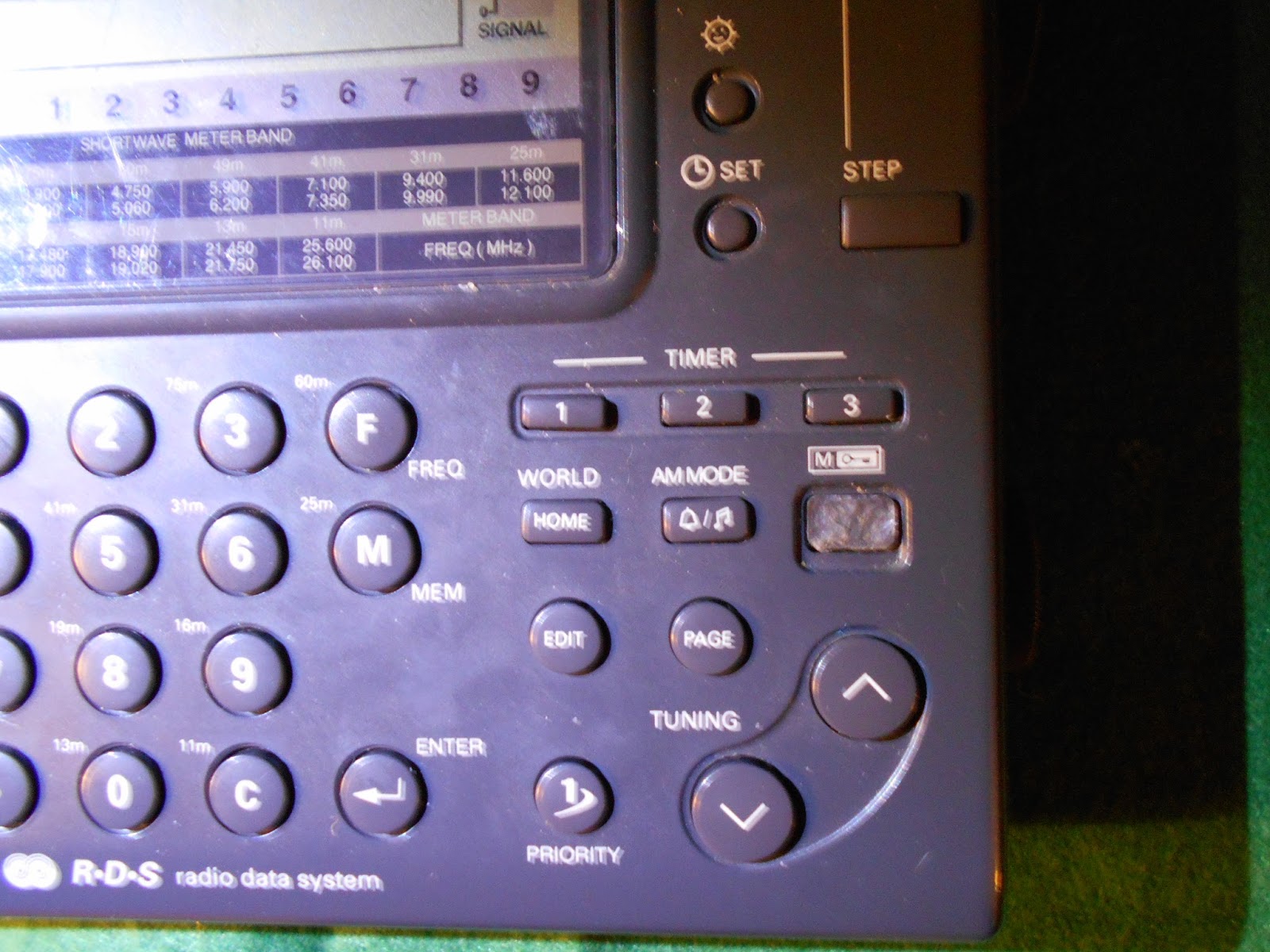
The DX-398 / Sangean ATS-909 was one of the first SW radios available everywhere that had FM with RDS -- a Radio Data System that uses the FM signal to carry station ID's, song titles, etc.

At first I had no use for RDS, but recently have come to appreciate it a lot more, because it's the only way you can tell what song is being played.

FM reception on the DX-398 is very good. I'm not an FM DXer, I mainly listen to the local rock and pop stations. But I've heard stations from Victoria, B.C., Canada during 'tropo' conditions, and that's pretty good for the hilly area where I live. 

FM sound in stereo is very good through headphones -- although my DX-398 is stuck in mono because of the switch I broke last year.
The memory "pages" can be labelled on the DX-398 rather easily, by using the "edit" button (just visible in the lower right of the picture) and using the tuner knob to scroll through letters and numbers. The newer Sangean ATS-909X has similar functions. Here you can see where in 2002-2003 I labelled this bank of frequencies as "India", as all of the frequencies were of All India Radio SW stations I'd heard, or other SW stations aimed at the subcontinent. The 10330 kHz station here was an AIR SW station from Madras (Chennai) beamed at overseas Indian listeners in East and Southern Africa. Sadly, that station isn't heard here anymore. 

***THE SANGEAN ATS-909X***
The DX-398 was discontinued some time in the mid to late 2000's, and it was replaced by the Sangean 909X, an updated version with some extra memories, a few cosmetic differences, and a different case. For the most part, the AM-SW-LW circuitry is exactly the same in both radios -- They're the same design.

Although there is some speculation that the 909X uses a modern 'DSP' chip (the SiLabs 4735) for all receiver RF & IF functions (a burgeoning trend in modern radio design), a look at the 909X's schematic diagram shows differently. The 909X is a DX-398 / ATS909 with some different parts, a different IF chip, and a SiLabs 4735 DSP chip replacing its predessor's FM RF-IF chip (the chip that amplifies and filters FM coming off the whip antenna) -- otherwise, the basic design seems to be the same.

The Sangean 909X's FET's are different part numbers, and the IF chip is different (instead of a TA7758, the 909X uses Unisonic's version of the TA7640). The IF chip is also only partly used, apparently as an extra IF amp for the AM-SW-LW section. The way the chip seems to be configured, there may be one extra stage of amplification, which may explain the apparent improvement in reception some 909X users report.

There is an added standard transistor right in front of the switchable filters in the AM-SW-LW circuits on the 909X. Whether it adds to the gain of the 909X or not, I really don't know.

In the FM circuits there is no 'front end' RF-IF chip -- a SiLabs chip is used instead, which does the same thing and may provide some extra filtering. From what I've read, the 909X is a slightly better performer on SW than the DX-398 / ATS-909, and presumably it's the same with the MW performance as well, possibly because of the newer model transistors or IF chip used -- or maybe that extra bipolar transistor in front of the switchable filters.

Either way, if the ATS909X is as good as the DX-398 is for Medium Wave, it would be an excellent DX machine. Reports I've read on the internet of the Sangean ATS-909X's Medium Wave performance is that it is an excellent MW DX radio.
Here you can see the DX-398's little brother, the Sangean ATS-505 (also known as the Radio Shack "PLL Synthesised World Receiver"), with its back off. The MW/AM antenna is the long grey bar at the very top of the radio. It's 120mm long, just like the one on the DX-398. However, the 505 isn't as sensitive on MW as the 398, because it doesn't have the 4-5 extra stages of amplification and filtering that the 398 does on MW. The ATS-505 is still a good MW radio -- it's just that in low signal areas it's best to use an external loop. The radio sounds very good through headphones and the selectivity is amazingly good for DXing.

IN CLOSING
Although the DX-398 and its Sangean equivalent, the ATS-909, have been long discontinued, they are still available online, mostly used -- some I've seen for sale around $100 US. It's been my experience that there is very little that can go wrong with these radios, provided they haven't been misused, or provided that somebody didn't try to do an electronic modification and mess it up. The only defect mine had was a negative battery solder joint that took 10 years to go intermittent and it was a 15 minute fix (including removing the back of the radio).
The "tailgate" to my DX-398 (a plastic piece intended to prop the radio up at an angle), which broke once, and I tried reinforcing the corners with Delrin guitar pick material -- but to no avail. The tailgate ended up in the drawer, along with the flimsy handle that came off of my DX-390. Most DX-398 owners probably have the tailgates of their radios stashed in a drawer somewhere.

And, of course, if one wanted a new radio, the Sangean ATS-909X probably is just as good, if not a little bit better in performance.

The only problem I've read online that has happened with a DX-398 is the tuner button skips. I've seen this mentioned at least once online, so I'm certain some others have experienced this. This can be remedied by shooting tuner cleaner down the side of the tuner button shaft (a trick I learned when my DX-394 decided to only tune in one direction!).

As I discovered too late -- you don't have to take the back off the radio do do this -- you just pull the tuner button off the shaft, and aim a few good shots of tuner cleaner alongside the shaft (I used a paper towel to keep the overspray from hitting my eyes, or getting all over the side of the case). The tuner shaft has just enough play to allow tuner cleaner to get inside the mechanism and clear off any oxidation on the contacts.

You may have to do this several times for the cleaner to work its way past the shaft to the parts inside the tuner mechanism.

Above you can see a pic of my Cat Pumpkin, which I carved for Halloween 2014. It's probably my favorite pumpkin stencil that I've used for carving pumpkins -- I also used it this year in 2016. Although it's no longer Halloween, I decided to put the pic on this blog post, anyway. :-)

Here's hoping all of you who are into radio and DXing have a safe and productive DX season. And may the rest of you have had a good November & December, wherever you are.

C.C. 11-11-2016 and 1-21-2017.


ADDENDUM, December 3rd, 2022.:
My DX-398 has decided recently to act up on me. On battery, it turns itself off about 30 seconds or so after powerup, saying the battery is dead, even though I have fresh batteries in it. This has happened with more than one set of fresh batteries. So I know it's not the batteries.

The last time this happened, some time around 2011 or so, the negative battery spring had somehow weakened the negative battery solder pad on the radio's main PCB. Now it's acting up the same way again, and resoldering the negative battery connector isn't helping. So it's a repair that will have to wait until I have more time and patience. I'm guessing it's the positive side of the battery somewhere that is acting up this time. 

Radio works fine off the AC adaptor, so it's not the actual circuits. It's a physical connection somewhere.
Live and learn. -- C.C.

ADDENDUM, March 21st, 2023:
I found out what the problem was (the problem I had with my radio turning itself off on battery power). There was some corrosion on part of the positive terminal -- that little metal plate inside the battery compartment that delivers the positive side of the battery to the radio. The corrosion looked like white powder, with a tiny bit of green thrown in (probably because of the copper metal in the positive terminal plate).

I scraped the corrosion clean with a small screwdriver blade and then further cleaned it with a Q-tip cotton swab soaked in tuner cleaner. It took a bit of work to clean it up.

Now my DX-398 works like normal! I DXed with it both on MW and SW earlier this evening for nearly 45 minutes with no cutting off of the radio. I'm a happy camper. :-)

Lesson learned: check the condition of your batteries, and the condition of the terminals and hardware in your radio's battery compartment!
-- C.C.